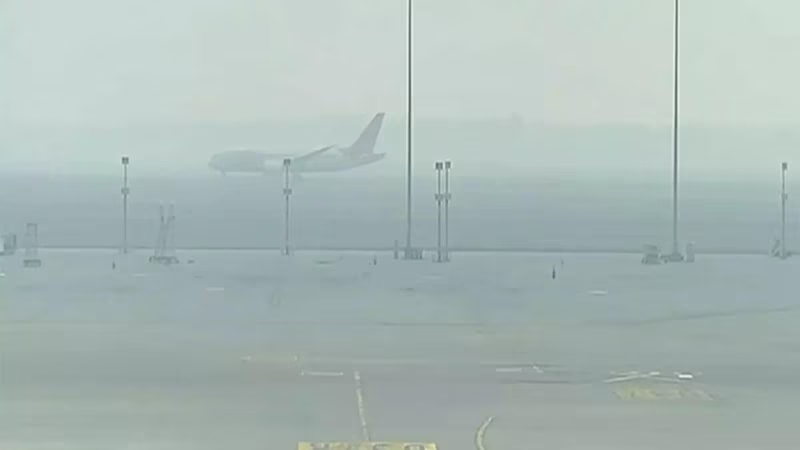
Winter has officially grounded more than just spirits—dense fog is bringing Indian aviation to a standstill. On Sunday, December 29, 2025, travelers across northern India woke up to a flurry of alerts as IndiGo announced the cancellation of 13 domestic flights due to forecasted fog chaos and operational constraints. Not to be outdone, Air India swiftly issued a travel advisory warning passengers of potential disruptions across its northern routes.
This isn’t just a minor inconvenience. With visibility dropping below 500 meters at key hubs like Delhi’s Indira Gandhi International Airport (IGI), the ripple effects are being felt from Srinagar to Kolkata. For thousands of holiday travelers, business commuters, and families reuniting for year-end celebrations, the dream of a seamless flight has turned into a game of wait-and-see.
And experts warn: this is only the beginning of the fog season.
Table of Contents
- What Happened: IndiGo and Air India Announcements
- Why Fog Chaos Is Worse This Winter
- Airports Most Affected by Fog Disruptions
- How Fog Operating Rules Impact Flights
- What Passengers Should Do Right Now
- Historical Context: Winter Disruptions in India
- Conclusion: Prepare, Don’t Panic
- Sources
What Happened: IndiGo and Air India Announcements
Early Sunday morning, IndiGo notified passengers of 13 flight cancellations spanning major city pairs, including Delhi-Lucknow, Delhi-Patna, and Mumbai-Varanasi. The airline cited “adverse weather conditions and operational requirements” as the primary reasons .
Crucially, these cancellations follow a pattern. Just days earlier, IndiGo had grounded several flights due to pilot duty time limitations—a knock-on effect of previous fog-related delays that left crews stranded past their legal flying hours.
Meanwhile, Air India took a proactive stance, issuing a formal travel advisory urging passengers flying to or from northern India to “expect delays, diversions, or cancellations” due to “very dense fog expected until early afternoon.” The airline advised travelers to monitor flight status closely and consider rebooking options without penalty where possible.
Why Fog Chaos Is Worse This Winter
The Indo-Gangetic Plain—which includes Delhi, Lucknow, Patna, and Amritsar—is notorious for winter fog. But this season is particularly intense due to a combination of factors:
- Unusually high moisture levels following late-season rainfall.
- Stagnant air masses with minimal wind to disperse fog.
- Colder-than-average temperatures creating ideal conditions for radiation fog.
- Agricultural stubble burning residue acting as condensation nuclei, thickening the fog .
According to the India Meteorological Department (IMD), visibility in parts of Delhi dropped to a mere 200 meters on Sunday morning—the lowest so far this season.
Airports Most Affected by Fog Disruptions
While fog can impact any northern airport, some are far more vulnerable due to infrastructure limitations:
- Delhi (IGI Airport) – Despite Cat III-B ILS, low visibility still causes ground delays and crew rest issues.
- Lucknow (Amausi) – Limited instrument landing capability makes it highly fog-sensitive.
- Patna – Frequent cancellations due to visibility often below operational thresholds.
- Varanasi – Heavy spiritual tourism amplifies passenger distress during disruptions.
- Amritsar – International connections suffer when fog grounds incoming flights.
[INTERNAL_LINK:best-winter-travel-tips-for-northern-india] offers a detailed guide on navigating this seasonal challenge.
How Fog Operating Rules Impact Flights
It’s not just about “can the pilot see?” Modern aviation relies on Instrument Landing Systems (ILS). Airports are classified by ILS categories:
- Cat I: Requires 550m visibility – many regional airports fall here.
- Cat II: Requires 300m visibility.
- Cat III-B: Allows landings with as little as 50m visibility – Delhi and Mumbai have this.
However, even Cat III-B has limits. If visibility drops below 50m—or if crosswinds exceed thresholds—landings are still prohibited. Moreover, pilots must be specially certified for low-visibility operations, and not all airlines maintain such crews on every route.
Compounding the issue: once a plane diverts or delays, crew duty time regulations (mandated by DGCA) prevent them from flying beyond a certain window, triggering cascading cancellations—exactly what IndiGo experienced.
What Passengers Should Do Right Now
If you’re traveling through northern India this week, take these steps:
- Check your flight status via airline apps (IndiGo, Air India, Vistara) every 2–3 hours.
- Don’t go to the airport unless your flight is confirmed active.
- Rebook early—most airlines offer free date changes during weather advisories.
- Carry essential meds and documents in your cabin bag in case of overnight delays.
- Follow airports on social media—Delhi Airport (@DelhiAirport) posts real-time updates.
Historical Context: Winter Disruptions in India
Fog-related chaos isn’t new. In January 2023, over 300 flights were cancelled in a single week at Delhi airport. The DGCA responded by mandating stricter adherence to crew rest rules and accelerating ILS upgrades at regional airports.
Yet, despite improvements, the aviation system remains fragile during peak fog months (December–February). As one DGCA official noted, “Technology helps, but nature sets the final limit.”
Conclusion: Prepare, Don’t Panic
The current fog chaos is a stark reminder that even in our age of AI and automation, weather remains the great equalizer in air travel. While IndiGo’s cancellations and Air India’s advisory are frustrating, they’re also necessary safety measures. The best response isn’t anger—it’s preparation. By staying informed, staying flexible, and understanding the “why” behind the delays, travelers can navigate this seasonal storm with far less stress. After all, a delayed flight beats a rushed risk any day.