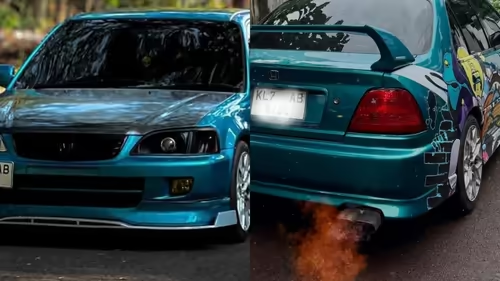
He wanted views. He got a violation notice—and a bill that dwarfed his car’s price tag. In a cautionary tale for every Instagram-speed-hungry car enthusiast, a 22-year-old student from Kerala recently found himself at the center of a high-profile traffic enforcement case in Bengaluru after his modified Honda City was caught spewing flames from its exhaust and roaring like a dragster through residential streets .
The result? A jaw-dropping fine of **₹1.1 lakh**—imposed not just for noise pollution or minor tampering, but for a suite of illegal, dangerous, and environmentally hazardous modifications that violated multiple sections of the Motor Vehicles Act. For context, the base model of his used Honda City likely cost less than ₹6–7 lakh. Now, one reckless stunt has cost him nearly 15–20% of that in penalties alone.
Table of Contents
- The Viral Stunt That Went Wrong
- What Is a Flame-Spitting Car—and Why Is It Illegal?
- The Flame-Spitting Car Fine: Full Breakdown
- Bengaluru Traffic Police Crackdown on Illegal Mods
- Legal Consequences of Illegal Vehicle Modification in India
- Social Media Influence and the Rise of Dangerous Car Trends
- Conclusion: Don’t Let Your Ride Become a Liability
- Sources
The Viral Stunt That Went Wrong
The student, reportedly studying engineering in Bengaluru, had purchased a second-hand Honda City and spent months modifying it to stand out. His goal? To film dramatic “launch control” videos with flames shooting from the tailpipe—a trend popularized by global YouTubers and car influencers.
But what looks cool online is a public hazard in real life. Residents in the Indiranagar area filed multiple noise complaints after the car’s deafening exhaust and fiery bursts disrupted nighttime peace. One video even showed the vehicle performing a burnout near a school zone. The footage went viral—not for clout, but for outrage.
Bengaluru Traffic Police acted swiftly. Using CCTV and tip-offs, they tracked down the car and impounded it during a routine check. What they found inside shocked even seasoned officers: a gutted exhaust system, removed catalytic converter, aftermarket ECU tuning, and a fuel-rich setup designed solely to ignite unburnt fuel in the exhaust—creating those dramatic (and illegal) flames .
What Is a Flame-Spitting Car—and Why Is It Illegal?
Flame-spitting isn’t magic—it’s mechanics gone rogue. Normally, a car’s engine burns fuel efficiently, and leftover gases are cleaned by the catalytic converter before exiting the tailpipe. In a “flame kit” setup, the engine is tuned to run extremely rich (excess fuel), and the catalytic converter is often removed. When this unburnt fuel hits the hot exhaust, it ignites—producing fire.
Why is this banned?
- Fire Hazard: Flames can ignite dry grass, roadside debris, or even other vehicles.
- Air Pollution: Removing the catalytic converter releases toxic gases like carbon monoxide and NOx directly into the air.
- Noise Pollution: These setups often involve straight-pipe exhausts, violating noise limits (max 75–80 dB for passenger cars).
- Safety Risk: Tampering with engine management can cause overheating, stalling, or even engine fires.
The Flame-Spitting Car Fine: Full Breakdown
The ₹1.1 lakh penalty wasn’t arbitrary. It was a cumulative charge under multiple provisions of the Motor Vehicles Act, 1988, and the Central Motor Vehicles Rules:
- Section 190(2): Driving a vehicle not conforming to original specifications – ₹5,000
- Rule 100: Use of non-approved silencer/exhaust – ₹2,000
- Section 190(3): Unauthorized structural alteration – ₹10,000
- Environmental Violation (Karnataka Pollution Control Board): Removal of catalytic converter – ₹50,000
- Repeat Offense Surcharge + Administrative Fees: ₹44,000
Additionally, the car will only be released once all modifications are reversed to factory condition and certified by an authorized RTO inspector—a process that could cost another ₹50,000–₹1 lakh .
Bengaluru Traffic Police Crackdown on Illegal Mods
This case is part of a broader city-wide initiative. In 2025, Bengaluru launched “Operation Silent Streets” to target noise pollution and illegal vehicle modifications. Over 1,200 vehicles have been penalized since January, with fines ranging from ₹5,000 to over ₹1 lakh for extreme cases .
“We’re not against car culture,” said Deputy Commissioner of Police (Traffic) Sandeep Reddy. “But when ‘enthusiasm’ turns into public nuisance or danger, we must act. Social media fame is not a license to break the law.”
Legal Consequences of Illegal Vehicle Modification in India
Under the amended Motor Vehicles Act (2019), any alteration that changes a vehicle’s original specifications—without prior approval from the registering authority—is illegal. This includes:
- Exhaust system changes
- Engine swaps or turbocharging
- Body kits that alter dimensions
- Tinted windows beyond permissible limits
- Light modifications (e.g., blue HID headlights)
First-time offenders may get a warning, but repeat violations can lead to vehicle seizure, license suspension, and even criminal charges under environmental laws. For authoritative guidance, the Ministry of Road Transport and Highways provides clear guidelines on permissible modifications .
For more on urban vehicle regulations, see our guide on [INTERNAL_LINK:safe-and-legal-car-modifications-india].
Social Media Influence and the Rise of Dangerous Car Trends
Platforms like Instagram Reels and YouTube Shorts have fueled a global “car flex” culture. But unlike countries with strict dyno-testing and emissions checks, India’s enforcement has been patchy—until now. Young enthusiasts, often unaware of legal boundaries, mimic overseas trends without understanding local laws.
Experts warn this gap between online fantasy and on-ground reality is creating a generation of “accidental offenders.” As auto journalist Priya Menon notes, “You can’t import a trend without importing the responsibility that comes with it.”
Conclusion: Don’t Let Your Ride Become a Liability
The flame-spitting car fine saga is more than just a story about one student’s mistake—it’s a wake-up call for every car lover in India. Passion for automobiles is valid, but it must coexist with public safety, environmental responsibility, and legal compliance. Before you weld that exhaust or flash that ECU, ask yourself: is a few seconds of viral fame worth ₹1.1 lakh—and your peace of mind?
Sources
- Times of India: Modified trouble: Kerala student’s flame-spitting car draws Rs 1.1L fine in Bengaluru
- Bengaluru Traffic Police: Official Website – Notices & Guidelines
- Karnataka Pollution Control Board: Vehicle Emission Norms & Penalties
- Ministry of Road Transport and Highways: Motor Vehicles Act, 1988 (Amended 2019)
- AutoCar India: Legal Modifications Guide for Indian Enthusiasts