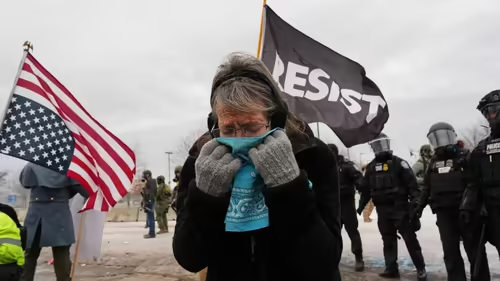
Federal Court Draws a Line: Protecting Peaceful Protesters in Minnesota
In a decisive move to safeguard civil liberties, a US federal judge has stepped in to protect peaceful protesters in Minnesota from aggressive tactics by federal immigration authorities. The ruling, which grants a temporary injunction, is a direct response to escalating tensions and a disturbing pattern of alleged misconduct during recent protests .
This legal intervention is more than just a local story; it’s a national flashpoint in the ongoing debate over the balance between law enforcement powers and the fundamental right to free speech and assembly. For many Americans watching from afar, the question is no longer just “What happened in Minnesota?” but “Could this happen in my city?”
Table of Contents
- The Landmark Injunction: What It Actually Says
- Why the Court Intervened: A History of Tensions
- What Are Peaceful Protesters’ Rights?
- The Broader National Implications
- What Happens Next?
- Conclusion: A Crucial Check on Power
- Sources
The Landmark Injunction: What It Actually Says
The court order is remarkably clear and direct. A US federal judge on Friday explicitly barred immigration officers in Minnesota from detaining or using force against individuals who are engaging in lawful and peaceful protest activities .
The injunction places several critical restrictions on federal agents:
- No Retaliation: Agents are prohibited from taking any retaliatory action against someone solely because they are participating in a peaceful protest.
- Probable Cause Required: Any arrest must be based on legitimate probable cause for a crime unrelated to the act of protesting itself.
- Ban on Crowd-Control Weapons: The use of so-called “less-lethal” munitions like tear gas, rubber bullets, or flash-bang grenades against peaceful assemblies is forbidden.
In essence, the ruling reinforces a simple but powerful principle: the First Amendment is not suspended in the presence of a federal badge.
Why the Court Intervened: A History of Tensions
This injunction didn’t materialize in a vacuum. It is the legal system’s response to a documented series of troubling incidents. Reports have surfaced of federal immigration agents, often in unmarked vehicles, detaining individuals near protest sites under questionable circumstances .
The judge’s decision was likely influenced by evidence suggesting a pattern where the line between legitimate law enforcement and intimidation of citizens exercising their constitutional rights had been dangerously blurred. The court recognized that without a strong judicial check, the very act of peaceful dissent could be chilled, undermining the core of American democracy.
Defining “Peaceful Protest”
It’s crucial to understand the scope of the court’s protection. The term “peaceful protesters” refers to individuals who are assembled to express their views without engaging in violence, property destruction, or inciting imminent lawless action. The moment a protest turns violent, the legal landscape changes dramatically, and law enforcement’s authority to intervene expands.
What Are Peaceful Protesters’ Rights?
The Minnesota ruling is a stark reminder of the robust legal protections afforded to citizens. Your rights at a peaceful protest include:
- The Right to Assemble: You can gather in public spaces like parks, sidewalks, and streets.
- The Right to Free Speech: You can chant, hold signs, and speak your mind, even if your message is unpopular.
- The Right to Record: You generally have the right to record police and other government officials performing their duties in public.
For a comprehensive guide on your rights, the American Civil Liberties Union (ACLU) offers an excellent, state-specific resource that every protester should review before heading out [[https://www.aclu.org/know-your-rights/protesters-rights/]].
The Broader National Implications
While this injunction is specific to Minnesota, its ripple effects could be felt nationwide. It sets a powerful legal precedent that other federal courts may look to when faced with similar cases. The ruling sends a clear message to all federal agencies: tactics that appear to target or intimidate citizens for their political speech will be met with swift judicial pushback.
This case also highlights the growing role of the judiciary as a critical check on executive power, especially in politically charged environments. It underscores the importance of an independent court system in defending civil liberties during times of social unrest.
What Happens Next?
The current order is a temporary injunction, meaning it’s a preliminary measure while the full case proceeds through the legal system. The federal government has the right to appeal this decision to a higher court. However, the strength of the judge’s reasoning and the clear evidence of potential constitutional violations make an immediate reversal unlikely.
For now, the people of Minnesota—and indeed, all Americans—can take some comfort in knowing that the courts are standing guard over their most fundamental rights. This development is a key chapter in the ongoing story of [INTERNAL_LINK:civil-rights-in-america].
Conclusion: A Crucial Check on Power
The federal judge’s decision to protect peaceful protesters in Minnesota is far more than a local legal victory. It is a vital affirmation of the principles upon which the United States was founded. In a time of deep division and heightened tensions, this ruling serves as a necessary and powerful reminder that the right to dissent peacefully is not just a privilege, but a cornerstone of a healthy democracy. The eyes of the nation will be watching to see how this case unfolds and what it means for the future of protest in America.
Sources
- Times of India. (2026). US judge bars actions against protesters as tensions soar.
- Associated Press. (2026). Judge restricts ICE tactics against protesters in Minnesota.
- American Civil Liberties Union (ACLU). (n.d.). Know Your Rights: Protesters’ Rights. [[https://www.aclu.org/know-your-rights/protesters-rights/]]