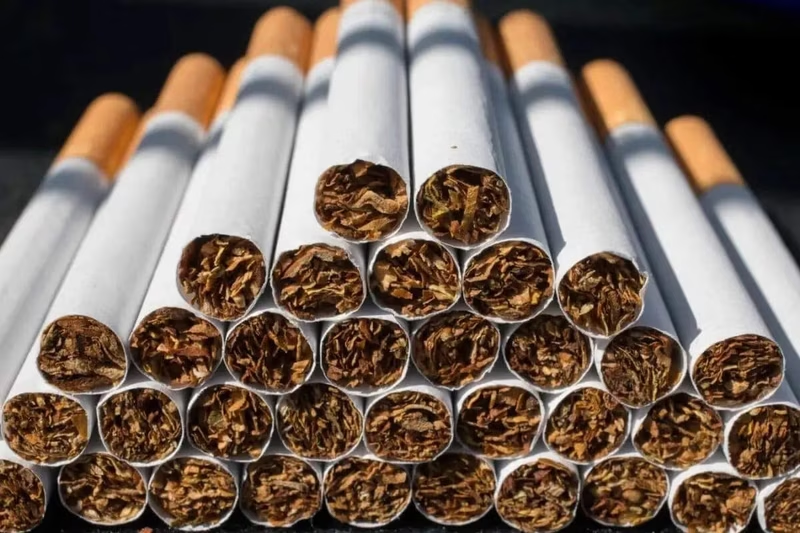
Mark your calendars: **February 1** isn’t just the start of a new month—it’s D-Day for India’s tobacco and pan masala industry. In a sweeping fiscal move aimed at curbing consumption and boosting public health, the central government has announced a dramatic overhaul of the indirect tax structure on so-called “sin goods.”
Under the new rules, effective from **Feb 1 GST** implementation, products like cigarettes, pan masala, and gutka will be slapped with a combined effective tax rate of up to **40%**, plus a new **health cess**—replacing the older GST compensation cess. Even bidis, long taxed at lower rates due to their association with rural livelihoods, will see changes. For consumers, this means significantly higher prices at the counter. For small vendors and manufacturers, it could mean shrinking margins or even business closures.
Table of Contents
- Feb 1 GST: Key Tax Changes at a Glance
- Why the Government Is Raising ‘Sin Taxes’
- Impact on Consumers: Prices Set to Spike
- Small Businesses and Pan Masala Makers at Risk
- How This Fits Into India’s Public Health Strategy
- Industry Reaction and Potential Legal Challenges
- What Comes Next for GST Policy?
- Conclusion: A Bold But Controversial Move
- Sources
Feb 1 GST: Key Tax Changes at a Glance
The Ministry of Finance has finalized the new tax architecture for tobacco and related products. Here’s a breakdown of what changes from February 1, 2026:
- Pan Masala & Gutka: Will now attract **28% GST + 12% Health Cess = 40% total tax** (up from previous combined rates of ~36–38%).
- Cigarettes: Subject to **28% GST + additional Health Cess** (varies by length and filter type), pushing effective rates to **36–40%**.
- Bidis (Biries): Will remain under **18% GST**, but a new **health cess of 2–5%** may apply based on production volume, moving closer to 20–23% total.
- Replacement: The old **GST Compensation Cess** on these items is being fully replaced by the new **Health Cess**, which will be directly credited to the National Health Mission.
Importantly, this isn’t just a revenue measure—it’s a public health intervention disguised as fiscal policy.
Why the Government Is Raising ‘Sin Taxes’
India has long used taxation as a tool to discourage harmful consumption. According to the World Health Organization’s 2025 Global Tobacco Report, a 10% price increase on tobacco can reduce consumption by 4–8% in low- and middle-income countries .
With over **267 million tobacco users** in India—nearly 30% of the adult population—the government sees high taxation as a cost-effective way to reduce disease burden. The new health cess is explicitly earmarked for funding anti-tobacco campaigns, cancer treatment subsidies, and public health infrastructure under the Ayushman Bharat scheme.
For deeper insights into health economics, see our analysis on [INTERNAL_LINK:how-tax-policy-influences-public-health-in-india].
Impact on Consumers: Prices Set to Spike
Get ready to pay more. A pack of premium cigarettes currently priced at ₹250 could jump to **₹330–₹350** post-Feb 1. Similarly, a ₹20 packet of pan masala might cost **₹27–₹28**.
While urban, higher-income consumers may absorb the hike, low-income and rural users—who make up the bulk of bidi and smokeless tobacco consumers—could face disproportionate financial strain. Some may quit, which is the desired outcome; others may switch to unbranded, illicit products, undermining the policy’s intent.
Small Businesses and Pan Masala Makers at Risk
The pan masala industry employs over **500,000 people**, mostly in small and micro units in Gujarat, Uttar Pradesh, and Maharashtra. Many operate on razor-thin margins of 8–12%. A sudden 4–6% tax increase could push them into losses.
Industry bodies like the All India Pan Masala Manufacturers Association have warned of **mass layoffs** and factory closures. “We’re not luxury producers—we’re small traders feeding families,” said one Gujarat-based manufacturer.
Unlike big tobacco firms with deep balance sheets, these MSMEs lack the pricing power to pass on full costs to consumers—putting them in a bind.
How This Fits Into India’s Public Health Strategy
This move aligns with India’s commitment under the WHO Framework Convention on Tobacco Control (WHO FCTC), which recommends tax as a “best buy” intervention. The government also aims to reduce tobacco use prevalence to **<10% by 2030** under its National Health Policy.
Previous tax hikes—like the 2017 GST rollout—did lead to temporary dips in legal sales. However, illicit trade grew by an estimated 15%, according to a 2024 study by the **Indian Institute of Public Health** . The success of the Feb 1 GST changes will depend on **simultaneous crackdowns on black-market products**.
Industry Reaction and Potential Legal Challenges
Tobacco and pan masala lobbies are expected to challenge the new cess in court, arguing it violates GST’s “one nation, one tax” principle by creating a dual-layer levy. They may also cite employment concerns and federalism issues, as states traditionally had more control over such goods.
Meanwhile, public health advocates are applauding the move. “This is the strongest fiscal signal India has sent against tobacco in a decade,” said Dr. R. K. Sharma of the Indian Council of Medical Research.
What Comes Next for GST Policy?
This could be the start of broader “sin tax” reforms. Experts speculate that alcohol, aerated drinks, and even high-sugar snacks may face similar layered taxation in future GST Council meetings. The new health cess model—linking revenue directly to health outcomes—could become a template for other social levies.
Conclusion: A Bold But Controversial Move
The **Feb 1 GST** overhaul on tobacco and pan masala is a high-stakes gamble. It balances public health ambition against economic reality, targeting addiction while risking livelihoods. If enforced well—with strong anti-illicit trade measures and support for transitioning workers—it could save thousands of lives. But if poorly implemented, it may only drive the market underground, hurting the very people it aims to protect. One thing is certain: from February 1, every puff and chew in India just got a lot more expensive—and a lot more political.
Sources
- Times of India: Feb 1 GST hit: Cigarette, bidi, pan masala to attract 40% tax
- Press Information Bureau (PIB): Ministry of Finance Notification on Health Cess
- World Health Organization (WHO): Global Tobacco Report 2025
- Indian Journal of Public Health: Impact of GST on Tobacco Consumption in India (2024 Study)
- Ministry of Health & Family Welfare: National Tobacco Control Programme Guidelines