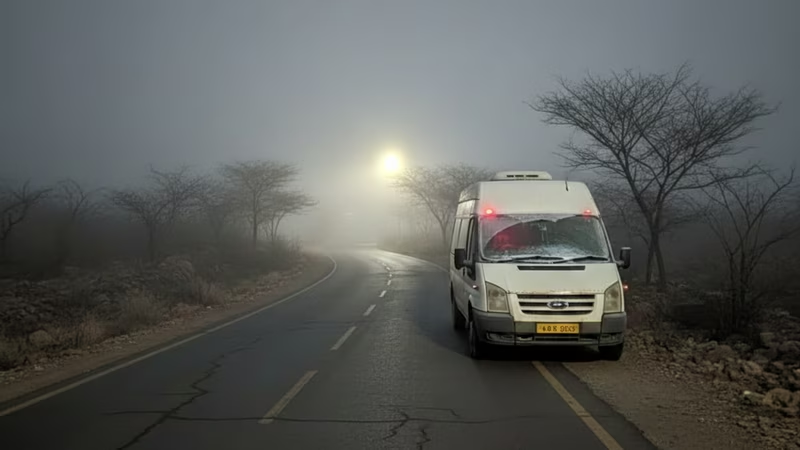
In the suffocating blanket of a winter fog, on a road that connects two of the National Capital Region’s (NCR) busiest cities, a 25-year-old woman’s world was shattered. For nearly three agonizing hours, she was held captive and allegedly gang-raped inside a moving van on the Gurgaon-Faridabad Road . Her desperate cries for help were swallowed by the dense fog and the chilling isolation of the night—a terrifying reality that has now sparked a crucial conversation about safety, infrastructure, and systemic failure in one of India’s most developed regions.
Table of Contents
- The Harrowing Night: A Timeline of Terror
- Faridabad Gang Rape: What We Know So Far
- Why Was No One Heard? The Fog Factor
- A History of Danger: The Gurgaon-Faridabad Road Safety Crisis
- Systemic Failures: Beyond the Crime Itself
- Conclusion: A Call for Urgent, Tangible Action
- Sources
The Harrowing Night: A Timeline of Terror
The incident, which occurred in the early hours, paints a picture of calculated cruelty. The victim, a married woman, was reportedly offered a lift by two men—now identified as van drivers. What began as a simple act of seeking transport ended in a nightmare. Trapped inside the moving vehicle, she was allegedly assaulted for hours before being callously thrown onto the roadside . The perpetrators, shielded by the near-zero visibility of the dense fog, were able to roam freely, their crime hidden in plain sight. CCTV footage has since emerged, showing the van cruising along the route during the time of the assault, a chilling piece of evidence that underscores the brazenness of the act .
Faridabad Gang Rape: What We Know So Far
Police have moved swiftly to arrest the two van drivers, who are now in custody. The investigation is ongoing, with authorities working to identify any other potential accomplices through further forensic analysis and identification procedures . The victim, who sustained severe physical and psychological injuries, is currently under medical care and police protection. This horrific event, coming over a decade after the Nirbhaya case, is a grim reminder that the safety of women in public and private spaces remains a critical, unresolved issue in the NCR .
Why Was No One Heard? The Fog Factor
The dense winter fog that blankets the NCR every year isn’t just a weather inconvenience; it’s a significant safety hazard. The Gurgaon-Faridabad Road, a vital artery for daily commuters, becomes a corridor of vulnerability during these conditions. Low visibility drastically increases road risks, not just for accidents but for criminal activity that can go undetected . The oppressive silence of the fog on that lonely stretch of road created the perfect environment for predators.
While authorities have implemented some measures, such as installing reflective tapes on barricades to improve nighttime and fog-weather visibility , the question remains: are these efforts enough to protect vulnerable citizens? The Faridabad Police have acknowledged the need for enhanced road safety during fog, but this tragic case exposes a massive gap between policy and on-the-ground reality .
A History of Danger: The Gurgaon-Faridabad Road Safety Crisis
This road has long been a point of concern for safety advocates. Despite being a major connector, it suffers from patchy lighting, inadequate patrolling, and poor maintenance in certain stretches. In late 2025, Gurgaon police themselves pushed for urgent infrastructure repairs to avert accidents during the foggy season, highlighting the known dangers for pedestrians and two-wheeler riders .
A research paper analyzing traffic safety on the Faridabad-Gurugram Road (MDR 137) had previously flagged serious safety concerns, calling for a comprehensive review of its design and traffic management systems . Community outreach and awareness programs have been announced , but their effectiveness in preventing violent crimes like this remains to be seen. The question is no longer about whether the road is dangerous, but why decisive action to secure it has been so slow.
Systemic Failures: Beyond the Crime Itself
While the NCR has seen fluctuations in its overall crime rate , with some reports indicating a decline in certain categories , the persistence of brutal, high-profile cases like this Faridabad gang rape reveals a deeper, more insidious problem. It points to a failure in creating a truly safe ecosystem for women. This involves not just law enforcement but also urban planning, public transport policy, and community vigilance.
The fact that a woman could be held captive in a moving vehicle for hours on a main road speaks volumes about the lack of an effective, real-time safety net. It highlights the urgent need for:
- 24/7 Active Patrolling: Increased police presence, especially on high-risk, isolated stretches during vulnerable hours.
- Robust Public Transport: Safe, reliable, and frequent public transport options to reduce dependence on unverified private vehicles.
- Smart Infrastructure: Investment in smart street lighting, high-resolution CCTV with AI-powered anomaly detection, and emergency call boxes at regular intervals.
- Community Policing: Fostering a culture where citizens feel empowered and equipped to report suspicious activity without fear.
For more on urban safety planning, see our in-depth analysis on [INTERNAL_LINK:smart-city-safety-initiatives].
Conclusion: A Call for Urgent, Tangible Action
The Faridabad gang rape is more than a news headline; it’s a national shame. It forces us to confront the uncomfortable truth that our systems are failing to protect the most vulnerable. The dense fog may have been the immediate enabler, but the root causes lie in years of neglected infrastructure, under-resourced law enforcement, and a societal apathy towards women’s safety. We must move beyond statements of condemnation and demand concrete, measurable actions from our authorities. The safety of every woman on every road must be a non-negotiable priority.
Sources
The information in this article is based on the following sources:
- Times of India: Original Article
- India Today: Faridabad gang-rape case: CCTV shows van roaming
- The Hindu: 13 years after Nirbhaya, Faridabad woman gangraped
- Hindustan Times: Reflective tapes to crash barriers: As fog blankets Gurgaon
- The Indian Express: Gurgaon cops push for infra repairs to avert accidents in winter
- National Crime Records Bureau (NCRB): Official Crime Statistics Portal