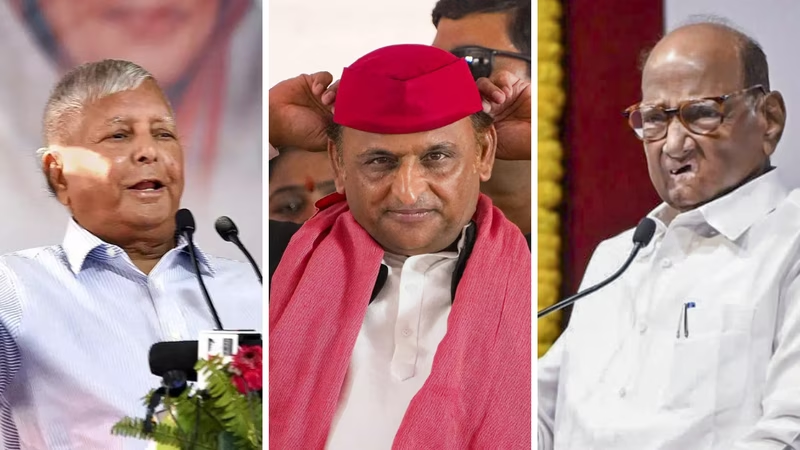
Remember when a phone call from a regional satrap could make or break a government in New Delhi? Those days feel like ancient history. Today, many of India’s once-mighty regional parties are not plotting national strategy—they’re fighting over who gets the family mansion and the party symbol. A wave of family feuds in regional parties is sweeping across the country, transforming them from kingmakers into cautionary tales of dynastic decay.
From Lalu Prasad Yadav’s fractured household in Patna to the Thackeray cousins’ cold war in Mumbai, and the Pawar clan’s public spats in Pune, internal kin wars have become the new normal. These aren’t just private dramas; they’re political earthquakes that are shaking the foundations of state politics and reshaping electoral maps .
Table of Contents
- The Kingmaker Era: When Regional Parties Ruled the Roost
- The RJD’s Fractured Dynasty: A House Divided
- Shiv Sena’s Great Schism: Uncle vs. Nephew
- NCP, BRS, and Other Dynasties in Distress
- Why the Family Business Model Is Failing in Politics
- Conclusion: Can Regional Parties Survive Without Dynasties?
- Sources
The Kingmaker Era: When Regional Parties Ruled the Roost
In the 1990s and early 2000s, regional parties were the ultimate power brokers. With no single national party able to secure a majority, leaders like N. T. Rama Rao, M. Karunanidhi, and Lalu Prasad Yadav held immense sway. Their parties were built on strong regional identities, charismatic leadership, and deep grassroots networks. Succession was often assumed to be a family affair—a smooth handover from father to son or daughter, seen as a way to preserve the party’s legacy and ideology.
The RJD’s Fractured Dynasty: A House Divided
The Rashtriya Janata Dal (RJD) in Bihar offers a textbook case of how family feuds in regional parties can spiral out of control. Once a formidable force under Lalu Prasad Yadav, the party is now a shadow of its former self, largely due to infighting among his children. The feud intensified in late 2025 when Rohini Acharya, one of Lalu’s daughters, made explosive allegations, prompting three of her sisters to leave the family residence in Patna . This public airing of dirty laundry has not only damaged the family’s image but has also created confusion among loyal voters about who truly speaks for the RJD’s legacy.
Shiv Sena’s Great Schism: Uncle vs. Nephew
Perhaps the most dramatic split occurred in Maharashtra’s Shiv Sena. The party, founded on Marathi pride and a distinct ideology, was long led by Bal Thackeray and then his son Uddhav. However, in 2022, a rebellion led by Eknath Shinde, backed by the BJP, resulted in a formal split. While not a direct father-son conflict, the rift between Uddhav Thackeray and his cousin Raj Thackeray’s Maharashtra Navnirman Sena (MNS) had already weakened the family’s unified front. As of January 2026, Uddhav Thackeray, leading the Shiv Sena (UBT), is navigating a complex alliance landscape, his authority permanently diminished by the schism [[4], [6]].
NCP, BRS, and Other Dynasties in Distress
The crisis isn’t limited to the Hindi heartland or the west. In the south, the Bharat Rashtra Samithi (BRS), formerly TRS, faces its own succession struggle. K. Chandrashekar Rao (KCR), the party’s founder, is grappling with questions about his daughter Kavitha’s role and future leadership, creating an atmosphere of uncertainty .
Similarly, Sharad Pawar’s Nationalist Congress Party (NCP) suffered a major blow when his nephew, Ajit Pawar, staged a surprise coup in 2023, aligning with the BJP and splitting the party. This move left Sharad Pawar leading a rump faction, demonstrating how quickly loyalty can evaporate in a dynastic setup .
Why the Family Business Model Is Failing in Politics
Several factors explain why this model is crumbling:
- Lack of Internal Democracy: When leadership is inherited, not earned, it breeds resentment among non-family members who have dedicated their careers to the party.
- Changing Voter Sentiment: A new generation of voters is increasingly skeptical of dynastic entitlement and demands performance over pedigree.
- National Party Pressure: The BJP and Congress, with their vast resources, are adept at exploiting these internal fissures to poach key leaders and weaken their regional rivals.
- Ambition vs. Legacy: Younger family members often have different visions for the party, clashing with the established guard and leading to irreconcilable differences.
Conclusion: Can Regional Parties Survive Without Dynasties?
The current turmoil suggests that the era of unquestioned dynastic rule in regional politics is coming to an end. To survive and thrive, these parties must evolve. They need to build institutional structures, foster a second rung of non-family leadership, and reconnect with their core voter base on issues, not just family names. The alternative is a slow, painful decline into irrelevance. The story of India’s regional parties is at a crossroads: will they reform and renew, or will they become mere footnotes in the history of a nation moving beyond its dynastic past? For more on the changing face of Indian politics, see our analysis on [INTERNAL_LINK:future-of-coalition-politics-in-india].
Sources
- Times of India: From kingmakers to kin wars: How family feuds are crippling regional parties across states
- The Hindu: After Rohini Acharya, Lalu Yadav’s 3 more daughters move out of Patna residence
- Indian Express: BMC Election 2026: ‘Will never part ways with Raj Thackeray,’ says Uddhav
- Mint: Power & patriarchy: Succession struggles plague Indian regional parties
- Scroll.in: Kin vs kin: The family feuds shaking south India’s political landscape