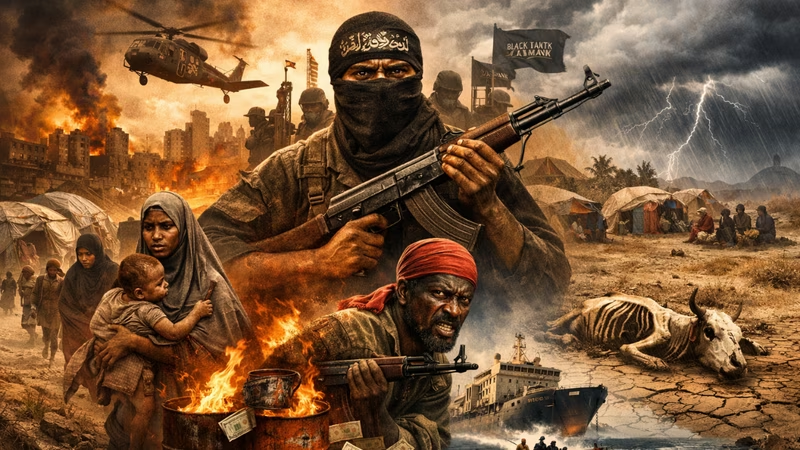
In 1960, the world watched with optimism as Somalia emerged from colonial rule—a unified nation forged from British Somaliland and Italian Somaliland, brimming with potential. Fast forward to today, and Somalia is frequently labeled the definitive **failed state**: a country where the government struggles to control its territory, armed groups rule vast regions, and millions live in fear, hunger, or exile.
But how did a nation that once symbolized African unity and self-determination descend into decades of anarchy, warlordism, and terror? The story of Somalia isn’t just about war—it’s about the collapse of institutions, the weaponization of clan identity, foreign interference, and the tragic cost of political ambition over national unity.
Table of Contents
- Independence and Early Hope (1960–1969)
- The Siad Barre Dictatorship: Seeds of Collapse
- The 1991 Civil War: When the State Vanished
- Warlords, Famine, and Failed Foreign Intervention
- The Rise of al-Shabaab and Islamist Insurgency
- Why Is Somalia Still a Failed State?
- Global Implications of Somalia’s Instability
- Glimmers of Hope: Can Somalia Rebuild?
- Conclusion
- Sources
Independence and Early Hope (1960–1969)
At independence, Somalia had a functioning government, a national army, and a vision: to unite all Somali-speaking peoples across the Horn of Africa—including regions in Ethiopia, Kenya, and Djibouti. This pan-Somali dream, known as “Greater Somalia,” quickly became a source of regional tension.
Despite democratic elections in 1964, the young republic suffered from weak institutions, corruption, and deep clan divisions. Political parties were often clan-based, not ideology-driven. By 1967, President Abdirashid Ali Shermarke was struggling to maintain cohesion. Then, in 1969, he was assassinated—and the military, led by General **Mohamed Siad Barre**, seized power in a bloodless coup.
The Siad Barre Dictatorship: Seeds of Collapse
Barre promised socialism, modernization, and national unity. He banned political parties, outlawed clan references, and aligned with the Soviet Union. For a time, literacy improved and infrastructure expanded.
But Barre’s regime grew increasingly brutal. After Somalia’s disastrous 1977 war with Ethiopia over the Ogaden region—and the USSR’s switch of allegiance to Ethiopia—Barre turned to the West, abandoned socialism, and intensified repression.
He began favoring his own Marehan clan, marginalizing others like the Isaaq (in the north) and Hawiye (in Mogadishu). This fueled resentment. By the 1980s, armed opposition groups—such as the Somali National Movement (SNM) and United Somali Congress (USC)—were forming, often backed by Ethiopia or other regional rivals.
The 1991 Civil War: When the State Vanished
In January 1991, Barre was overthrown. But instead of democracy, Somalia plunged into full-scale civil war. Clan-based militias turned on each other. Mogadishu became a battleground. The central government ceased to exist—literally. For over two decades, **Somalia had no functional state**.
The north declared independence as **Somaliland**—a self-governing region that remains unrecognized but remarkably stable. The south descended into chaos, ruled by warlords like Mohamed Farah Aidid, whose forces famously downed two U.S. Black Hawk helicopters in 1993, leading to the withdrawal of American troops.
Warlords, Famine, and Failed Foreign Intervention
The 1990s saw repeated international attempts to stabilize Somalia:
- UNOSOM I & II (1992–1995): Humanitarian missions that devolved into combat operations.
- U.S. Operation Restore Hope: Initially welcomed, but ended in tragedy after the Battle of Mogadishu.
- Ethiopian interventions: Often worsened clan tensions by backing rival factions.
Meanwhile, famine killed hundreds of thousands. Displacement became the norm. And the idea of a united Somali state seemed like a relic of the past.
The Rise of al-Shabaab and Islamist Insurgency
In the power vacuum, Islamist groups gained traction. The Islamic Courts Union (ICU) briefly brought order to Mogadishu in 2006—until Ethiopia, with U.S. backing, invaded to oust them. The ICU splintered, and its militant wing evolved into **al-Shabaab**—an al-Qaeda-affiliated terrorist group that now controls large rural areas and regularly attacks government and African Union forces.
Al-Shabaab exploits governance gaps, offering Sharia courts and basic services where the state cannot. It funds itself through extortion, charcoal smuggling, and sugar trafficking—making it resilient despite military pressure.
Why Is Somalia Still a Failed State?
Even after the formation of the Federal Government of Somalia in 2012, the country remains fragile. Key reasons include:
- Clan politics: Power-sharing is based on clan quotas, not merit or policy.
- Weak institutions: Police, courts, and civil services lack capacity and reach.
- Corruption: Billions in foreign aid vanish due to graft.
- Security dependence: Reliance on African Union troops (ATMIS) delays true sovereignty.
- Climate shocks: Recurrent droughts displace millions and fuel conflict over resources.
According to the Fund for Peace’s Fragile States Index, Somalia has ranked among the world’s most fragile nations for over 15 years .
Global Implications of Somalia’s Instability
Somalia’s crisis isn’t contained within its borders:
- Piracy: Though reduced, the threat lingers off the Horn of Africa.
- Terrorism: Al-Shabaab has attacked Kenya, Uganda, and Ethiopia.
- Refugees: Over 3 million Somalis are displaced—internally or in neighboring countries.
- Geopolitical rivalry: Turkey, UAE, Qatar, and China compete for influence in Somali ports and infrastructure.
Glimmers of Hope: Can Somalia Rebuild?
There are signs of cautious progress:
- Recent elections (though delayed) have been more inclusive.
- Somalia is gradually taking over security from ATMIS, aiming for full control by 2026.
- Local governance in regions like Puntland shows functional decentralization.
- Diaspora investment is fueling small businesses and tech startups in Mogadishu.
Yet, without sustained peace, youth employment, and institutional reform, the **failed state Somalia** label may persist for years to come [[INTERNAL_LINK:somalia-reconstruction-efforts-2026]].
Conclusion
Somalia’s journey from hopeful independence to enduring crisis is a tragic lesson in how colonial borders, authoritarian rule, clan fragmentation, and external meddling can destroy a nation’s fabric. While the “failed state” label is often criticized for oversimplifying complex realities, it underscores a painful truth: without legitimate, inclusive governance, no amount of military force or foreign aid can bring lasting peace. For Somalia, the path forward remains long—but not impossible.
Sources
- Times of India. “’A failed state’: How Somalia slid from independence into permanent crisis.” https://timesofindia.indiatimes.com/…
- Fund for Peace. “Fragile States Index 2025.” https://fragilestatesindex.org/
- United Nations Office for the Coordination of Humanitarian Affairs (OCHA). “Somalia Humanitarian Response Plan.” https://reliefweb.int/country/som