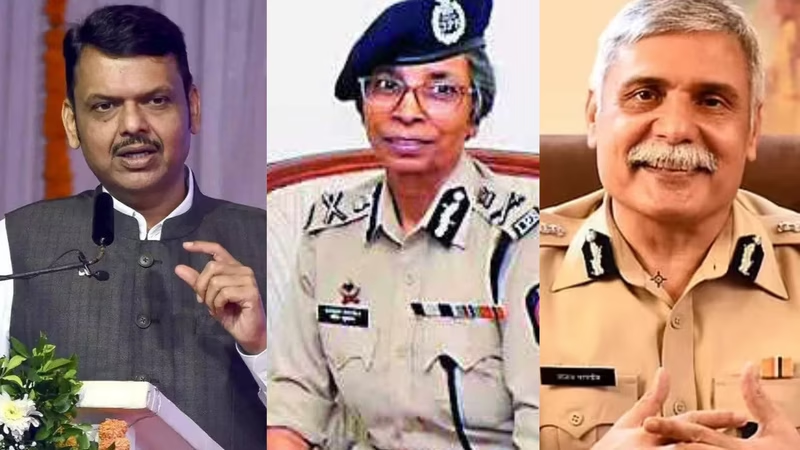
In a revelation that could send shockwaves through Maharashtra’s political and police establishment, a confidential investigative report submitted just before her retirement by former Director General of Police (DGP) Rashmi Shukla has recommended filing FIRs against ex-DGP Sanjay Pandey and two others for allegedly orchestrating a Fadnavis arrest plot back in 2016.
The explosive document, now under review by the state home department, alleges that Pandey—a senior IPS officer who later served as Mumbai Police Commissioner—pressured a Nagpur-based businessman to falsely name then-Chief Minister Devendra Fadnavis and current CM Eknath Shinde in a controversial Urban Land Ceiling (ULC) certificates scam. The goal? To tarnish their reputations and potentially trigger legal action that could have derailed their political careers .
Table of Contents
- What Is the Fadnavis Arrest Plot?
- Key Findings of Rashmi Shukla’s Report
- Who Is Sanjay Pandey—and Why Is He Named?
- The 2016 ULC Scam: Context and Controversy
- Political Fallout in Maharashtra
- Legal Process Ahead: What’s Next?
- Conclusion: A Test for Maharashtra’s Institutions
- Sources
What Is the Fadnavis Arrest Plot?
The term “Fadnavis arrest plot” refers to an alleged conspiracy in 2016 to fabricate evidence linking Devendra Fadnavis—who was then Maharashtra’s Chief Minister—and Eknath Shinde, a rising Shiv Sena leader, to illegal dealings involving Urban Land Ceiling (ULC) certificates. These certificates were used to bypass land acquisition laws, often for real estate development.
According to Shukla’s report, the plan involved coercing a Nagpur businessman into signing a statement falsely implicating both leaders. The document claims this pressure came directly from high-ranking police officials, with ex-DGP Sanjay Pandey playing a central role in directing the operation .
Key Findings of Rashmi Shukla’s Report
Submitted days before her retirement in January 2026, Shukla’s 42-page report is based on testimonies, call records, and internal police communications. Its most damning conclusions include:
- Sanjay Pandey allegedly instructed subordinates to “build a case” against Fadnavis using the ULC angle.
- A businessman was summoned multiple times and threatened with fabricated charges unless he named the CM.
- Two other officers—identified only as “senior IPS officers from Nagpur range”—were complicit in the pressure tactics.
- No credible evidence ever linked Fadnavis or Shinde to the scam; the case collapsed due to lack of proof.
- Shukla recommends immediate registration of FIRs under Sections 120B (criminal conspiracy), 166A (public servant disobeying law), and 506 (criminal intimidation) of the IPC.
Who Is Sanjay Pandey—and Why Is He Named?
Sanjay Pandey is a 1987-batch IPS officer who held several high-profile posts, including Mumbai Police Commissioner (2023–2024) and DG of the Anti-Corruption Bureau. Known for his aggressive policing style, he has also been a polarizing figure, often at odds with political leadership.
Notably, Pandey retired in November 2025—just weeks before Shukla’s report was finalized. His supporters claim the allegations are politically motivated, possibly stemming from internal rivalries within the IPS cadre. However, Shukla’s reputation for integrity—she previously led the National Investigation Agency (NIA)—lends significant weight to her findings .
The 2016 ULC Scam: Context and Controversy
The Urban Land Ceiling Act, though repealed in Maharashtra in 2007, left behind a legacy of disputed land titles and forged certificates. In 2016, a series of raids uncovered a racket where officials issued fake ULC clearance documents for prime plots in Nagpur and Mumbai—often for kickbacks.
While several mid-level bureaucrats were arrested, attempts to link top politicians failed due to lack of evidence. Now, Shukla’s report suggests those attempts weren’t just investigative overreach—they were deliberate acts of political sabotage.
Political Fallout in Maharashtra
The timing of this disclosure is explosive. With Maharashtra gearing up for crucial local body elections in 2026, the BJP and Shiv Sena (Shinde faction) are likely to use the report to attack rivals and demand accountability.
“This isn’t just about one officer—it’s about systemic misuse of state machinery to target elected leaders,” said a senior BJP spokesperson. Meanwhile, opposition parties have called for an independent probe, questioning why the report wasn’t acted upon earlier .
The controversy also raises questions about oversight within the police force. How could such an alleged conspiracy proceed without higher-level scrutiny? And why did it take nearly a decade for these claims to surface formally?
Legal Process Ahead: What’s Next?
The ball is now in the court of Maharashtra’s Home Department. Key next steps include:
- Review of Shukla’s report by the current DGP and Home Secretary.
- Decision on whether to register FIRs against Pandey and the two unnamed officers.
- Potential summons to the Nagpur businessman for formal testimony.
- If FIRs are filed, the case may be handed to the CBI or a special investigation team (SIT) to ensure impartiality.
Given Pandey’s retired status, prosecution would require special permission under Section 197 of the CrPC—but legal experts say it’s not impossible if evidence is strong .
Conclusion: A Test for Maharashtra’s Institutions
The Fadnavis arrest plot allegations represent more than a political scandal—they’re a litmus test for Maharashtra’s commitment to institutional integrity. If the state acts swiftly and transparently, it could restore public trust in its law enforcement. But if the report is buried or diluted, it will reinforce fears that powerful figures operate above the law. As one civil society activist put it: “Justice delayed isn’t just justice denied—it’s democracy endangered.”
Sources
- Times of India: Fadnavis arrest ‘plot’: Maha top cop pushed for case against ex-DGP Sanjay Pandey
- Indian Express: Maharashtra Police Reforms and Accountability
- PRS Legislative Research: Urban Land Ceiling Act – Historical Overview
- The Hindu: Analysis of Political Interference in Law Enforcement
- Supreme Court of India Judgments: Section 197 CrPC – Prosecution of Public Servants