Table of Contents
- The Haunting Power of a Single Sentence
- Is It Really From The Great Gatsby?
- F. Scott Fitzgerald and the Illusion of the American Dream
- Why This F Scott Fitzgerald Quote Resonates Today
- Conclusion: The Enduring Echo of Despair
- Sources
The Haunting Power of a Single Sentence
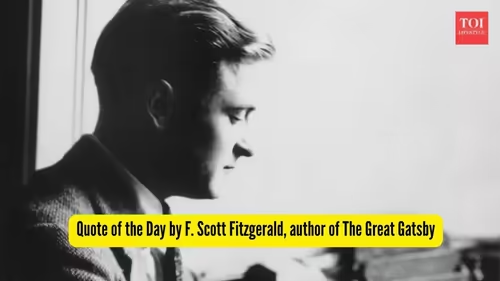
“The loneliest moment in someone’s life is when they are watching their whole world fall apart, and all they can do is stare blankly.”
This F Scott Fitzgerald quote has been shared millions of times across social media, quoted in films, and used as a caption for countless moments of personal crisis. Its raw, unflinching honesty cuts straight to the core of human vulnerability. But what makes this simple sentence so universally powerful? And what was the troubled genius behind it trying to tell us about the world he lived in—and the one we live in now?
To understand the full weight of this quote, we need to look beyond its surface and into the life of its author, the glittering yet tragic world of the Jazz Age, and the masterpiece that defined it all: The Great Gatsby.
Is It Really From The Great Gatsby?
One of the most persistent myths surrounding this F Scott Fitzgerald quote is that it appears directly in the pages of The Great Gatsby. While the sentiment is absolutely central to the novel’s themes of disillusionment and loss, the exact wording does not appear in the text .
Instead, this quote is widely attributed to Fitzgerald as a standalone piece of his wisdom, likely distilled from the same well of despair that fueled his greatest work. It perfectly encapsulates the emotional state of his characters, particularly Jay Gatsby himself, who builds an entire empire of illusion only to watch it crumble before his eyes, powerless to stop it.
F. Scott Fitzgerald and the Illusion of the American Dream
Fitzgerald wasn’t just a chronicler of the Roaring Twenties; he was its most incisive critic. He and his wife, Zelda, were the era’s golden couple, living a life of extravagant parties and public spectacle . Yet, beneath the surface, their relationship was fraught with instability, financial strain, and mental health struggles .
This personal experience of the hollowness behind the glitter directly informed his writing. In The Great Gatsby, published in 1925, he crafted a devastating critique of the American Dream. The novel argues that the promise of success through hard work had been corrupted into a shallow pursuit of wealth and status .
Gatsby’s dream isn’t just to be rich; it’s to rewrite his past and win back Daisy Buchanan. His entire existence is a performance built on illegal bootlegging, all in service of an ideal that is ultimately unattainable. When his world collapses, he is left with nothing but the stark reality of his own isolation—a perfect embodiment of the “loneliest moment.”
Ironically, the novel itself was a commercial flop upon its initial release, receiving mixed reviews and selling poorly . It was only decades later, after Fitzgerald’s death, that The Great Gatsby was recognized as the seminal work of American literature it is today . This posthumous fame adds another layer of poignancy to his words on loneliness and unrecognized despair.
Key Themes Linking the Quote to Gatsby’s World
- The Facade of Success: Both Gatsby and the Fitzgeralds projected an image of perfect happiness and success that masked deep personal turmoil.
- Powerlessness in the Face of Fate: The quote’s key phrase, “all they can do is stare blankly,” speaks to a profound helplessness. Gatsby cannot stop Daisy from choosing Tom, just as Fitzgerald could not control his own financial or marital decline.
- The Corrupted Dream: The “world falling apart” is often the shattering of a carefully constructed illusion—the belief that money, status, or love can provide lasting happiness .
Why This F Scott Fitzgerald Quote Resonates Today
In our modern age of curated social media feeds and constant comparison, Fitzgerald’s insight feels more relevant than ever. We are all, to some degree, performing versions of ourselves online, building our own “Gatsby-esque” mansions of digital persona.
The fear of having that facade crumble—whether through job loss, a broken relationship, or a global crisis—is a very real and modern anxiety. The feeling of being utterly alone in your despair, even while surrounded by a connected world, is the essence of contemporary loneliness. This meaning of Fitzgerald’s famous quote transcends its 1920s origins and speaks directly to the human condition in the 21st century.
It’s a reminder that true connection is not found in the trappings of success, but in authentic vulnerability—a quality that Gatsby, for all his grandeur, could never truly achieve.
Conclusion: The Enduring Echo of Despair
The enduring power of this F Scott Fitzgerald quote lies in its brutal simplicity. It doesn’t offer hope or a solution; it simply names a universal, terrifying experience. In doing so, it creates a strange kind of solidarity. Knowing that a literary giant like Fitzgerald understood this depth of despair can make us feel a little less alone in our own “loneliest moment.”
His work, especially The Great Gatsby, remains a timeless warning against the seductive but empty promises of a corrupted dream. For anyone who has ever felt their world slipping away, Fitzgerald’s words are a haunting, yet strangely comforting, companion. To explore more about the literary giants of the 20th century, check out our guide on [INTERNAL_LINK:modernist-literature].
Sources
- F. Scott Fitzgerald Quote Attribution: Goodreads
- The Great Gatsby’s Initial Reception and Legacy: Encyclopædia Britannica [[10], [12]]
- Fitzgerald and Zelda’s Biography: The F. Scott Fitzgerald Society [[21], [25]]
- American Dream Analysis in The Great Gatsby: SparkNotes [[26], [31]]