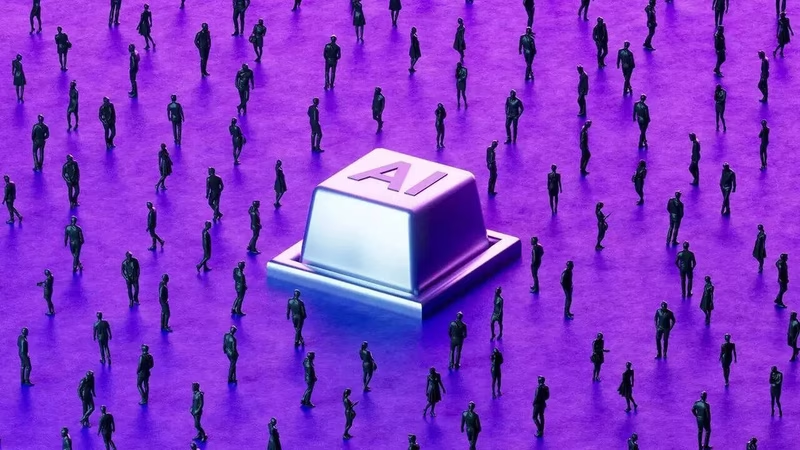
Europe stands at a technological and philosophical precipice. On one side lies its hard-won identity as a global leader in environmental stewardship. On the other, the immense, world-altering potential of artificial intelligence—a technology that’s increasingly seen as the key to future economic and geopolitical power. But here’s the rub: AI is an energy hog, and Europe’s own climate laws might be the very thing holding it back.
Enter Dan Ives, the outspoken Wedbush Securities analyst known for his bullish takes on Tesla and AI. His recent commentary has reignited a fierce debate: is Europe’s commitment to sustainability making it a spectator in the most important tech race of our generation? The core of the issue is a profound and seemingly irreconcilable conflict—a classic Europe AI dilemma.
Table of Contents
- The Dan Ives Wake-Up Call
- Europe AI Dilemma: Climate Rules vs. Compute Power
- The US-China Duopoly and Europe’s Strategic Gap
- Can Europe Have Its Cake and Eat It Too?
- Conclusion: The Fork in the Road
- Sources
The Dan Ives Wake-Up Call
Dan Ives isn’t known for his subtlety, and his message for Europe is as direct as it gets. He argues that the continent’s labyrinth of regulations, particularly those aimed at markets and climate, are actively “driving out business and investment” . For Ives, the choice is binary: compete or fall behind. In his view, the United States, with its aggressive focus on AI infrastructure and innovation, is setting the pace, while China is leveraging state coordination to catch up rapidly . Europe, meanwhile, seems content to debate the ethics while the race is being run.
This isn’t just about corporate profits; it’s about sovereignty. If Europe fails to develop its own AI capabilities, it will become perpetually dependent on American and Chinese tech giants, ceding control over its own digital future and economic destiny . This dependency could have far-reaching implications for everything from national security to the future of European labor markets.
Europe AI Dilemma: Climate Rules vs. Compute Power
The heart of the Europe AI dilemma lies in the stark reality of AI’s energy footprint. Training and running advanced AI models requires immense computational power, which translates directly into massive electricity consumption. Data centers, the engines of the AI age, are on track to consume more power than entire nations .
Europe’s ambitious climate goals, including a target for data centers to be climate-neutral by 2030 , are now colliding head-on with this energy demand. The continent’s regulatory response, most notably the landmark EU AI Act, attempts to thread this needle by imposing transparency requirements that include reporting on both energy and water consumption for large AI models .
However, critics argue that these well-intentioned rules create a significant barrier to entry. While the US and China are racing to build massive, power-hungry AI clusters, European firms must navigate a complex landscape of energy efficiency standards and environmental impact assessments. This regulatory friction can slow down innovation at a time when speed is of the essence. As one analysis put it, Europe is at a “fork in the road” between meaningful AI competition and its world-leading climate commitments .
The US-China Duopoly and Europe’s Strategic Gap
The data paints a sobering picture of Europe’s current standing. A recent report revealed a staggering compute capacity gap: the US possesses 17 times the AI computing power of the EU, while China has a significant lead as well . This creates a “self-reinforcing cycle where compute advantage leads to more innovation, which attracts more investment and talent” .
This duopoly isn’t just an economic problem; it’s a strategic one. The US frames AI around “freedom, innovation, and open markets,” while China sees it as a “vehicle for stability” and state control . If Europe doesn’t establish its own powerful, homegrown AI ecosystem, its values—privacy, human rights, and democratic oversight—may be sidelined in the global AI narrative. The EU is aware of this threat and is preparing a new strategy to reduce reliance on US and Chinese technology , but the question remains whether this will be enough to close the gap.
Can Europe Have Its Cake and Eat It Too?
Is there a third way? Can Europe leverage its strengths to turn this dilemma into an opportunity? Some experts believe so. They argue that AI, rather than being the enemy of climate goals, can be a powerful tool to achieve them. AI can enable better climate forecasting, optimize complex energy grids for renewables, and inform smarter policy decisions .
The path forward likely involves a multi-pronged approach:
- Massive Investment in Green Energy: Europe must dramatically accelerate its rollout of renewable energy sources to power its AI ambitions without increasing its carbon footprint.
- Regulatory Agility: While maintaining its core ethical principles, the EU could create “AI sandboxes” or innovation zones with streamlined permitting for green-powered data centers.
- Fostering Homegrown Champions: Strategic public-private partnerships are needed to nurture and scale European AI companies that can compete on the global stage .
Ultimately, Europe’s challenge is to prove that a human-centric, sustainable model of AI development can be not just viable, but a superior and attractive alternative to the models emerging from Washington and Beijing.
Conclusion: The Fork in the Road
The Europe AI dilemma is more than a policy debate; it’s a test of identity. Dan Ives’s warning is clear: in the hyper-competitive arena of global tech, neutrality is not an option. Europe can no longer afford to be a rule-maker on the sidelines while others build the future. The continent must find a way to marry its climate conscience with its competitive spirit. The choice isn’t simply between AI and the environment; it’s about whether Europe will be a shaper of the AI-powered future or merely a subject of it. The time for decisive action is now.
Sources
- Daniel Ives’ Post on X (formerly Twitter) regarding European regulations.
- “Europe is at a ‘fork in the road’ between AI competition and climate goals.”
- “AI, Climate, and Regulation: From Data Centers to the AI Act”.
- “AI’s hidden energy bill: Europe grapples with digital growth – IO+”.
- “AI and the energy sector | Epthinktank | European Parliament”.
- “The Global AI Energy Race: How China, EU, and US Compare”.
- “Europe steps-up AI investment to counter fierce US-China competition”.
- “State of AI 2025: five key charts for Europeans”.
- “A new AI strategy by the EU to cut reliance on the US and China”.
- “AI Industrial Policy: The New Geoeconomic Battlefield”.