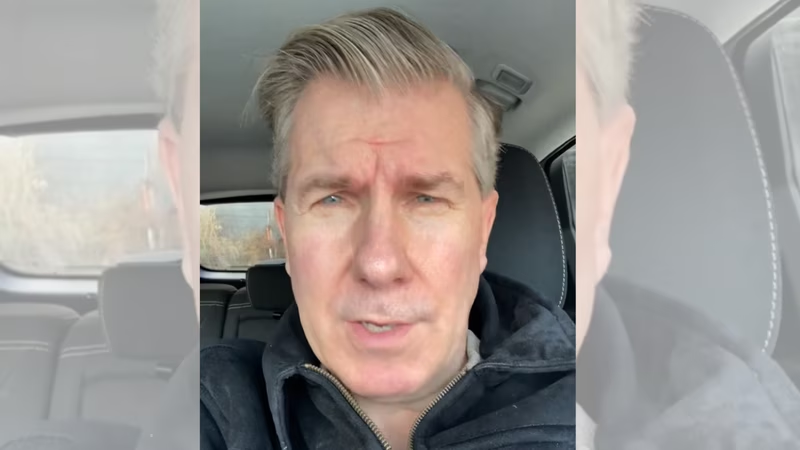
“Being holy doesn’t matter if I don’t trust the hygiene.”
Those chilling words—spoken by a white male parishioner to an Indian-American woman serving as an extraordinary minister of Holy Communion—have thrust a quiet suburban U.S. Catholic parish into the center of a national firestorm over race, faith, and inclusion.
The incident, which occurred during a recent Sunday Mass, has since gone viral on social media, with many calling it a stark example of how racial prejudice can hide behind religious rituals. While the Catholic Church teaches that the Eucharist is the body of Christ—sacred regardless of who distributes it—the man’s refusal has raised painful questions about implicit bias, xenophobia, and whether skin color still dictates who is deemed “clean” enough to handle the divine.
Table of Contents
- What Happened During the Eucharist Incident?
- The Church’s Response and Investigation
- Is This Racism or Religious Concern?
- Historical Context of Racial Bias in Religious Spaces
- Catholic Teachings on the Eucharist and Ministers
- Community Reactions and Advocacy Efforts
- Conclusion: Faith Should Not Have a Color
- Sources
What Happened During the Eucharist Incident?
According to multiple witnesses, the Indian-American woman—a trained and commissioned extraordinary minister—was distributing the Eucharist when the man stepped forward, looked at her, and said, “No thank you,” before adding, “I don’t trust the hygiene.” When she asked for clarification, he reportedly repeated, “Being holy doesn’t matter.”
The woman, who has served in her parish for over five years, was left shaken. “I’ve never felt so dehumanized in a place meant for worship,” she later shared anonymously. “My hands were clean. My heart was ready. But my skin wasn’t acceptable.”
Other congregants expressed shock. One elderly parishioner called it “a betrayal of everything Christ taught us.”
The Church’s Response and Investigation
The local diocese issued a statement condemning “any form of discrimination” and confirming it has launched a formal investigation. “The distribution of the Eucharist is a sacred duty entrusted to qualified ministers regardless of race, ethnicity, or gender,” the statement read .
However, critics argue the response lacks urgency. “Statements aren’t enough,” said Dr. Anjali Mehta, a theologian and advocate for South Asian Catholics. “We need mandatory anti-bias training, public accountability, and pastoral outreach to affected communities.”
Is This Racism or Religious Concern?
While the man claimed his objection was about “hygiene,” experts point out the deeply coded nature of such language. In Western contexts, “hygiene” has long been weaponized against immigrants, people of color, and marginalized groups—especially those from South Asia, Africa, and Latin America.
Notably:
- The woman followed all liturgical protocols, including hand sanitization before Mass.
- No other ministers—white or otherwise—were questioned about cleanliness.
- The comment directly targeted her identity, not her actions.
This aligns with patterns identified by the Southern Poverty Law Center, which notes that “cultural cleanliness” rhetoric is often a proxy for racial exclusion .
Historical Context of Racial Bias in Religious Spaces
Unfortunately, this isn’t new. From segregated pews in 19th-century American churches to modern-day microaggressions against Black, Latino, and Asian worshippers, houses of worship have often reflected societal prejudices rather than transcending them.
In the Catholic context, immigrant communities—particularly Filipino, Vietnamese, and Indian Catholics—have long reported being treated as “less authentically Catholic” despite their deep devotion and growing presence in U.S. parishes.
Catholic Teachings on the Eucharist and Ministers
The Catechism of the Catholic Church is unequivocal: “The Eucharist is ‘the source and summit of the Christian life’” (CCC 1324). It further states that Christ is truly present “under the species of bread and wine,” irrespective of the minister’s personal attributes.
Extraordinary ministers are appointed by bishops or pastors after rigorous formation. Their role is not symbolic—it’s sacramental. To reject the Eucharist from a duly authorized minister is, theologically, to reject Christ himself—a point emphasized by Pope Francis in his 2023 apostolic letter Desiderio Desideravi .
Community Reactions and Advocacy Efforts
The incident has galvanized interfaith and Catholic advocacy groups. The National Association of Indian Catholics (NAIC) called for “zero tolerance for bigotry in sacred spaces,” while the U.S. Conference of Catholic Bishops (USCCB) faces renewed pressure to address systemic inclusion gaps.
Online, the hashtag #HolyHandsHaveColor trended, with South Asian Catholics sharing stories of similar slights—being mistaken for janitors, questioned about their “real” faith, or excluded from leadership roles.
Conclusion: Faith Should Not Have a Color
At its core, this Eucharist controversy isn’t about theology—it’s about humanity. If a person can stand before the altar and declare another unworthy based on appearance, then the message of love, humility, and universal dignity at the heart of Christianity has been lost.
Churches must do more than issue statements. They must become sanctuaries where every face—brown, Black, white, or yellow—is seen as bearing the image of God. For deeper insights into faith and inclusion, explore [INTERNAL_LINK:diversity-in-modern-churches].
Sources
- Times of India: ‘Don’t trust the hygiene’: Catholic man refuses Eucharist from Indian woman in US
- United States Conference of Catholic Bishops (USCCB): Guidelines for Extraordinary Ministers of Holy Communion
- Southern Poverty Law Center: The Language of Exclusion: How ‘Hygiene’ Masks Racism
- Pope Francis, Desiderio Desideravi (2023): On the Liturgical Formation of the People of God