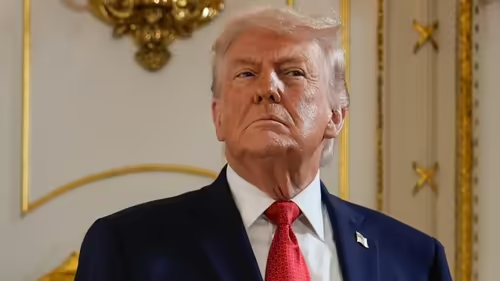
In a stunning rebuke to Washington, the European Union has effectively put a critical trade agreement with the United States on ice. The catalyst? None other than former President Donald Trump’s latest—and most brazen—threat to impose sweeping tariffs on the EU unless it relinquishes control over Greenland. This isn’t just a policy disagreement; it’s a full-blown geopolitical crisis that risks fracturing the transatlantic alliance at a time when global stability is already on shaky ground.
The decision by the European Parliament to suspend the ratification process of the long-negotiated trade deal is a direct and forceful response to what EU leaders are calling “unacceptable” and “reckless” behavior . It marks a significant hardening of Europe’s stance against perceived American bullying, signaling that Brussels is no longer willing to be a passive partner in its own economic future.
Table of Contents
- EU Suspends US Trade Deal in Historic Move
- Trump’s Greenland Obsession and the Tariff Threat
- Why Greenland Is a Geopolitical Prize
- Economic Fallout for Businesses and Consumers
- What Happens Next to the Transatlantic Relationship?
- Conclusion: A New Chapter of Economic Conflict
- Sources
EU Suspends US Trade Deal in Historic Move
The European Parliament’s decision to halt the approval process is more than a procedural delay—it’s a powerful political statement. By formally suspending the EU suspends US trade deal ratification, European lawmakers have drawn a clear red line. They are telling the United States that economic coercion will not be tolerated, especially over a matter as sensitive as the sovereignty of a territory that is an integral part of the Kingdom of Denmark.
This move effectively freezes a deal that was designed to lower barriers for everything from agricultural products to digital services between the two largest economies in the world. The suspension means that businesses on both sides of the Atlantic now face a prolonged period of uncertainty, with potential new tariffs and regulatory hurdles looming on the horizon .
Trump’s Greenland Obsession and the Tariff Threat
Donald Trump’s fascination with Greenland is not new. During his first term, he openly mused about purchasing the island, a proposal that was swiftly and firmly rejected by Danish authorities. Now, in early 2026, he has escalated his rhetoric, threatening to impose a blanket 25% tariff on all EU goods unless the bloc agrees to cede control of the strategically vital Arctic territory—a demand that is both legally impossible and politically absurd .
His justification hinges on a distorted view of Greenland’s status, ignoring its autonomous government and its deep-rooted ties to Denmark and the EU. The threat appears less like a serious negotiation tactic and more like a high-stakes gamble to rally his domestic base by projecting an image of aggressive American strength. However, the consequences of this gamble are being felt far beyond US borders.
Why Greenland Is a Geopolitical Prize
Greenland’s value extends far beyond its icy landscape. It sits at the epicenter of the rapidly melting Arctic, a region that is becoming a new frontier for global competition. Its strategic importance is threefold:
- Mineral Wealth: The island is believed to hold vast, untapped reserves of rare earth elements, which are essential for manufacturing everything from smartphones to advanced military hardware.
- Strategic Location: Its position between North America and Europe makes it a critical node for future shipping lanes and military surveillance as the Arctic ice recedes.
- Scientific Research: Greenland’s ice sheet is a key indicator of climate change, making it a focal point for international scientific collaboration.
For the EU, allowing any external power to dictate terms over Greenland would set a dangerous precedent for its own sovereignty and its role as a global actor. This is why the EU’s response has been so swift and unified .
Economic Fallout for Businesses and Consumers
The immediate impact of the suspended trade deal is a cloud of uncertainty that will stifle investment and planning. Companies that were counting on smoother market access are now forced to reassess their supply chains and pricing strategies. In the short term, consumers in both the US and EU could see price increases on a wide range of imported goods, from French wine to American soybeans.
Financial markets are already on alert, with analysts warning that a prolonged standoff could trigger volatility across global equities and currencies . The situation is a stark reminder of how quickly political grandstanding can translate into real-world economic pain for ordinary citizens and businesses who have no stake in the underlying dispute.
What Happens Next to the Transatlantic Relationship?
The path forward is fraught with difficulty. While the EU has made its position clear, it has also left the door open for dialogue, reaffirming its commitment to a rules-based international order while condemning the use of economic threats . The ball is now in the US court.
Will the current US administration distance itself from Trump’s inflammatory remarks and work to de-escalate the situation? Or will it be pressured into adopting a harder line, further damaging the transatlantic partnership? The answer to this question will shape not only trade policy but the broader geopolitical alignment of the West for years to come. For now, the message from Brussels is unambiguous: a deal is a deal, and coercion is off the table .
Conclusion: A New Chapter of Economic Conflict
The decision to EU suspends US trade deal is a watershed moment. It demonstrates that the European Union is willing to leverage its immense economic power to defend its principles and its allies. This standoff over Greenland is not just about a remote island; it’s a test of whether international relations will be governed by the rule of law or the law of the jungle. As the world watches, the stakes for global economic stability have never been higher.
Sources
- Times of India: Greenland row escalates: After Trump’s tariff threat, EU moves to suspend US trade deal
- [INTERNAL_LINK:impact-of-us-tariffs-on-european-markets]
- [INTERNAL_LINK:history-of-us-eu-trade-negotiations]