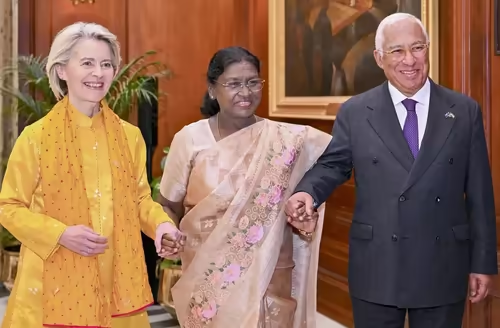
Move over, old alliances. A powerful new axis is forming on the world stage, and it’s connecting Brussels to New Delhi. In a speech that resonated with historic weight at a presidential banquet in India’s capital, European Commission President Ursula von der Leyen delivered a clear and resounding message: “EU-India ties have never been stronger” [[3]].
This isn’t just diplomatic nicety. Her words were backed by two concrete, game-changing agreements signed just days before: a long-awaited Free Trade Agreement (FTA) and a groundbreaking Security and Defence Partnership. Together, these deals mark a quantum leap in the relationship between the world’s largest democracy and its most integrated economic bloc, signaling a united front in an era of profound global uncertainty.
Table of Contents
- The Historic Free Trade Agreement
- A New Era for EU-India Security Cooperation
- Why This Moment Matters for EU-India Ties
- The Strategic Implications for the Global Order
- Conclusion: A Partnership for the Future
The Historic Free Trade Agreement
After nearly two decades of on-and-off negotiations, the EU and India have finally concluded their Free Trade Agreement. Dubbed by some as the “mother of all trade deals,” this pact is expected to be a massive economic engine for both sides [[4]].
The agreement aims to slash tariffs on a vast array of goods, from European machinery and wines to Indian textiles and pharmaceuticals. It will also establish new rules for digital trade, intellectual property, and services, creating a more predictable and level playing field for businesses. For the EU, it opens up a market of 1.4 billion consumers. For India, it provides a crucial gateway to one of its largest export destinations, potentially boosting its manufacturing and tech sectors significantly.
This FTA is more than just a commercial deal; it’s a statement of shared economic values and a commitment to a rules-based international order—a direct counter to the rising tide of protectionism.
A New Era for EU-India Security Cooperation
If the FTA was the economic pillar, the newly signed Security and Defence Partnership is the strategic one. On January 27, 2026, during the 16th EU-India Summit in New Delhi, the two sides formalized this first-ever overarching framework for defence and security collaboration [[1]].
This partnership is a major step up from previous dialogues. It establishes a structured mechanism for regular consultations on regional and global security challenges, from maritime security in the Indo-Pacific to counter-terrorism efforts. Crucially, it also paves the way for deeper cooperation in defence research, technology, and even industrial partnerships, potentially expanding market access for Indian military equipment in Europe [[6]].
This move aligns the EU with other key Indo-Pacific partners like Japan and South Korea, who have similar agreements with the bloc [[4]]. It signals that the EU is no longer just an economic player but is actively seeking a strategic role in the region’s security architecture, with India as its central partner.
Why This Moment Matters for EU-India Ties
Von der Leyen’s visit and the timing of these agreements are not coincidental. They come at a critical juncture where both the EU and India are reassessing their global positions.
- Shared Strategic Concerns: Both entities are navigating a complex geopolitical landscape marked by great power competition and supply chain vulnerabilities. A strong partnership offers them greater strategic autonomy.
- Economic Diversification: The war in Ukraine and US-China tensions have highlighted the risks of over-reliance on single markets. The FTA allows both to diversify their economic partnerships and build more resilient supply chains.
- A Voice for the Global South: India, as a leader of the Global South, and the EU, as a champion of multilateralism, see their partnership as a way to shape a more balanced and inclusive international system.
This convergence of interests has transformed the relationship from a potential partnership into a necessary one. As the joint statement from the 16th EU-India Summit put it, the leaders “welcomed the signing of the India–EU Security and Defence Partnership, the first such overarching defence and security framework” [[7]].
The Strategic Implications for the Global Order
The strengthening of EU-India ties is a significant development that will ripple across the global order. It creates a powerful democratic counterweight in a world increasingly defined by authoritarian blocs. This partnership is built on a foundation of shared democratic values, rule of law, and a commitment to a free and open Indo-Pacific.
For other nations, this signals a viable alternative path to cooperation—one that is not based on coercion but on mutual benefit and respect. It also puts pressure on other major powers to engage constructively with this new axis. [INTERNAL_LINK:global-geopolitics] This is not about forming a new military alliance against anyone, but about building a coalition of capable democracies to uphold the international rules-based order.
Conclusion: A Partnership for the Future
Ursula von der Leyen’s declaration that EU-India ties are “never been stronger” is more than a soundbite; it’s a reflection of a new geopolitical reality. The simultaneous launch of a comprehensive Free Trade Agreement and a Security and Defence Partnership is a masterstroke of diplomacy that binds the two regions together economically and strategically for decades to come.
This is not the end of a journey, but the beginning of a much deeper and more consequential partnership. As the world faces unprecedented challenges, the Brussels-New Delhi axis stands as a beacon of hope for a more stable, prosperous, and rules-based future.
Sources
- [[1]] European External Action Service (EEAS): EU and India sign security & defence partnership
- [[3]] Times of India: ‘Never been stronger’: Ursula von der Leyen hails Europe–India ties at presidential banquet
- [[4]] Al Jazeera: India, EU agree on ‘mother of all’ trade deals
- [[6]] EU-India.org: EU-India security and defense partnership aims to expand market access for Indian military equipment
- [[7]] European Commission: Joint Statement of the 16th EU-India Summit