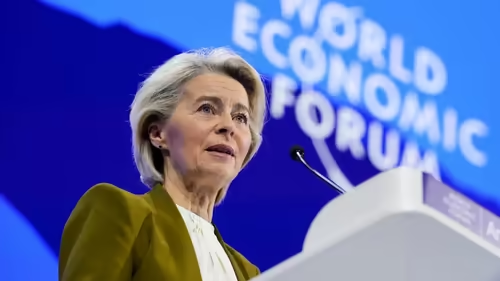
For almost 20 years, the promise of a robust trade pact between the world’s largest democracy and its most powerful trading bloc has been just out of reach. But now, the long wait appears to be over. In a stunning development, European Commission President Ursula von der Leyen has declared that the EU and India are on the “cusp of a historic trade agreement” .
With an official signing date of January 27, 2026, firmly on the calendar, the EU-India FTA is no longer a distant dream but an imminent reality. This isn’t just another trade deal; it’s a strategic reset that could reshape global supply chains, boost economies on both sides, and send a powerful message about de-risking from geopolitical rivals.
Table of Contents
- What is the EU-India FTA?
- Why January 27 is a Pivotal Date
- Key Issues Resolved in the Final Stretch
- What the EU-India FTA Means for Businesses
- The Bigger Strategic Picture
- Conclusion: A New Chapter in Global Trade
- Sources
What is the EU-India FTA?
The EU-India Free Trade Agreement (FTA) is a comprehensive pact designed to eliminate or reduce tariffs on a vast array of goods and services traded between the 27-nation European Union and India. The negotiations, which began way back in 2007, were suspended in 2013 due to disagreements over issues like market access and intellectual property rights.
Talks were officially revived in 2022, driven by a shared desire to diversify supply chains away from China and build a more resilient economic partnership. The agreement is expected to cover not just traditional trade in goods, but also modern areas like digital trade, services, and investment protection.
Why January 27 is a Pivotal Date
January 27, 2026, is not a random Tuesday. It’s the date of the highly anticipated 16th EU-India Summit in New Delhi . European Council President António Costa and European Commission President Ursula von der Leyen will lead the EU delegation for this landmark event .
This summit is the perfect stage for such a historic announcement. Both sides have been working tirelessly to bridge their final gaps, with multiple rounds of high-level talks held in late 2025 and early January 2026 [[19], [23]]. The expectation is clear: the conclusion of the FTA negotiations will be formally announced at this summit, marking the end of a 19-year journey .
Key Issues Resolved in the Final Stretch
Getting to this point required compromise on some of the most sensitive topics. Here’s a look at the major hurdles that were finally cleared:
- Tariffs and Market Access: The EU sought greater access for its automobiles, wines, and dairy products into the Indian market. India, in turn, pushed for easier entry for its pharmaceuticals, textiles, and IT services into Europe. A delicate balance was struck to protect domestic industries while opening new doors.
- Rules of Origin: Defining what constitutes a “Made in India” or “Made in EU” product is crucial for determining which goods qualify for preferential tariffs. This technical but vital issue was a major focus of the final negotiation rounds .
- Protection for Vulnerable Sectors: India was adamant about safeguarding its farmers and Micro, Small, and Medium Enterprises (MSMEs) from a sudden influx of cheaper imports. The final text is expected to include robust safeguards and transition periods for these sectors .
- Geographical Indications (GIs): The EU wanted strong protection for its famous GIs like Champagne and Parmigiano Reggiano. India, with its own rich heritage of products like Darjeeling Tea and Basmati Rice, successfully negotiated for reciprocal recognition and protection .
What the EU-India FTA Means for Businesses
This deal is a game-changer for companies on both continents. For European exporters, it means a massive, young, and growing consumer market with reduced barriers. For Indian businesses, it offers a stable and lucrative gateway to the heart of the European economy.
Industries poised to benefit the most include:
- Indian IT & Services: Easier movement of professionals and streamlined regulations for service providers.
- European Machinery & Automotive: Lower import duties will make European equipment and vehicles more competitive in India.
- Pharmaceuticals: A clearer regulatory pathway for Indian generic drugs in the EU market.
- <Agriculture & Food Processing: Both sides gain new opportunities to export their unique food and beverage products.
For entrepreneurs and investors, this signals a more predictable and integrated business environment between two of the world’s largest economies.
The Bigger Strategic Picture
Beyond the balance sheets, the EU-India FTA is a cornerstone of a broader strategic alignment. In an era of geopolitical uncertainty, this pact is a clear signal of mutual trust and a shared vision for a multipolar world.
For the EU, it’s a critical part of its “de-risking” strategy, reducing dependence on China by building a strong, reliable partnership with India . For India, it’s a major diplomatic and economic victory that cements its position as a pivotal global player and a preferred alternative manufacturing hub. The summit will also cover cooperation on clean energy, technology, and security, making this a truly holistic partnership .
Conclusion: A New Chapter in Global Trade
The impending signing of the EU-India FTA on January 27 is more than just a trade deal; it’s a historic moment that will redefine economic relations between two giants. After years of complex negotiations and political will, the agreement promises to unlock billions in trade, create new jobs, and foster a deeper strategic bond. As we stand on the cusp of this new era, one thing is certain: the world of global trade is about to get a lot more interesting. Keep an eye on our [INTERNAL_LINK:global-trade-trends] section for ongoing analysis of this landmark agreement’s impact.
Sources
- Times of India: ‘Cusp of historic agreement’: EU chief says they are close to signing FTA with India
- European Parliament News: EU-India relations | 19-01-2026
- Government of India, Ministry of Commerce & Industry: Press Releases on India-EU FTA
- European Commission: EU-India trade relations