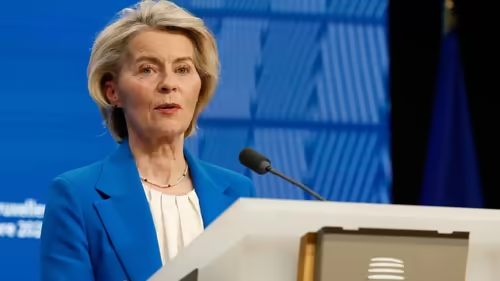
It’s not every day that a single agreement has the potential to shift the tectonic plates of global economics and geopolitics. Yet, that’s precisely the moment we’re in. As European Commission President Ursula von der Leyen arrives in India for the pivotal summit on January 27, 2026, all eyes are on the imminent EU-India FTA—a deal that promises to be far more than just a ledger of tariffs and quotas.
“Let’s seize the moment,” von der Leyen declared, capturing the urgency and opportunity of this watershed event . And seize it they must, because the world is watching, and the stakes have never been higher.
Table of Contents
- What is the EU-India FTA?
- Why This Deal is a Strategic Masterstroke
- The New EU-India Defence Partnership
- Key Benefits for Indian and EU Businesses
- Challenges and Sticking Points
- Conclusion: The Future of EU-India Ties
What is the EU-India FTA?
The EU-India Free Trade Agreement (FTA) is the culmination of over a decade of negotiations, designed to create a seamless corridor for goods, services, and investment between the world’s largest democracy and its most integrated economic bloc. At its core, the FTA aims to eliminate or significantly reduce tariffs on a vast majority of traded products, simplify complex customs procedures, and establish a robust framework for resolving trade disputes.
This isn’t just about making trade cheaper; it’s about making it smarter and more resilient. In an era defined by supply chain fragility and economic nationalism, the EU-India FTA represents a powerful vote for open, rules-based commerce. [INTERNAL_LINK:global-trade-trends] For businesses on both sides, it unlocks a market of over 1.7 billion consumers with a combined GDP exceeding $30 trillion.
Why This Deal is a Strategic Masterstroke
Beyond the balance sheets, the timing of this agreement is its true genius. The upcoming summit is set to adopt a “joint EU-India comprehensive strategic agenda,” a document that elevates their relationship from a transactional partnership to a deeply integrated strategic alliance . This move is a direct response to a volatile world order, where diversification of partners is no longer a luxury but a necessity for both economic and national security.
For the EU, India offers a critical counterbalance in a multipolar world, a reliable partner for its clean energy transition, and a massive market for its high-value goods and services. For India, the EU provides access to cutting-edge technology, a stable source of foreign direct investment, and a powerful ally in shaping global norms. This synergy is what makes the EU-India FTA a true game-changer.
The New EU-India Defence Partnership
Perhaps the most groundbreaking element of this summit is the planned signing of a new Security and Defence Partnership. This is not a mere formality; it’s a significant elevation of their security ties. The pact will cover crucial areas like maritime security in the Indo-Pacific, joint military exercises, and cooperation on defence research and industry .
This development is particularly noteworthy. The EU has extended such a comprehensive defence framework to only a select few nations, signaling a profound level of trust and strategic alignment with India . It moves their relationship beyond traditional diplomacy into the realm of shared security interests, a clear message to the world about their collective vision for a stable and rules-based international system.
Key Benefits for Indian and EU Businesses
The economic windfall from the EU-India Free Trade Agreement is expected to be substantial for both economies. Here’s a quick look at what businesses can anticipate:
- For Indian Exporters: Easier access to the EU market for key sectors like textiles, pharmaceuticals, gems & jewellery, and agricultural products. Reduced tariffs will make Indian goods more competitive against rivals from other regions.
- For EU Companies: A streamlined path to invest in India’s booming digital economy, renewable energy sector, and advanced manufacturing. The agreement is expected to include strong provisions for intellectual property rights, which is a major concern for European firms.
- For Both Sides: A more predictable and stable business environment, reduced bureaucratic red tape, and new opportunities for collaboration in innovation and R&D.
Challenges and Sticking Points
Despite the overwhelming momentum, the road to a final deal hasn’t been without its bumps. Negotiations have been complex, with both sides holding firm on sensitive issues. The EU has been pushing for India to eliminate tariffs on more than 95% of its imports, while New Delhi has signaled a willingness to go closer to 90%, protecting its domestic industries in key sectors .
Other sticking points have included data localization rules, visa regulations for professionals, and geographical indications for certain products. However, the current political will on both sides appears strong enough to overcome these final hurdles. The “last mile is the hardest,” as von der Leyen noted, “but it will be more than worth it” .
Conclusion: The Future of EU-India Ties
The agreements emerging from the January 2026 summit are not just a collection of policy documents; they are a declaration of intent. The EU-India FTA, coupled with the new defence partnership, marks the beginning of a new era in their relationship—one defined by deep strategic convergence, mutual economic benefit, and a shared commitment to a stable global order. This is a moment that both Brussels and New Delhi have been working towards for years, and its successful execution could reshape the economic and security landscape for decades to come.
Sources
- European Council. “EU-India summit, 27 January 2026.” consilium.europa.eu.
- European Commission. “President von der Leyen visits India to advance trade and defence cooperation.” ec.europa.eu.
- Financial Times. “How ‘the greatest of trade deals’ can deliver gains amid global turmoil.” ft.com.
- Ministry of External Affairs, India. “India, E.U. agree to sign security and defence partnership.” mea.gov.in.
- Reuters. “The EU-India FTA: Profitable Commerce, Adversarial Politics?” reuters.com.