Introduction: A Delicate Diplomatic Dance
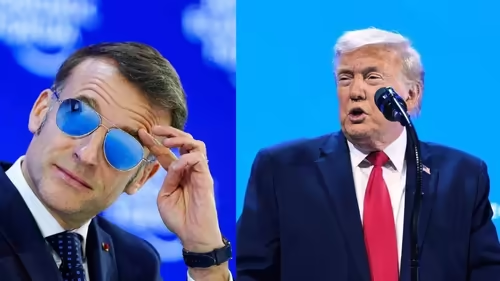
In a move that blends economic pragmatism with geopolitical strategy, French President Emmanuel Macron has publicly urged China to increase its foreign direct investment (FDI) in Europe. Speaking during a high-level dialogue, Macron emphasized Europe’s need for growth, innovation, and—crucially—technology transfer, while simultaneously criticizing U.S. trade protectionism .
Beijing’s response was swift and measured. Chinese officials reaffirmed their commitment to mutual benefit but stressed that their global competitiveness stems not from unfair practices, but from decades of strategic investment in research and development (R&D). They also called for a “fair, open, and non-discriminatory” European market for Chinese enterprises—a clear reference to recent EU tariffs and security reviews targeting Chinese tech and green energy firms.
This exchange highlights the growing complexity of EU-China trade relations, caught between economic interdependence and strategic rivalry. Is Macron’s overture a genuine bridge-building effort—or a tactical maneuver in a broader global realignment?
Table of Contents
- Macron’s Proposal: More Chinese FDI for Europe
- Beijing’s Response: It’s Not About Unfair Advantage
- The US Factor: Macron’s Critique of American Trade Policy
- EU-China Trade Relations at a Crossroads
- What Does “Fair Treatment” Really Mean?
- Conclusion
- Sources
Macron’s Proposal: More Chinese FDI for Europe
Macron’s pitch is rooted in Europe’s current economic anxieties. Facing sluggish growth, an aging population, and a widening technology gap with the U.S. and China, the EU is desperate for capital and innovation. Chinese FDI—which once flowed freely into European ports, energy, and automotive sectors—has slowed dramatically since 2016 due to heightened scrutiny over national security and reciprocity .
“Europe needs investment, not just consumption,” Macron argued. “We welcome Chinese companies that bring not only capital, but also advanced technologies and know-how.” His message is clear: if China wants better access to the European market, it should invest in Europe’s future—not just sell to it.
Beijing’s Response: It’s Not About Unfair Advantage
China’s Ministry of Commerce pushed back against the narrative that its success is built on subsidies or intellectual property theft. In its official statement, Beijing highlighted that Chinese firms now rank among the world’s top spenders on R&D—companies like Huawei, BYD, and CATL are investing billions annually to lead in 5G, EVs, and battery tech .
“The competitiveness of Chinese products comes from innovation, not distortion,” the spokesperson said. “We hope the EU will provide a level playing field.” This is a direct rebuttal to recent EU measures like the anti-subsidy investigation into Chinese electric vehicles and restrictions on critical infrastructure investments.
The US Factor: Macron’s Critique of American Trade Policy
Notably, Macron took a swipe at U.S. trade practices, calling them “increasingly unilateral and protectionist.” He referenced the Inflation Reduction Act (IRA), which offers massive subsidies to green tech manufacturers—but only if they operate in North America. This has lured European companies and capital across the Atlantic, weakening the EU’s industrial base .
By contrasting U.S. “economic nationalism” with his call for EU-China cooperation, Macron is positioning Europe as a more predictable, rules-based partner. It’s a strategic gambit: align with China on trade norms while distancing from Washington’s “America First” approach.
EU-China Trade Relations at a Crossroads
The current state of EU-China trade relations is fraught with contradictions:
- Economic Interdependence: The EU is China’s largest trading partner; China is the EU’s second-largest. Bilateral trade exceeded €700 billion in 2025 .
- Strategic Distrust: The EU now labels China a “systemic rival,” citing human rights, IP concerns, and support for Russia.
- Regulatory Friction: New EU laws on foreign subsidies, critical raw materials, and digital markets disproportionately affect Chinese firms.
Macron’s outreach may reflect a faction within the EU that believes engagement—not containment—is the path forward. But he faces resistance from Germany, the Baltics, and others wary of deepening ties with Beijing.
What Does “Fair Treatment” Really Mean?
Both sides use the term “fair,” but their definitions diverge sharply:
- For China: Fair treatment means no discriminatory tariffs, security reviews, or forced tech transfers. It wants its EVs, solar panels, and telecom gear evaluated on merit, not geopolitics.
- For the EU: Fairness requires reciprocity—equal access to Chinese markets, transparent state support, and adherence to labor/environmental standards.
Bridging this gap will require more than rhetoric. Concrete confidence-building measures—like mutual recognition of standards or joint R&D funds—could be a starting point. As [INTERNAL_LINK:eu-china-green-deal-cooperation] experts suggest, climate collaboration might offer a neutral ground for rebuilding trust.
Conclusion
Macron’s call for increased Chinese FDI is less about economics and more about sovereignty. In a world dominated by U.S.-China rivalry, Europe risks becoming a bystander. By inviting China to co-invest in its future, Macron is attempting to reclaim agency—but only if Beijing feels it’s getting a fair deal in return. The evolution of EU-China trade relations will hinge on whether both sides can move beyond suspicion and build a framework where competition doesn’t preclude cooperation. The alternative—a fragmented, zero-sum global economy—is in no one’s interest.