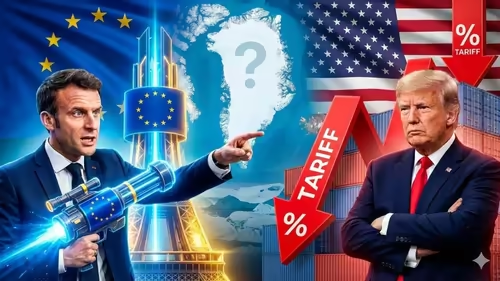
In a world where trade is the new battlefield, a single word from a leader can send shockwaves through global markets. That word, from French President Emmanuel Macron, is “unacceptable.” In response to former President Donald Trump’s renewed threats of tariffs on European nations over the long-settled issue of Greenland, Macron has called for the EU to ready its most potent economic weapon yet: the EU anti-coercion instrument.
This isn’t a mere political spat. It’s a high-stakes game of economic chess that could redefine the transatlantic relationship and test the resolve of a newly empowered European bloc. The question on everyone’s mind is simple: Is the EU finally ready to fire its trade ‘bazooka’?
Table of Contents
- Macron’s Ultimatum: “No Intimidation Will Influence Us”
- What is the EU Anti-Coercion Instrument?
- The Greenland Dispute: A Pretext for a Trade War?
- Historical Context: A Long History of US-EU Trade Tensions
- Potential Consequences for Global Markets
- Conclusion: A New Era of EU Economic Diplomacy
- Sources
Macron’s Ultimatum: “No Intimidation Will Influence Us”
Speaking with characteristic defiance, President Macron has drawn a clear line in the sand. He stated unequivocally that “no intimidation or threat will influence us—neither in Ukraine, nor in Greenland, nor anywhere else in the world when we are confronted with such unacceptable pressure” . His message is a direct rebuke to Trump’s reported plan to impose a 10% tariff on a coalition of European nations, including France, Germany, and the UK, as leverage over the Arctic territory .
For Macron, this is about more than just trade; it’s about sovereignty and the fundamental principle that international relations should not be dictated by economic blackmail. He argues that Europe must respond in a “united and coordinated” manner, and his chosen vehicle for that response is the freshly minted EU anti-coercion instrument .
What is the EU Anti-Coercion Instrument?
Often dubbed the EU’s trade ‘bazooka,’ the Anti-Coercion Instrument (ACI) is a powerful legal framework that entered into force on December 27, 2023 . Its sole purpose is to protect the EU and its member states from economic coercion by third countries. Think of it as a formalized, structured playbook for retaliation.
The process is methodical. If a member state like France believes it is being coerced, it can request the European Commission to launch an investigation. If the Commission confirms the existence of economic coercion, it can then propose a range of countermeasures. These are not limited to simple tit-for-tat tariffs. The ACI grants the EU a formidable arsenal, including:
- Trade restrictions: Imposing or increasing customs duties on imports.
- Investment barriers: Restricting foreign direct investment from the coercing country.
- Market access limitations: Curtailing services, public procurement opportunities, or intellectual property rights for companies from the offending nation .
The beauty of the ACI lies in its flexibility and deterrence value. It signals to the world that the EU is no longer a passive player in economic statecraft but a strategic actor willing to defend its interests with calibrated, powerful responses .
The Greenland Dispute: A Pretext for a Trade War?
The core of this conflict is bewildering to many. Greenland, a self-governing territory of the Kingdom of Denmark, has been a subject of US interest for decades, most notably during the Trump administration’s first term. The idea that a new set of tariffs would be levied in 2026 over a matter that was politically settled years ago seems less about Greenland itself and more about establishing a new precedent for US trade policy.
Analysts suggest that this move is a strategic gambit by Trump to test the unity and resolve of the European Union before a potential return to the White House. By linking a geopolitical curiosity to a broad-based economic penalty, he aims to create division among European allies and force concessions on other trade fronts. However, Macron’s swift and unified call for action using the ACI appears to have turned the tables, transforming a potential point of weakness into a moment of European solidarity.
Historical Context: A Long History of US-EU Trade Tensions
This latest standoff is not happening in a vacuum. The US and EU have a long, contentious history of trade disputes. The most recent major clash occurred in 2018 when the Trump administration imposed sweeping tariffs on steel and aluminum imports from the EU, citing dubious national security grounds .
The EU’s response was swift and targeted, imposing retaliatory tariffs on a carefully selected list of American goods, from bourbon to motorcycles, worth billions of dollars . This tit-for-tat cycle created significant uncertainty for businesses on both sides of the Atlantic and damaged the overall trade relationship.
The creation of the EU anti-coercion instrument is a direct consequence of these past experiences. It represents a strategic evolution from ad-hoc retaliation to a pre-defined, legally robust system designed to deter future aggression. The current situation over Greenland is its first major real-world test.
Potential Consequences for Global Markets
If the EU formally activates the ACI, the ripple effects could be profound. A full-blown trade war between the world’s two largest economic blocs would likely lead to:
- Increased consumer prices on a wide range of goods in both the US and Europe.
- Supply chain disruptions for multinational corporations deeply integrated across the Atlantic.
- Market volatility as investors react to the heightened geopolitical and economic risk.
- A potential shift in global trade alliances, with other nations forced to choose sides or seek new partnerships.
However, the very existence of the ACI might be enough to prevent escalation. Its primary function is deterrence. By publicly threatening its use, the EU is signaling to Washington that the cost of these tariffs will be far higher than anticipated, potentially forcing a retreat before a single new duty is imposed.
Conclusion: A New Era of EU Economic Diplomacy
Emmanuel Macron’s push to activate the EU anti-coercion instrument marks a pivotal moment. It signifies a shift from a Europe that reacts to one that proactively shapes its economic destiny. Whether or not the ‘bazooka’ is fired, the act of loading it sends a powerful message: the era of European economic passivity is over.
This standoff over Greenland is less about a remote island and more about the rules of the global economic order. The EU, under pressure from leaders like Macron, is now equipped with a sophisticated tool to defend those rules. The world is watching to see if they have the collective will to use it. For businesses and policymakers alike, understanding the mechanics and implications of this new instrument is no longer optional—it’s essential for navigating the future of international trade.
Sources
- European Commission. “Protecting against coercion – Trade and Economic Security.” https://ec.europa.eu/trade/policy/in-focus/anti-coercion-instrument/
- Xinhua News Agency. “Macron rejects US tariff threats over Greenland as ‘unacceptable’.” January 18, 2026.
- Times of India. “Greenland row: France’s Macron urges trade ‘bazooka’ action against US tariffs.” Original Article
- Baker McKenzie. “Determined to Deter? The EU’s new Anti-Coercion Instrument.” January 9, 2024.
- Council on Foreign Relations. “Winners and losers: The long game of US-EU trade conflicts.” April 23, 2025.