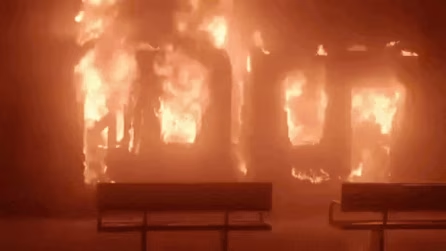
Ernakulam Express Fire: Tragedy Strikes as Midnight Blaze Claims One Life
In a terrifying pre-dawn incident on Monday, December 29, 2025, a massive fire erupted on the Ernakulam–Howrah Express near Yalamanchili railway station in Andhra Pradesh’s Anakapalli district. The inferno, which rapidly engulfed two coaches, claimed the life of one passenger and left rail authorities scrambling to investigate its cause. Miraculously, due to the swift actions of railway staff and emergency responders, all other passengers were safely evacuated—avoiding what could have been a far greater catastrophe .
The incident has reignited urgent questions about fire safety protocols on long-distance Indian trains, especially as the national rail network recovers from a series of operational challenges in recent years. With over 23 million passengers relying on Indian Railways daily, this Ernakulam Express fire serves as a stark reminder of both systemic vulnerabilities and human resilience.
Table of Contents
- What Happened During the Ernakulam Express Fire?
- Passenger Evacuation and Emergency Response
- Victim Identified as Investigation Begins
- Possible Causes of the Blaze
- Indian Railways’ Fire Safety Record
- Reactions from Officials and Passengers
- What Next for Affected Passengers and Train Services?
- Conclusion: An Urgent Need for Modernization
- Sources
What Happened During the Ernakulam Express Fire?
The Ernakulam–Howrah Express (Train No. 12659) was traveling through coastal Andhra Pradesh around 4:30 a.m. when passengers in S1 and S2 coaches reported smoke and flames near a compartment area. Panic ensued as the fire spread quickly, fueled by flammable interior materials.
The train was immediately halted at the nearest station—Yalamanchili—where railway personnel sprang into action. Within minutes, the burning coaches were uncoupled from the rest of the train to prevent the fire from spreading further .
“It was like a nightmare,” said passenger Rajesh Mehta, traveling from Visakhapatnam. “One moment everything was quiet, the next there were screams and thick black smoke. But the staff were heroes—they got us all out in under 15 minutes.”
Passenger Evacuation and Emergency Response
Railway officials executed a textbook emergency protocol:
- All 780+ passengers were evacuated without major injuries.
- Local fire tenders from Anakapalli and Samalkot reached the site within 20 minutes.
- Affected passengers were provided food, water, and medical check-ups at the station.
- Alternate transport was arranged for onward journeys by the South Central Railway zone .
Despite these efforts, one male passenger—later identified as a 58-year-old from West Bengal—was found unconscious inside a burnt compartment and pronounced dead on arrival at a nearby hospital.
Victim Identified as Investigation Begins
The deceased has been identified as Mr. Arindam Banerjee, a retired schoolteacher from Howrah. Railway Protection Force (RPF) officials confirmed he was traveling alone and was seated near the coach’s electrical panel.
A high-level inquiry committee, led by the Chief Commercial Manager of South Central Railway, has been formed to determine the cause of the fire. Forensic teams are examining the wreckage for signs of electrical short-circuit, sabotage, or accidental ignition .
Possible Causes of the Blaze
While the investigation is ongoing, preliminary reports suggest several plausible triggers:
- Electrical fault: Aging wiring in older LHB coaches can overheat, especially during winter when heaters are in use.
- Passenger negligence: Unattended cooking or charging devices are common culprits in train fires.
- Arson: Though less likely, authorities aren’t ruling it out without forensic confirmation.
Notably, both gutted coaches were older ICF-type carriages, not the newer Linke Hofmann Busch (LHB) models known for better fire resistance—a detail that has drawn criticism from rail safety advocates.
Indian Railways’ Fire Safety Record
Train fires, while relatively rare, remain a persistent threat. According to data from the Ministry of Railways’ Annual Safety Report 2024, there were 47 reported fire incidents on passenger trains nationwide—down from 63 in 2023, but still concerning .
Indian Railways has mandated fire-retardant materials, smoke detectors, and fire extinguishers in all coaches. However, implementation is inconsistent, especially on routes using older rolling stock.
For more on rail safety reforms, see our deep dive on [INTERNAL_LINK:indian-railways-modernization-challenges].
Reactions from Officials and Passengers
Railway Minister Ashwini Vaishnaw expressed condolences and praised the “exemplary response” of on-ground staff. “The quick decoupling of coaches undoubtedly saved lives,” he said in a statement.
Passengers, however, voiced frustration over the lack of real-time alerts. “There was no announcement, no alarm—just chaos,” said Sunita Reddy, a passenger from Vijayawada. “If this had happened at night with everyone asleep, it could’ve been a massacre.”
What Next for Affected Passengers and Train Services?
The South Central Railway has announced:
- Full refunds or free rebooking for all affected passengers.
- Ex-gratia compensation of ₹5 lakh to the victim’s family.
- Temporary suspension of ICF coaches on the Ernakulam–Howrah route pending safety review.
Meanwhile, train services on the Howrah–Chennai main line have resumed, though with minor delays.
Conclusion: An Urgent Need for Modernization
The Ernakulam Express fire is more than an isolated tragedy—it’s a symptom of a larger issue. As Indian Railways pushes toward 100% LHB coach adoption by 2030, incidents like this underscore the human cost of delays. While staff heroism prevented mass casualties, systemic upgrades can’t wait for the next disaster.
For millions who depend on trains daily, safety shouldn’t be a matter of luck—but of guaranteed standards.