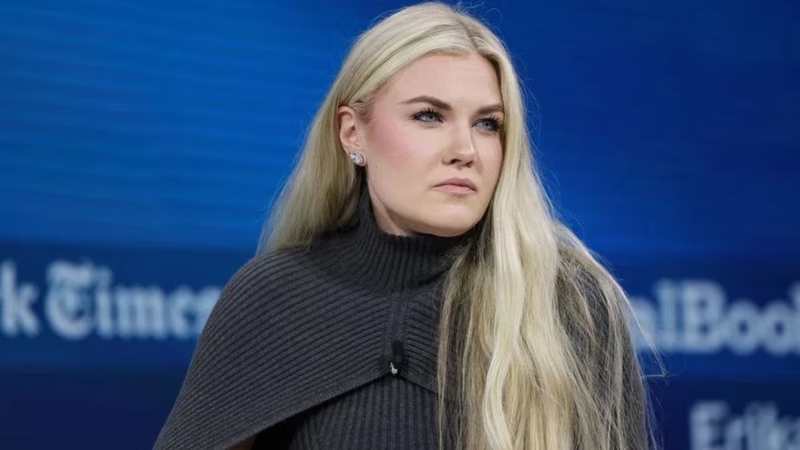
On January 10, 2025, Erika Kirk did something millions of Americans do every weekend: she went to a football game. She attended the Peach Bowl in Atlanta—a major college football playoff semifinal—and shared a few photos from the stands. But because she’s the widow of high-profile conservative figure Charlie Kirk, and because she didn’t bring her children along, her simple act of self-care became fodder for a vicious online pile-on.
Virtually overnight, social media erupted with accusations: “How can she leave her kids?” “She’s not acting like a grieving mother!” “This isn’t what Charlie would’ve wanted.” The Erika Kirk Peach Bowl backlash wasn’t just criticism—it was a public interrogation of her grief, her parenting, and her right to exist as an individual beyond her roles as wife and mother.
Table of Contents
- What Happened at the Peach Bowl?
- The Online Firestorm: Why People Are So Angry
- Grief Is Not One-Size-Fits-All: Experts Speak Out
- The Dangers of Public Shaming in the Digital Age
- Support Pours In for Erika Kirk—from Unexpected Places
- Conclusion: Let Widows Grieve on Their Own Terms
- Sources
What Happened at the Peach Bowl?
There was no scandal, no controversy—just a woman attending a sporting event. Erika Kirk, who has been private since her husband Charlie’s passing, posted a brief social media update showing her in the crowd at Mercedes-Benz Stadium. She did not mention her children, nor did she claim to be representing anyone but herself.
Yet, in the court of online opinion, that was enough. Critics immediately assumed her children were home unattended (despite no evidence), or that she was “choosing fun over family” during a time of mourning. The narrative snowballed, fueled by armchair psychologists and performative outrage .
The Online Firestorm: Why People Are So Angry
The backlash reveals deeper societal expectations placed on women—especially widows:
- The “Perfect Mourner” Myth: Society often expects grieving individuals, particularly mothers, to be visibly somber, withdrawn, and entirely child-focused.
- Loss of Autonomy: Once labeled a “widow,” many women report being treated as symbols rather than people—with their choices scrutinized through a moral lens.
- Political Projection: Given Charlie Kirk’s prominence in conservative media, some critics used Erika’s outing as a proxy to attack his legacy or ideology .
As one Twitter user wrote (in defense): “Since when did going to a football game become a crime for a widow? Let her breathe.”
Grief Is Not One-Size-Fits-All: Experts Speak Out
Mental health professionals are clear: there is no “correct” way to grieve. Dr. Megan Devine, author of It’s OK That You’re Not OK, emphasizes that “grief needs expression, not performance.” For some, solitude is healing; for others, social connection is vital.
Attending a lively event like the Peach Bowl could be therapeutic—a chance to feel normalcy, joy, or distraction, even briefly. As the American Psychological Association notes, “Returning to enjoyable activities is a healthy part of long-term adjustment after loss” . Judging someone for doing so reflects a profound misunderstanding of human resilience.
The Dangers of Public Shaming in the Digital Age
This incident is part of a troubling trend: the policing of personal behavior on social media. From parenting choices to fashion decisions, ordinary moments are weaponized for clicks and clout. The consequences can be severe—ranging from anxiety and depression to real-world harassment.
In Erika Kirk’s case, the shaming is especially cruel given her recent loss. It sends a toxic message: that widows must perform perpetual sorrow to be deemed “worthy” of sympathy. This not only harms individuals but reinforces rigid, outdated gender norms .
Support Pours In for Erika Kirk—from Unexpected Places
Thankfully, the narrative isn’t one-sided. Thousands have rallied to Erika’s defense:
“My mom went to a concert six months after my dad died. It saved her. Stop telling women how to grieve.” — @MomOfThree, X user
“If she left her kids with a trusted caregiver to get two hours of peace, she’s not failing them—she’s modeling self-care.” — Licensed therapist Dr. Lena Torres
Even people who disagree with the Kirks’ politics have condemned the harassment, recognizing that grief transcends ideology.
Conclusion: Let Widows Grieve on Their Own Terms
The Erika Kirk Peach Bowl backlash says far more about our culture’s discomfort with grief than it does about her character. Healing isn’t linear, and it certainly isn’t public. Instead of demanding that mourners conform to our expectations, we should offer grace, privacy, and the freedom to heal in whatever way brings them peace—even if that means cheering at a football game alone.
Sources
- Times of India: Erika Kirk faces online backlash for attending Peach Bowl alone
- American Psychological Association: Recovering from Loss
- Devine, M. (2017). It’s OK That You’re Not OK: Meeting Grief and Loss in a Culture That Doesn’t Understand. Sounds True.
- [INTERNAL_LINK:grief-and-parenting-after-loss]
- [INTERNAL_LINK:social-media-shaming-culture-analysis]