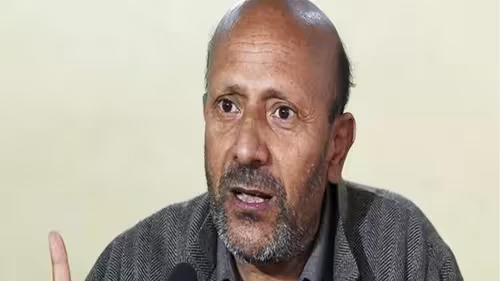
In a twist that reads like a political thriller, Sheikh Abdul Rashid—better known as Engineer Rashid—is set to take his seat in the Lok Sabha. But there’s a catch: he’ll be doing it from behind bars, escorted by armed security. A Delhi court’s recent decision to grant him interim bail has thrown a spotlight on a rarely tested intersection of criminal justice and parliamentary democracy in India.
Held in Tihar Jail since 2019 on charges under the stringent Unlawful Activities (Prevention) Act (UAPA) in a terror-funding case, Rashid stunned the nation by defeating former Chief Minister Omar Abdullah in the 2024 Baramulla Lok Sabha elections . Now, the very man who won on a wave of public sympathy and youth support is being allowed to perform his constitutional duties—but only under the watchful eyes of his jailers.
Table of Contents
- Who is Engineer Rashid?
- The Engineer Rashid Interim Bail Order Explained
- Can a Jailed MP Attend Parliament? The Legal Framework
- The Political Implications of a Custodial MP
- Conclusion: A Test for Indian Democracy
- Sources
Who is Engineer Rashid?
Once a two-time MLA from Langate in Jammu and Kashmir, Engineer Rashid has long been a polarizing figure. His arrest in 2019 by the National Investigation Agency (NIA) on allegations of funding terrorist activities marked a dramatic fall from grace . However, his imprisonment did little to quell his popularity. In fact, it may have amplified it.
During the 2024 general elections, Rashid, running as an independent candidate from his jail cell, secured a landslide victory in the Baramulla constituency. He defeated National Conference’s Omar Abdullah by a margin of over one lakh votes, a result widely seen as a mix of protest vote, sympathy, and a desire for change among the valley’s youth . This victory forced a complex legal and constitutional question: how does a convicted or accused person, deprived of personal liberty, exercise their mandate as a Member of Parliament?
The Engineer Rashid Interim Bail Order Explained
The recent court order is not a conventional release. It’s a highly specific form of relief known as “custody parole” or “interim bail for a specific purpose.” The Delhi court has permitted Rashid to attend the ongoing Budget Session of Parliament, but with strict conditions:
- He must remain in the custody of the prison authorities at all times.
- His movements will be restricted solely to the Parliament building and back to jail.
- He will be under constant armed escort, effectively making Parliament his temporary, high-security workplace.
This isn’t the first time such a request has been made. The court had previously reserved its order on similar pleas for the Winter Session , indicating the complexity of balancing an individual’s right to represent their constituents against the state’s duty to enforce the law. The current order is a limited, temporary measure that acknowledges his elected status without compromising the judicial process in his UAPA case .
Can a Jailed MP Attend Parliament? The Legal Framework
India’s Constitution doesn’t explicitly bar a jailed person from being an MP. An elected representative can even take their oath of office from prison. However, the practical ability to attend sessions is a different matter entirely. The rules are clear: if an MP is absent for 60 consecutive days without the Speaker’s permission, their seat can be declared vacant .
This creates a legal tightrope. To prevent their seat from being vacated, jailed MPs must seek court permission to attend sessions. The judiciary, in turn, has the discretion to grant such relief if it deems the MP’s presence necessary for the functioning of democracy. This principle was recently echoed in other cases, such as that of jailed MP Amritpal Singh, where the High Court recognized the unique parliamentary privileges that come with the office .
For Rashid, this means his participation is not a right he can claim unilaterally, but a privilege granted by the court on a case-by-case basis. Each session he wishes to attend will likely require a fresh legal battle.
The Political Implications of a Custodial MP
Rashid’s situation is more than a legal curiosity; it’s a potent political symbol. His party and supporters have welcomed the court’s decision as a victory for democratic representation . They argue that the people of Baramulla voted for him with full knowledge of his incarceration, and their mandate must be honored.
On the other hand, critics question the optics and practicality of an MP who cannot freely interact with his constituents, hold public meetings, or even move without state supervision. How can he effectively raise issues, participate in committee work, or be a true voice for his people?
This scenario also places Parliament in an unprecedented position. For the first time in recent memory, a member may cast votes, ask questions, and debate national policy while technically being a prisoner of the state. This duality—serving the nation while being punished by it—creates a profound tension at the heart of the world’s largest democracy.
Conclusion: A Test for Indian Democracy
The saga of Engineer Rashid’s interim bail is far from over. It’s a live, evolving test of India’s democratic and judicial systems. On one side is the foundational principle that the will of the electorate is supreme. On the other is the rule of law, which demands that no one is above it—not even an elected MP.
As Rashid takes his seat in the Lok Sabha under armed guard, he becomes a walking paradox: a symbol of both popular sovereignty and state control. His presence will be a constant reminder of the complex, often messy, reality of democracy in a diverse and challenging nation. One thing is certain: all eyes will be on how this unprecedented arrangement unfolds, setting a potential precedent for future cases of its kind.
Sources
- Times of India: Jailed J&K MP Engineer Rashid gets interim bail to attend budget session in custody
- The Hindu: Delhi court allows Engineer Rashid to attend Budget Session
- PRS Legislative Research: [INTERNAL_LINK:parliamentary-procedures-and-privileges]
- Election Commission of India: [INTERNAL_LINK:lok-sabha-election-2024-results]