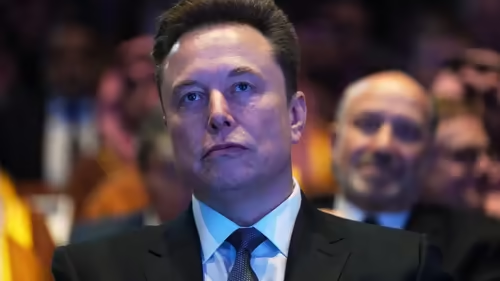
In the final, unscripted moments of Tesla’s Q4 2025 earnings call on January 28, 2026, CEO Elon Musk didn’t just report on profits and losses. He delivered a blunt, almost prophetic warning that sent ripples through the business and tech communities. His message was clear and urgent: American companies must act decisively to secure their future by investing in US battery manufacturing—or risk being left behind in a world increasingly defined by energy independence and technological sovereignty.
Table of Contents
- Musk’s Urgent Plea to American Industry
- The Geopolitical Time Bomb in Your EV
- Tesla’s Blueprint for Resilience: The Texas Lithium Refinery
- Why This Is a National Security Issue, Not Just a Business One
- Conclusion: The Race for Battery Sovereignty Has Begun
- Sources
Musk’s Urgent Plea to American Industry
Musk’s warning wasn’t a casual aside; it was a calculated, strategic message aimed at the heart of American industrial policy. He argued that the current global supply chain for critical battery materials like lithium, nickel, and cobalt is not just inefficient—it’s dangerously fragile [[2]]. Relying on a handful of foreign nations for these essential components creates a massive vulnerability for any company, and indeed any nation, that aspires to lead in the electric vehicle (EV) and clean energy revolutions.
His core argument? If American companies fail to build out their own integrated US battery manufacturing ecosystem—from mining and refining to cell production—they will be perpetually at the mercy of geopolitical whims and international trade disputes. This isn’t just about cost; it’s about control, security, and long-term competitiveness.
The Geopolitical Time Bomb in Your EV
The risks Musk highlighted are very real. A significant portion of the world’s battery-grade lithium is refined in China, while the Democratic Republic of Congo dominates cobalt production, and Russia is a major player in nickel [[10]]. This geographic concentration creates a single point of failure. Trade tensions, political instability, or even simple logistical bottlenecks in any of these regions can send shockwaves through the entire global EV market, causing price spikes and production delays.
This dependency is more than an economic concern; it’s a strategic liability. As one analysis from Nature points out, “The supply chains for battery materials such as lithium, cobalt, nickel and manganese are vulnerable to geopolitical disruptions” [[11]]. For the United States, which aims to be a leader in the green energy transition, this reliance on potentially adversarial or unstable nations is simply untenable.
The Cost of Inaction
Companies that ignore this warning do so at their peril. The potential consequences include:
- Production Halts: An unexpected embargo or export restriction could bring EV assembly lines to a standstill.
- Price Volatility: Companies with no control over their upstream supply are subject to wild price swings dictated by foreign markets.
- Loss of Innovation Edge: Without a secure and stable supply of materials, it becomes harder to invest confidently in next-generation battery R&D.
Tesla’s Blueprint for Resilience: The Texas Lithium Refinery
Musk isn’t just talking the talk; he’s walking the walk. While urging others to act, Tesla has been executing its own ambitious plan to de-risk its supply chain. The centerpiece of this strategy is its massive lithium refinery in Robstown, Texas.
This facility, representing an investment of over $1 billion on more than 1,200 acres, is a game-changer [[20]]. It’s designed to be America’s first major lithium refinery, capable of producing the battery-grade lithium hydroxide that powers Tesla’s vehicles and energy storage products [[22]]. Construction began in 2023, and the plant was already processing raw spodumene rock by 2024, with full operational status achieved in 2025 [[21], [23]].
This move gives Tesla unprecedented control over a critical part of its supply chain. By bringing lithium refining—the crucial step between mining the ore and making a battery—onto American soil, Tesla is insulating itself from the very geopolitical risks it warns others about. It’s a powerful, tangible example of what Musk means by investing in domestic infrastructure.
Why This Is a National Security Issue, Not Just a Business One
Musk’s warning transcends the boardroom. A robust, independent US battery manufacturing base is fundamental to national security. The military relies on advanced batteries for everything from communications to next-generation vehicles. The civilian power grid of the future will depend on massive battery storage to integrate renewable energy sources. Ceding control of this foundational technology to foreign powers is a strategic mistake of the highest order.
This perspective aligns with growing concerns in Washington, D.C., where policymakers are increasingly viewing the clean energy supply chain through a national security lens. Musk’s public plea can be seen as a call for a public-private partnership, urging industry to move faster while the government provides the necessary policy framework and support.
Conclusion: The Race for Battery Sovereignty Has Begun
Elon Musk’s closing remarks on Tesla’s earnings call were more than just a CEO’s opinion; they were a clarion call to action. The era of relying on a globalized, just-in-time supply chain for the most critical components of our energy future is over. The new paradigm is one of resilience, security, and domestic capability.
The path forward is clear: massive investment in a vertically integrated US battery manufacturing ecosystem. Tesla has laid down its blueprint with its Texas refinery. Now, the question is whether the rest of American industry—and the nation as a whole—will heed the warning and join the race for true battery sovereignty before it’s too late. For companies looking to navigate this shift, understanding the full scope of [INTERNAL_LINK:battery-supply-chain-strategy] is now a critical business imperative.
Sources
- [[2]] AOL. “Elon Musk ended Tesla’s earnings call with an urgent plea.” Accessed January 30, 2026.
- [[10]] AInvest. “Geopolitical and Labor Risks in the U.S. Battery Supply Chain.” September 10, 2025.
- [[11]] Nature. “Understanding supply chain constraints for the US clean energy transition.” 2025.
- [[20]] ProTexas Industry. “Tesla Launches Lithium Refinery in South Texas.” December 19, 2024.
- [[21]] Interesting Engineering. “Inside Tesla’s New Texas Lithium Refinery.” January 16, 2026.
- [[22]] Discovery Alert. “Tesla Fires Up America’s First Major Lithium Refinery.” January 19, 2026.
- [[23]] Teslarati. “Tesla says its Texas lithium refinery is now operational.” January 15, 2026.