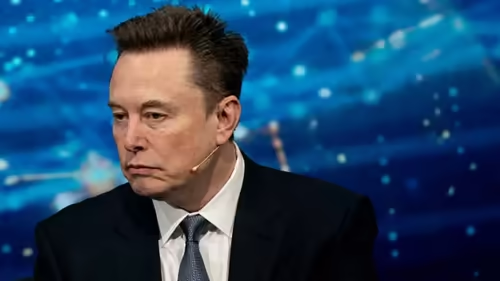
In a statement that has reignited one of America’s most polarizing debates, tech titan Elon Musk declared: “This country will die without secure elections.” The blunt warning came in response to U.S. Senator Rick Scott’s proposed Secure and Verifiable Elections (SAVE) Act, a bill that would require proof of U.S. citizenship for all federal voter registrations—a move supporters hail as essential for integrity and critics condemn as voter suppression.
Musk’s intervention is significant not just because of his global influence, but because it places him squarely in the middle of a fierce national argument over what “secure elections” really mean—and who gets to decide.
Table of Contents
- What Is the SAVE Act?
- Elon Musk’s Statement and Why It Matters
- The Great Divide: Election Integrity vs. Voter Access
- Historical Context: How Common Is Voter Fraud?
- Public and Political Reactions
- What Happens Next?
- Conclusion
- Sources
What Is the SAVE Act?
Introduced by Florida Senator Rick Scott, the SAVE Act (Secure and Verifiable Elections Act) aims to amend the National Voter Registration Act of 1993—commonly known as the “Motor Voter Law.” Under the proposed legislation, individuals registering to vote in federal elections would be required to provide documented proof of U.S. citizenship, such as a birth certificate, passport, or naturalization papers.
Currently, voters only need to attest to their citizenship under penalty of perjury when registering. The SAVE Act would replace that self-declaration with a documentary requirement, effectively raising the bar for voter eligibility.
Proponents argue this closes a loophole that could allow non-citizens to register—intentionally or accidentally. Opponents counter that it creates unnecessary barriers for eligible voters, particularly among marginalized communities who may lack easy access to official documents.
Elon Musk’s Statement and Why It Matters
Musk’s comment—“This country will die without secure elections”—was posted on X (formerly Twitter) in direct reply to a thread about the SAVE Act. While brief, the statement carries outsized weight given Musk’s platform, which reaches over 200 million followers, and his growing role as a political influencer.
His stance aligns with a broader conservative narrative that questions the legitimacy of recent U.S. elections, though Musk has not endorsed baseless claims of widespread fraud. Instead, he frames the issue as a matter of systemic trust: if citizens doubt whether elections are fair, democratic stability erodes.
This perspective taps into a real anxiety. According to a 2025 Pew Research Center survey, only 42% of Americans say they are “very confident” that elections reflect the will of the people . Musk’s warning amplifies that concern—but also risks oversimplifying a deeply nuanced policy debate.
The Great Divide: Election Integrity vs. Voter Access
At the heart of the controversy lies a fundamental tension:
- Election Integrity Advocates argue that requiring proof of citizenship prevents even rare cases of non-citizen voting, thereby preserving public trust.
- Voting Rights Groups contend that such laws disproportionately affect elderly, low-income, rural, and minority voters—who are less likely to possess readily available citizenship documents.
States like Kansas and Arizona have previously implemented similar citizenship-document requirements. In both cases, courts found the laws led to the removal of thousands of eligible voters from rolls due to administrative hurdles—not fraud .
The Brennan Center for Justice estimates that up to 13 million voting-age U.S. citizens lack easy access to citizenship documentation—despite being fully eligible to vote . This raises serious questions about whether the SAVE Act solves a real problem or creates new ones.
Historical Context: How Common Is Voter Fraud?
Despite frequent claims, evidence of widespread non-citizen voting remains elusive. A comprehensive study by the Government Accountability Office (GAO) in 2024 reviewed voter rolls across 10 states and found fewer than 50 credible cases of non-citizen registration out of over 20 million records examined .
Likewise, a decade-long analysis by Loyola Law School tracked every reported case of voter fraud in the U.S. and concluded that the incidence rate is between 0.0003% and 0.0025%—statistically negligible .
Yet perception often outweighs data. For many voters, the possibility of fraud—even if rare—is enough to justify stricter rules. This psychological gap is what legislation like the SAVE Act seeks to address, regardless of empirical risk.
Public and Political Reactions
Senator Rick Scott hailed Musk’s support as validation of the bill’s necessity, tweeting: “When innovators like Elon see the threat, it’s time Washington listens.”
Conversely, Democratic leaders and civil rights organizations pushed back hard. Stacey Abrams’ Fair Fight Action called the SAVE Act “a solution in search of a problem” and warned it could disenfranchise “hundreds of thousands of legal voters.”
Even some moderate Republicans expressed caution, noting that while election security is vital, any reform must balance integrity with accessibility—a principle enshrined in the Voting Rights Act of 1965.
What Happens Next?
The SAVE Act is currently in committee and faces an uphill battle in the evenly divided Senate. However, its introduction—and Musk’s endorsement—has already shifted the Overton window on election reform.
Expect more states to propose similar measures ahead of the 2026 midterms. Meanwhile, advocacy groups on both sides are mobilizing: voter ID proponents are pushing for federal standardization, while coalitions like the NAACP and ACLU are preparing legal challenges.
For deeper insights into how tech leaders influence policy, see our analysis on [INTERNAL_LINK:tech-ceos-in-politics].
Conclusion
Elon Musk’s warning about the need for secure elections has thrown fuel on an already blazing national debate. While his call for integrity resonates with millions, the real challenge lies in crafting policies that protect democracy without excluding its participants. The SAVE Act may not pass—but the conversation it sparked will shape America’s electoral future for years to come.
Sources
- Times of India: ‘This country will die without secure elections’: Elon Musk on America’s future
- Pew Research Center: Public Confidence in U.S. Elections, January 2025
- Brennan Center for Justice: The Impact of Citizenship Documentation Laws
- U.S. Government Accountability Office (GAO): Noncitizen Voter Registration: Evidence from State Reviews (2024)
- Loyola Law School: The Myth of Voter Fraud: A Decade of Data