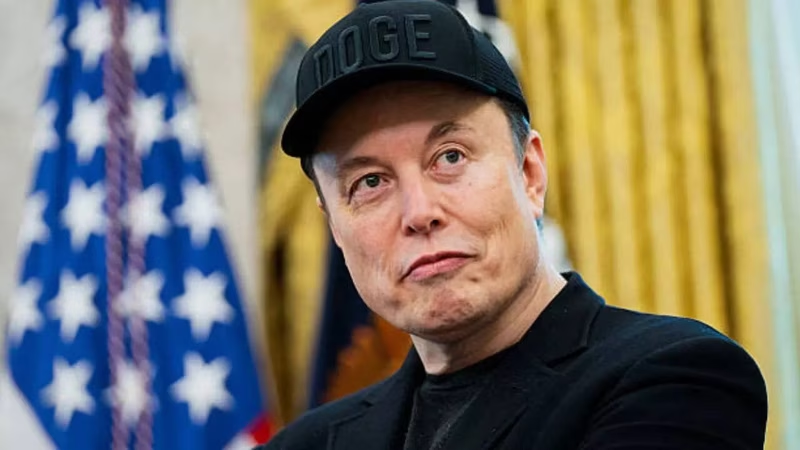
Elon Musk’s Bombshell Claim: Your 401(k) Might Be a Relic of the Past
For decades, the golden rule of personal finance has been simple: start saving for retirement early. But what if that entire premise is about to be upended? In a recent public remark, tech billionaire and futurist Elon Musk dropped a bombshell prediction: “Saving for retirement will lose its importance… it will be irrelevant in 20 years” . This isn’t just a casual observation; it’s a direct challenge to one of the most fundamental pillars of modern financial planning. Coming from the man behind Tesla, SpaceX, and xAI, this statement demands serious attention—and scrutiny.
Table of Contents
- What Elon Musk Actually Said
- The Logic Behind the Claim: AI and Abundance
- Why Financial Experts Strongly Disagree
- Historical Context: When Futurists Get It Wrong
- What You Should *Actually* Do With Your Retirement Plan
- Conclusion: Hope for the Future, Plan for Reality
- Sources
What Elon Musk Actually Said
Musk’s comments, as reported, stem from his belief in the accelerating pace of artificial intelligence and automation. He envisions a future so profoundly transformed by AI that the very concept of “work” as we know it will cease to exist for most people. In such a world, where machines handle all production and services, the need to save money over a 40-year career to fund a post-work life would simply vanish .
His underlying assumption is that this technological leap will create such immense abundance that basic human needs—food, shelter, energy—will be virtually free or extremely cheap. This vision often aligns with concepts like a Universal Basic Income (UBI), where citizens receive a regular stipend from the state or a collective resource, funded by the output of these AI systems. In this utopian (or dystopian, depending on your view) scenario, your retirement account balance becomes meaningless.
The Logic Behind the Claim: AI and Abundance
Musk’s prediction isn’t pulled from thin air. It’s rooted in a legitimate, albeit highly optimistic, interpretation of current technological trends:
- Exponential AI Growth: AI models are becoming more capable at an unprecedented rate, automating tasks once thought to be exclusively human.
- Automation of Labor: From manufacturing to white-collar jobs, automation is already displacing workers. Musk believes this trend will reach a tipping point.
- Energy Revolution: Through ventures like Tesla’s solar and battery tech, Musk is betting on a future of near-limitless, clean, and cheap energy, which is the foundation for any post-scarcity economy.
In this framework, the traditional economic cycle of “work → earn → save → retire” collapses because the first step is no longer necessary for survival.
Why Financial Experts Strongly Disagree
While Musk’s vision is compelling, the financial planning community is almost universally skeptical. Here’s why:
- The Timeline is Wildly Optimistic: Predicting a complete societal overhaul in just 20 years ignores the immense political, social, and economic inertia that slows down change. The transition will be messy and gradual, not a clean flip of a switch.
- Wealth Inequality Could Worsen: If AI creates massive wealth, who owns the AI? Without strong regulatory frameworks, this could lead to extreme concentration of wealth, making retirement savings *more* critical for the average person, not less.
- Human Desire for Purpose: Retirement isn’t just about finances; it’s about a life stage. Even in a world of abundance, people will seek purpose, contribution, and structure, which may still involve some form of work or engagement.
As the U.S. Social Security Administration notes, retirement security remains a top concern for millions, and current systems are already under strain .
Historical Context: When Futurists Get It Wrong
History is littered with overly optimistic predictions about a leisure-filled future. In the 1960s, experts predicted we’d all be working 20-hour weeks by the year 2000. Instead, many are working longer hours than ever. Technology often creates new forms of work and consumption rather than eliminating the need for it entirely.
Musk himself has a track record of announcing ambitious timelines (like fully autonomous Tesla vehicles “next year”) that consistently slip. While his vision may be directionally correct, the specific 20-year horizon for retirement becoming “irrelevant” feels more like provocative rhetoric than a concrete forecast. For a deeper look at how technology reshapes economies, see our analysis on [INTERNAL_LINK:automation-and-the-future-of-jobs].
What You Should *Actually* Do With Your Retirement Plan
Should you stop contributing to your 401(k) or IRA based on Musk’s comment? Absolutely not. Here’s a balanced approach:
- Keep Saving: The future is uncertain. Your best defense against any economic scenario is having your own financial cushion.
- Stay Informed: Follow developments in AI and automation, but filter them through a lens of practicality, not hype.
- Diversify Your Skills: Instead of banking on a static retirement, focus on lifelong learning to stay adaptable in a changing job market.
Your retirement plan is your personal safety net, not a bet on a specific technological future.
Conclusion: Hope for the Future, Plan for Reality
Elon Musk’s claim about Elon Musk retirement savings being irrelevant is a fascinating thought experiment that highlights the potential long-term impact of AI. However, it’s a dangerous oversimplification to treat it as actionable financial advice. The path to a post-scarcity society is fraught with challenges, and the next two decades will likely be a period of intense transition, not a sudden arrival at utopia. Until that future is a guaranteed reality—not just a billionaire’s dream—your best strategy remains the same: save diligently, invest wisely, and prepare for a range of possibilities.
Sources
- Times of India: ‘Saving for retirement will lose its importance’: Elon Musk’s big claim; what he said
- Social Security Administration (SSA): Official Website – Retirement Information