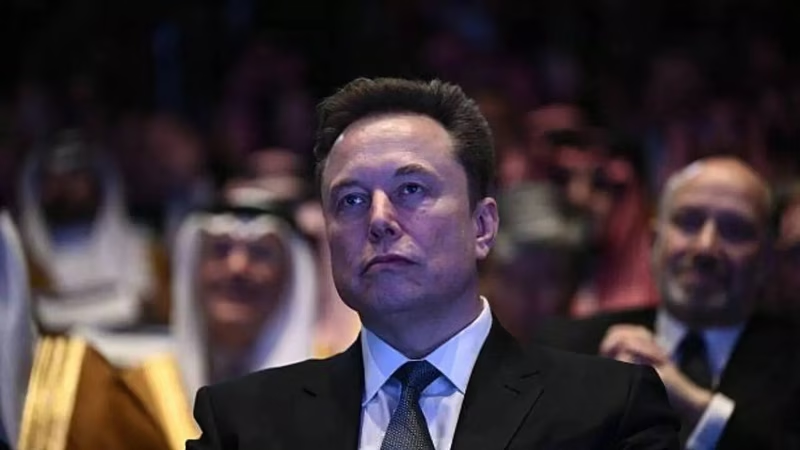
Elon Musk Praises China’s EV & Solar Boom—And Admits He’s Impressed
It’s not every day that Elon Musk—the man who’s disrupted electric cars, space travel, and social media—publicly tips his hat to another nation. But in a recent statement that caught global attention, the Tesla and SpaceX CEO said he’s genuinely impressed with China .
More specifically, Musk highlighted how quickly China has adopted large-scale battery storage, electric vehicle (EV) production, and solar energy infrastructure—technologies he himself has championed for over a decade. His remark wasn’t just flattery; it was an acknowledgment that China is now leading the charge in the very energy transition Musk once dreamed of spearheading from Silicon Valley.
Table of Contents
- What Elon Musk Actually Said About China
- China’s Explosive Growth in EVs and Solar Power
- Why Batteries Are the Key to the Future—According to Musk
- Tesla’s Megapack and the New Megablock: Powering the AI Age
- The Global Energy Race: Who’s Really Winning?
- Conclusion: A Compliment That Says More Than It Seems
What Elon Musk Actually Said About China
During a recent tech forum, Musk quipped with a mix of humor and respect: “It seems like China just does everything faster… They’re building more EVs, more solar, and more batteries than anyone else” . He added that China appears to be acting on the exact energy roadmap he’s been promoting—almost as if they’re reading from his playbook.
This is significant coming from Musk, who rarely lauds geopolitical competitors. His comments came amid rising U.S.-China tensions over tech, trade, and supply chains. Yet, instead of criticism, he offered a backhanded compliment: “Maybe I should give them my notes.”
China’s Explosive Growth in EVs and Solar Power
Musk’s praise isn’t unfounded. China dominates the global clean energy landscape:
- EV Production: China produces over 60% of the world’s electric vehicles, with BYD alone outselling Tesla in Q2 2025 .
- Solar Manufacturing: The country controls roughly 80% of global solar panel supply chains, from polysilicon to finished modules .
- Battery Capacity: Chinese firms like CATL and BYD are the world’s top lithium-ion battery producers, supplying not just domestic automakers but also Tesla, BMW, and Volkswagen .
This vertical integration—raw materials, manufacturing, and deployment—gives China a strategic edge that even Silicon Valley giants struggle to match.
Why Batteries Are the Key to the Future—According to Musk
For Musk, the future isn’t just about generating clean energy—it’s about storing it. “You can’t run civilization on intermittent sources like solar and wind without massive battery systems,” he’s often said .
He argues that the real bottleneck in the energy transition isn’t solar panels or wind turbines—it’s the lack of grid-scale storage. And as AI data centers multiply, energy demand is skyrocketing. Without batteries, renewable energy can’t meet baseline or peak loads reliably.
That’s where Elon Musk China comments take on deeper meaning: China isn’t just building EVs—it’s building the entire energy ecosystem needed to sustain them.
Tesla’s Megapack and the New Megablock: Powering the AI Age
To meet this growing need, Tesla has scaled up its utility-scale battery offerings. The Megapack—a 3.9 MWh containerized battery—has become a cornerstone of grid stability projects worldwide, from California to Australia .
Now, Tesla is rolling out an even more powerful solution: the Megablock. Essentially a cluster of Megapacks, it can deliver hundreds of megawatt-hours of storage, designed specifically for AI data centers and industrial-scale renewable integration .
Musk believes these systems will be essential to prevent blackouts as AI-driven computing demand surges. “AI is incredibly power-hungry,” he warned. “Without stationary storage, the grid will buckle.”
The Global Energy Race: Who’s Really Winning?
While the U.S. and EU scramble to onshore battery production through the Inflation Reduction Act and the Net-Zero Industry Act, China is already miles ahead in deployment speed and scale.
However, this doesn’t mean Western innovation is obsolete. Tesla’s software-driven energy management (via Autobidder) and advanced battery chemistry still lead in efficiency and grid responsiveness . But manufacturing scale? That’s China’s domain.
The irony? Musk’s Gigafactories in Shanghai and Nevada are proof of a hybrid model: Western tech, Chinese execution. [INTERNAL_LINK:tesla-gigafactory-strategy] explores how this balance is reshaping global manufacturing.
Conclusion: A Compliment That Says More Than It Seems
When Elon Musk says he’s impressed with China, it’s more than polite diplomacy—it’s a strategic observation about who’s winning the clean energy race. China’s rapid adoption of EVs, solar, and—crucially—grid-scale batteries validates Musk’s long-held vision.
But it also serves as a wake-up call: innovation alone isn’t enough. Speed of deployment, supply chain control, and policy alignment matter just as much. As the world races to power the AI era sustainably, the lessons from China—and Musk’s candid praise—may shape the next decade of energy policy everywhere.