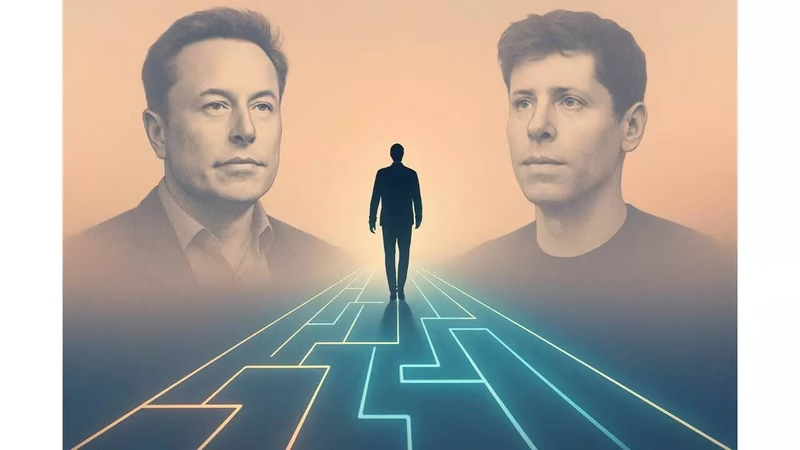
A viral clip from an old interview has thrust the complicated history of Elon Musk OpenAI back into the spotlight. In it, Musk looks directly at then-OpenAI CEO Sam Altman and delivers a pointed reminder: “Remember, because of me, OpenAI exists.” This isn’t just a boast—it’s a loaded statement packed with years of tension over AI’s direction, ethics, and control . As artificial intelligence reshapes our world, Musk’s message is a stark warning about how far the organization he helped birth has strayed from its founding ideals.
Table of Contents
- The Birth of OpenAI: A Reaction to Google
- Elon Musk OpenAI: The Original Vision
- The Pivot That Changed Everything
- Musk vs. Altman: The Core of the Conflict
- Who Controls OpenAI Now?
- Why This Debate Matters for the Future of AI
- Conclusion: A Founder Disowned by His Creation?
- Sources
The Birth of OpenAI: A Reaction to Google
The story begins not in a lab, but in a conversation between tech titans. Around 2015, Elon Musk grew deeply concerned after discussions with Google co-founder Larry Page. Musk feared that Google’s approach to artificial intelligence was dangerously profit-driven and lacked sufficient safeguards for existential risk . He believed AI development should be transparent, open-source, and guided by humanity’s best interests—not shareholder value. Unable to sway Page, Musk decided to create a counterforce. Thus, OpenAI was born in December 2015 as a non-profit research lab dedicated to ensuring “safe and beneficial” AI for all .
Elon Musk OpenAI: The Original Vision
Musk wasn’t just a name on the letterhead; he was a co-founder and major early funder, reportedly donating over $50 million . His vision was crystal clear: build a powerful AI alternative that would remain open, accessible, and accountable. The goal was to prevent a single corporation—like Google—from monopolizing superintelligence. This philosophy was embedded in OpenAI’s original charter, which emphasized collaboration over competition and public good over private gain. For Musk, this was a mission-critical project for the survival of civilization itself.
Key Pillars of OpenAI’s Original Mission
- Non-Profit Structure: To avoid commercial pressures that could compromise safety.
- Open-Source Research: Sharing findings to accelerate global progress and scrutiny.
- AI Safety First: Prioritizing alignment and control mechanisms before scaling capabilities.
The Pivot That Changed Everything
Everything shifted in 2019. Citing the immense costs of cutting-edge AI research, OpenAI announced a dramatic restructuring. It created a for-profit subsidiary, OpenAI LP, and began seeking massive external investment . Microsoft stepped in with a $1 billion deal, followed by multi-billion dollar commitments in subsequent years. While this funding supercharged OpenAI’s development—leading to breakthroughs like GPT-3 and ChatGPT—it also marked a fundamental departure from its roots. The open-source ethos faded, replaced by proprietary models and tight corporate control.
Musk vs. Altman: The Core of the Conflict
Musk’s recent viral message is the culmination of years of growing frustration. He sees OpenAI’s transformation as a betrayal. In his view, the organization he helped create to be a watchdog has become the very thing it was meant to guard against: a powerful, closed-source AI entity tightly coupled with a tech giant (Microsoft). His criticism isn’t just philosophical; it’s practical. He questions who is truly in the driver’s seat—Altman, the OpenAI board, or Microsoft’s leadership . This power dynamic is central to his concern that safety is being sacrificed for speed and market dominance.
Who Controls OpenAI Now?
The governance structure of OpenAI is notoriously complex. While it retains a non-profit parent (OpenAI Inc.) that is supposed to oversee the for-profit arm, the reality is murkier. Microsoft, as the primary investor and cloud partner, wields enormous influence. This has led to widespread speculation about the true independence of OpenAI’s decision-making, especially regarding the release of powerful new models. Musk’s warning highlights a critical transparency gap: without clear accountability, who ensures that AI development remains aligned with human values? For deeper insights into AI governance models, the Partnership on AI, a multi-stakeholder organization, offers valuable frameworks .
Why This Debate Matters for the Future of AI
This isn’t just a feud between billionaires. The Elon Musk OpenAI saga is a microcosm of a much larger battle for the soul of artificial intelligence. Will AI be a public utility, developed openly for the benefit of all? Or will it be a proprietary asset, controlled by a handful of corporations whose primary duty is to their shareholders? The answer will shape everything from job markets and privacy to democracy and global security. Musk’s insistence on remembering OpenAI’s origins is a call to re-center the conversation on ethics and long-term safety—a call that becomes more urgent with every new AI breakthrough.
Conclusion: A Founder Disowned by His Creation?
Elon Musk’s viral reminder serves as both a historical footnote and a prophetic warning. He may no longer have any formal ties to OpenAI, but his foundational role is undeniable. His message to Sam Altman is clear: don’t forget why you started. As OpenAI races toward artificial general intelligence (AGI), the world is watching to see if it can reconcile its commercial success with its original promise of safe, open, and beneficial AI for humanity. The stakes couldn’t be higher.
Sources
- Times of India: Elon Musk’s message to OpenAI CEO Sam Altman
- OpenAI’s official blog posts on its founding and restructuring [[12], [18]]
- Financial Times and The New York Times reporting on Musk’s early involvement and funding
- Partnership on AI: Governance and Best Practices in AI