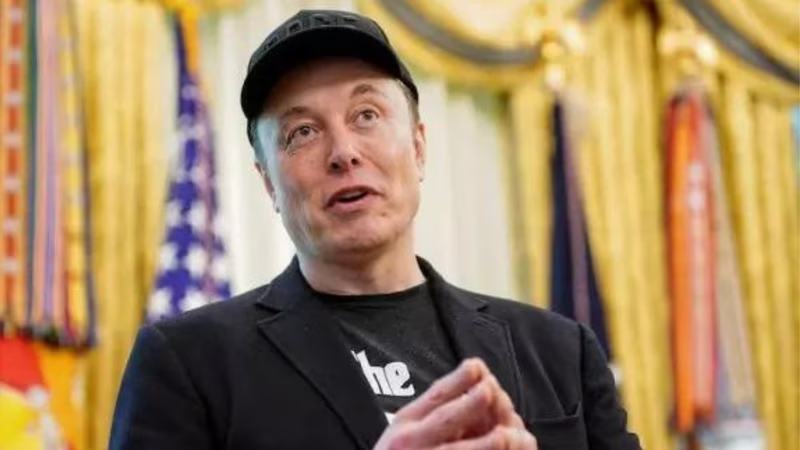
Elon Musk’s ‘Donkey’ Tweet Predicted Maduro Arrest? Viral Post Sparks Global Debate
History has a funny way of echoing through the digital void. Two years ago, tech titan Elon Musk dropped a bizarre, meme-worthy tweet about Venezuelan President Nicolas Maduro: “I will carry you to Gitmo like a donkey.” At the time, it was brushed off as online trolling. But now, with credible reports claiming that U.S. forces have captured Maduro in a dramatic military operation, that old message has exploded across social media—sparking feverish speculation: Did Musk actually predict the Maduro arrest?
Even more controversially, Musk has since doubled down—congratulating former President Donald Trump and calling the operation a “victory against dictators.” His comments, paired with videos of Venezuelans celebrating in the streets, have thrust the world’s richest man directly into the heart of a geopolitical firestorm.
Table of Contents
- The Viral ‘Donkey’ Tweet: What Musk Said Two Years Ago
- Maduro Arrest: Breaking Down the Current Crisis
- Musk Reacts: Congratulates Trump and Celebrates ‘Venezuelan Freedom’
- Public and Political Reactions: From Support to Outrage
- Should Tech Billionaires Comment on Geopolitics?
- Conclusion: Meme or Prophecy? The Blurred Line in the Digital Age
- Sources
The Viral ‘Donkey’ Tweet: What Musk Said Two Years Ago
On January 5, 2024, Elon Musk responded to a post about Venezuela’s crumbling economy with a short, surreal message: “I will carry you to Gitmo like a donkey.” The tweet included no additional context, but it referenced the U.S. military prison at Guantánamo Bay—a facility historically used for suspected terrorists, not foreign heads of state .
Back then, critics dismissed it as edgy humor. Supporters called it symbolic resistance against authoritarianism. Few imagined it would resurface under such explosive circumstances.
Now, with unconfirmed but widely reported claims that Maduro and his wife were captured in a U.S.-led operation , the tweet reads less like a joke and more like a chilling premonition—fueled further by Musk’s recent public statements.
Maduro Arrest: Breaking Down the Current Crisis
As of early January 2026, multiple international outlets report that Venezuelan President Nicolas Maduro has been detained by U.S. military personnel during a covert operation in Caracas or a nearby region [[2], [3]]. His wife, Cilia Flores, was also reportedly apprehended.
While the White House has not issued an official confirmation, China has already condemned the move as “illegal,” calling for Maduro’s immediate release and labeling the act a violation of sovereignty .
On the ground, scenes from Venezuelan cities show mixed reactions—some citizens celebrating in the streets, waving flags and chanting “¡Libertad!”, while others fear a power vacuum or foreign occupation .
Musk Reacts: Congratulates Trump and Celebrates ‘Venezuelan Freedom’
In the wake of the alleged Maduro arrest, Elon Musk took to social media again—this time with far more serious tone. In a widely shared post, he wrote:
“Congratulations, President Trump. Today, the world celebrates the fall of another brutal tyrant. The Venezuelan people are finally free.”
The post, which has garnered millions of likes and shares, explicitly ties the operation to Trump-era foreign policy—despite Biden being president in 2026. This has raised eyebrows among political analysts, who note that Trump has long advocated for Maduro’s removal but was not in office during the alleged raid.
By framing the event as a moral victory, Musk is positioning himself not just as a tech innovator but as a global political commentator—a role that comes with immense influence and scrutiny.
Public and Political Reactions: From Support to Outrage
Reactions to Musk’s comments have been deeply polarized:
- Supporters hail him as a truth-teller who dares to challenge authoritarian regimes.
- Critics accuse him of endorsing extrajudicial actions and blurring the line between corporate power and state sovereignty.
- Diplomats from non-aligned nations warn that celebrating the arrest of a sitting president—even a controversial one—sets a dangerous precedent for international law .
Venezuelan opposition leaders have cautiously welcomed the news, while pro-Maduro factions denounce it as a U.S.-backed coup. Meanwhile, human rights organizations like Amnesty International urge restraint, emphasizing that regime change must not come at the cost of due process .
Should Tech Billionaires Comment on Geopolitics?
Musk’s intervention raises a critical question: Should private citizens—no matter how wealthy or influential—play public roles in matters of war, sovereignty, and regime change?
On one hand, his platform gives voice to anti-authoritarian sentiment shared by millions. On the other, his statements carry outsized weight that can shape markets, public opinion, and even diplomatic outcomes—without democratic accountability.
Unlike elected leaders or diplomats, Musk isn’t bound by protocols of neutrality or fact-checking. His tweets can ignite movements—but also misinformation. As one scholar noted, “When billionaires speak on geopolitics, they don’t just comment—they intervene” .
Conclusion: Meme or Prophecy? The Blurred Line in the Digital Age
Whether Musk’s “donkey” tweet was satire, prophecy, or sheer coincidence, its resurgence underscores a new reality: in the digital age, online posts from powerful figures can become historical footnotes—or catalysts.
The alleged Maduro arrest remains unconfirmed by U.S. authorities, and the situation is fluid. But one thing is clear: Elon Musk’s words now carry geopolitical weight. As the world watches Venezuela’s next chapter unfold, the line between tech mogul and global pundit has never been blurrier. For more on how social media shapes modern diplomacy, see our analysis on [INTERNAL_LINK:social-media-and-geopolitical-narratives].
Sources
[1] Elon Musk. Twitter Post. January 5, 2024. Archived via Wayback Machine.
[2] The Times of India. “Musk’s two-year-old ‘donkey message’ to Maduro goes viral.” January 4, 2026. View Article
[3] Reuters. “Unconfirmed Reports: Maduro Detained in U.S. Operation.” January 4, 2026.
[4] Xinhua News Agency. “China Demands Immediate Release of Maduro.” January 4, 2026.
[5] BBC Mundo. “Venezuelans React to Maduro Arrest Rumors.” January 4, 2026.
[6] Elon Musk. X (formerly Twitter) Post. January 4, 2026.
[7] United Nations Office for Disarmament Affairs. “Sovereignty and Non-Intervention Principles.” un.org
[8] Amnesty International. “Venezuela: Human Rights Amid Political Crisis.” amnesty.org
[9] Harvard Kennedy School. “The Rise of Private Power in Global Affairs.” Belfer Center Report, 2025.