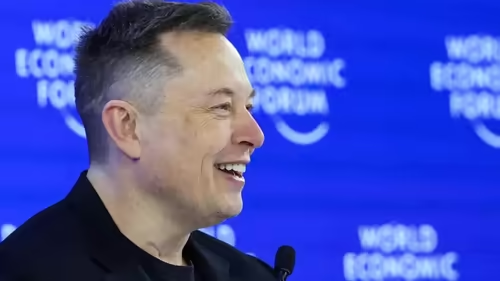
The hallowed halls of the World Economic Forum in Davos were the stage for a moment of high-stakes, high-wattage political theater this week. In a surprise appearance, tech titan Elon Musk didn’t just talk about AI or Mars; he delivered a cutting, one-liner that instantly went viral: a mocking reference to President Donald Trump’s newly minted “Board of Peace” as a “piece of Greenland.” The awkward silence that followed spoke volumes, but what was the real story behind this now-infamous jab?
Table of Contents
- The Davos Showdown: Musk vs. Trump’s Board of Peace
- What is Trump’s Board of Peace?
- Decoding the Greenland Joke: A History of Tension
- The Strange Bedfellows of Tech and Politics
- Conclusion: More Than Just a Bad Pun
- Sources
The Davos Showdown: Musk vs. Trump’s Board of Peace
On January 22, 2026, President Donald Trump held a signing ceremony in Davos to formally ratify the charter for his new international body, the Board of Peace . The initiative, which carries a $1 billion price tag, is positioned as a key element in his administration’s plan to resolve international conflicts, with an initial focus on Gaza [[7], [8]]. Just hours later, during his own WEF session, Elon Musk appeared to take direct aim at the announcement .
According to multiple reports, Musk quipped, “I heard about the formation of the Peace Summit and I thought, ‘Peace or piece?’… a piece of Greenland?” . The audience reportedly met the comment with a “deathly silence,” a clear sign the joke had fallen spectacularly flat . This wasn’t just a random dig; it was a calculated reference to a long-standing point of friction between the two powerful figures.
What is Trump’s Board of Peace?
To understand the weight of Musk’s mockery, one must first grasp the stated purpose of the Board of Peace. Officially, it is an international body chaired by President Trump himself, designed to “promote stability, restore dependable and transparent governance, and foster economic opportunity in conflict zones” . Its charter outlines a 20-point plan, with strategic oversight and resource mobilization as its core functions .
The launch in Davos was a major diplomatic event for the Trump administration, signaling a renewed push for U.S.-led global conflict resolution. By mocking its very name, Musk wasn’t just making a pun; he was questioning its fundamental legitimacy and sincerity, suggesting it was more about acquiring geopolitical “pieces” (like territory or influence) than achieving genuine peace.
Decoding the Greenland Joke: A History of Tension
The “Greenland” reference is not a new punchline. It dates back to 2019 when then-President Trump publicly expressed interest in the U.S. purchasing the autonomous Danish territory, a suggestion that was swiftly and firmly rebuffed by Denmark’s prime minister . The incident became a global symbol of Trump’s unconventional and often transactional approach to foreign policy.
Musk’s joke cleverly ties this historical gaffe to the present. By conflating “peace” with “piece,” he implies that Trump’s grand initiatives are ultimately driven by a desire for acquisition and control, not diplomacy. The awkwardness of the moment was amplified by recent reports that Trump has again confused Iceland with Greenland in speeches, referring to the latter as a “big piece of ice” . Musk’s comment felt less like a fresh joke and more like a pointed reminder of past controversies.
The Strange Bedfellows of Tech and Politics
The dynamic between Musk and Trump is complex and ever-shifting. Despite this public mockery, reports suggest Musk has indicated he may provide significant financial backing to Republican candidates ahead of the 2026 midterms . This highlights the often paradoxical relationship between Silicon Valley and Washington, where personal jabs coexist with strategic political alignment.
This incident raises important questions for observers:
- Is Musk positioning himself as a kingmaker? His ability to command a global stage like Davos gives his political commentary immense weight.
- What does this mean for U.S. foreign policy? The public skepticism from a figure as influential as Musk could undermine the perceived credibility of initiatives like the Board of Peace.
- Is this performance or principle? For more on the intersection of celebrity and statecraft, see our analysis on [INTERNAL_LINK:tech-billionaires-in-politics].
For a deeper look into the official stance of the U.S. government on international bodies, you can refer to the U.S. Department of State’s website on international organizations.
Conclusion: More Than Just a Bad Pun
Elon Musk’s “piece of Greenland” comment at Davos was far more than a failed attempt at humor. It was a loaded, multi-layered critique that tapped into a well of public skepticism about grand political announcements. By targeting the name of Trump’s Board of Peace, Musk challenged its very premise, suggesting that in the current geopolitical climate, the line between peace and a strategic “piece” of the world map is dangerously thin. Whether this moment will have any lasting impact on policy remains to be seen, but it has certainly cemented the ongoing, unpredictable saga of tech power clashing with political authority on the world’s biggest stages.
Sources
- Al Jazeera and News Agencies. “Trump launches Board of Peace at signing ceremony in Davos.” January 22, 2026.
- Times of India. “Elon Musk ‘mocks’ Donald Trump’s Board of Peace at Davos.” Accessed January 24, 2026.
- Various news outlets on Musk’s Davos remarks. [[3], [4], [6], [15], [17], [19]]
- Reports on the Board of Peace’s structure and purpose. [[7], [8], [9], [10], [11], [13]]
- Historical context on Trump’s Greenland comments. [[14], [16], [18], [20]]
- U.S. Department of State. “International Organizations.” https://www.state.gov/international-organizations/