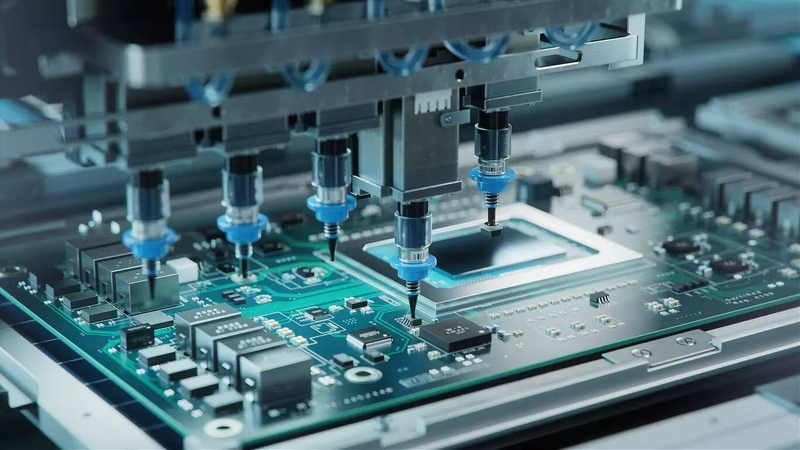
Electronics Manufacturing India Just Got a Game-Changing Infusion
Move over, assembly lines—India is now building the bones of the digital age. In a decisive leap toward tech sovereignty, the Indian government has given the green light to 22 new electronics component manufacturing projects, unlocking a staggering ₹42,000 crore in investments .
This isn’t about slapping “Made in India” labels on imported phones. This is about forging the actual guts of our devices—semiconductors, printed circuit boards (PCBs), displays, and advanced sensors—right here on Indian soil. With global tech titans like Samsung, Foxconn, and homegrown powerhouse Tata Electronics leading the charge, India is signaling a bold ambition: to become the world’s next electronics manufacturing superpower—and finally break free from decades of import addiction.
Table of Contents
- Electronics Manufacturing India: The ₹42,000 Crore Breakdown
- Key Players: Samsung, Foxconn, and Tata Take Center Stage
- Why Components Matter: The Heart of Tech Sovereignty
- The PLI Scheme: Engine Behind India’s Manufacturing Boom
- Economic Impact: Jobs, Export, and Import Reduction
- Challenges Ahead: Skilled Labor, Infrastructure, and Global Competition
- Conclusion: From Assembly to Innovation—India’s Tech Coming of Age
- Sources
Electronics Manufacturing India: The ₹42,000 Crore Breakdown
The approved projects span high-value, capital-intensive segments critical to India’s digital future:
- Semiconductor packaging and testing units – Essential for final chip integration.
- Advanced PCB and flexible circuit manufacturing – The backbone of every smartphone and laptop.
- Display module assembly – Reducing reliance on Korean and Chinese screen imports.
- Electronic component fabrication – Including capacitors, resistors, and connectors.
Collectively, these projects are expected to create over 100,000 direct and indirect jobs and slash India’s electronics import bill—which currently exceeds $60 billion annually—by up to 30% within five years .
Key Players: Samsung, Foxconn, and Tata Take Center Stage
While the government didn’t disclose full beneficiary lists, industry sources confirm major commitments:
- Samsung India: Expanding its Noida facility to include PCB and camera module production, aiming to supply not just its Indian operations but global markets.
- Foxconn (Hon Hai): Building a dedicated component park in Tamil Nadu focused on semiconductor packaging and smartphone sub-assemblies.
- Tata Electronics: Leveraging its Dholera (Gujarat) and Hosur (Tamil Nadu) units to produce advanced sensors and display drivers under its strategic partnership with major global OEMs.
These aren’t speculative ventures—they’re part of India’s restructured Production Linked Incentive (PLI) Scheme for Electronics Components and Semiconductors, which offers up to 50% capex support for brownfield and greenfield investments .
Why Components Matter: The Heart of Tech Sovereignty
For years, India celebrated assembling iPhones and TVs. But true manufacturing power lies in components. Consider this: an iPhone assembled in India still imports over 80% of its value in parts from China, Vietnam, and Malaysia.
By localizing component production, India can:
- Achieve genuine “Atmanirbhar Bharat” in tech.
- Become an export hub for intermediate goods, not just finished products.
- Secure supply chains against geopolitical shocks (like US-China trade wars).
- Attract R&D centers that follow manufacturing ecosystems.
The PLI Scheme: Engine Behind India’s Manufacturing Boom
Launched in 2020, the PLI scheme has evolved into India’s most successful industrial policy tool. The electronics vertical alone has attracted over ₹1.5 lakh crore in total investment commitments across mobile, IT hardware, and now components.
What makes the latest component-focused tranche different? It targets the upstream value chain—the “invisible” but high-margin segments that were previously deemed too complex or capital-heavy for India. By de-risking these investments through fiscal support and fast-tracked clearances, the government is changing the game .
Economic Impact: Jobs, Export, and Import Reduction
The ripple effects will be massive:
- Employment: 60,000+ high-skilled engineering jobs in Tier-2 cities like Dholera, Sri City, and Hosur.
- Exports: Component exports could cross $15 billion by 2030, up from just $2 billion today.
- Import Substitution: Saving an estimated ₹2.5 lakh crore in foreign exchange over the next decade.
For more on how PLI is transforming Indian industry, see our deep dive on [INTERNAL_LINK:pli-scheme-success-stories].
Challenges Ahead: Skilled Labor, Infrastructure, and Global Competition
Despite the momentum, hurdles remain:
- Skilled workforce gap: India needs 2 million semiconductor technicians by 2030—but current training pipelines are insufficient.
- Stable power & water: High-precision fabs require 24/7 clean power and ultra-pure water—still a challenge in many states.
- Global competition: Vietnam, Thailand, and Malaysia are offering even more aggressive incentives to lure the same companies.
Success will depend on execution—not just announcements.
Conclusion: From Assembly to Innovation—India’s Tech Coming of Age
The approval of these 22 electronics manufacturing India projects marks a historic pivot—from being a passive assembly hub to an active creator of core technologies. With ₹42,000 crore in committed capital, global giants betting big, and policy tailwinds at its back, India is finally building the foundation for a self-reliant, export-oriented electronics ecosystem. The world is watching to see if this momentum can be sustained beyond headlines—and into hard-won global market share.