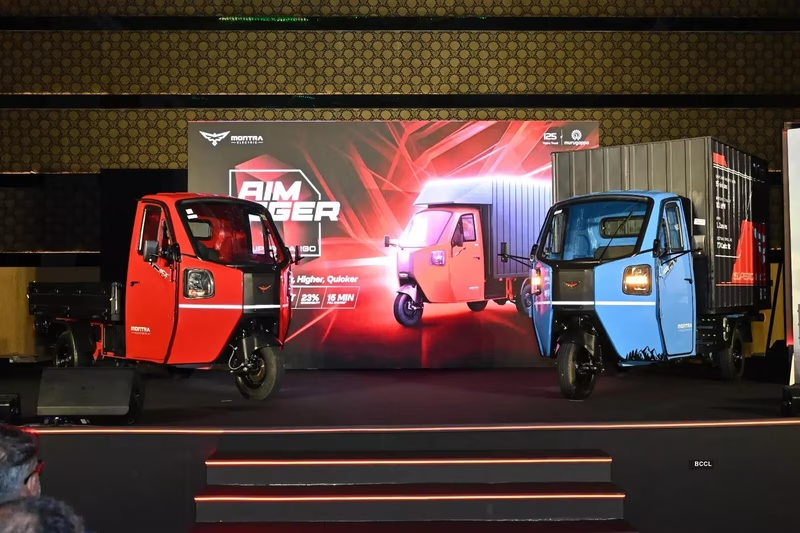
Subsidy Sunset: Why the Govt Pulled the Plug on Electric Three-Wheeler Support
In a major policy shift, the Indian government has officially ended the electric three-wheeler subsidy under the FAME II (Faster Adoption and Manufacturing of Electric Vehicles) scheme. The reason? Mission accomplished—at least on paper. With over 1 million electric three-wheelers reportedly deployed nationwide, the Centre claims it has surpassed its penetration target, making continued central financial support unnecessary.
But for millions of drivers, small fleet operators, and EV startups, this decision isn’t just bureaucratic—it’s deeply personal. For many, the subsidy was the thin margin that made switching from petrol autos to electric ones financially viable. Now, with prices set to rise, the dream of a clean, affordable urban commute faces its toughest test yet.
Table of Contents
- Why the Subsidy Ended: Targets Met, But at What Cost?
- Impact on Drivers and Fleet Operators
- How EV Manufacturers Are Reacting
- Why Two-Wheelers Still Get Support
- States Step Up: Delhi’s Expected EV Package
- Broader Implications for India’s EV Vision
- What Should Buyers Do Now?
- Conclusion: A Transition at a Crossroads
- Sources
Why the Subsidy Ended: Targets Met, But at What Cost?
Launched in 2019, FAME II allocated ₹10,000 crore to accelerate EV adoption, with a significant chunk reserved for three-wheelers—especially passenger and cargo variants used in urban and semi-urban areas. The scheme offered up to ₹1.25 lakh per vehicle, drastically reducing upfront costs.
According to the Ministry of Heavy Industries, more than 1.05 million electric three-wheelers have been registered under FAME II as of December 2025—exceeding the 1 million target. “The objective was to create a self-sustaining ecosystem,” said a senior official. “Now, the market must stand on its own.”
However, critics argue that “success” masks deeper issues: many vehicles sit idle due to lack of charging infrastructure, and drivers struggle with loan repayments once subsidies vanish.
Impact on Drivers and Fleet Operators
For an auto driver earning ₹800–1,200 a day, the loss of subsidy means a ₹1–1.5 lakh increase in vehicle cost—equivalent to over a year’s savings. “We were told electric autos would save us money on fuel,” said Rajesh Kumar, a driver in Varanasi. “But without subsidy, I can’t even afford the EMI.”
Small operators who invested in fleets of 2–3 vehicles are now trapped: their existing loans are based on subsidised pricing, but resale value is plummeting. Without relief, many may revert to petrol or CNG vehicles—undermining the very emissions goals the policy sought to achieve.
How EV Manufacturers Are Reacting
Major players like Mahindra Electric, Biliti Electric, and Euler Motors are scrambling to respond. Some are absorbing partial costs temporarily, while others are negotiating bulk fleet deals with ride-hailing platforms like BluSmart and Yulu.
“The end of central subsidy doesn’t mean the end of demand,” said a spokesperson for an EV startup. “But it does mean we need state support, better financing, and faster infrastructure rollout.”
Why Two-Wheelers Still Get Support
Interestingly, the government is likely to extend subsidies for electric two-wheelers into FY2026–27. Why? Because sales remain far below target—only around 3.8 million units against a 7 million goal.
Two-wheelers face different challenges: higher price sensitivity among middle-class buyers, intense competition from ICE bikes, and limited model variety. The continued support reflects a pragmatic acknowledgment that not all EV segments are ready to fly solo.
States Step Up: Delhi’s Expected EV Package
With the Centre stepping back, states are now the frontline of EV policy. Delhi—a leader in clean air initiatives—is poised to announce a new incentive package in early 2026, potentially including:
- State-level subsidy of ₹25,000–50,000 for electric three-wheelers
- Waiver of road tax and registration fees
- Priority access to high-occupancy vehicle lanes
- Subsidised battery-swapping stations near metro hubs
Other states like Maharashtra, Karnataka, and Telangana are watching closely. [INTERNAL_LINK:state-ev-policies-india] could become the new battleground for India’s EV future.
Broader Implications for India’s EV Vision
This policy shift signals a mature but risky phase in India’s EV journey:
- From subsidy dependence to market resilience: Can manufacturers innovate on cost without government crutches?
- Equity concerns: Will only wealthy operators afford EVs now?
- Infrastructure gap: Without affordable vehicles, charging networks may stall due to low utilisation.
The International Energy Agency (IEA) has repeatedly warned that emerging economies need “targeted, sustained support” during EV transitions—especially for commercial fleets that drive urban emissions.
What Should Buyers Do Now?
If you’re considering an electric three-wheeler, act fast—but wisely:
- Check for last FAME II allocations: Some manufacturers may still have pending subsidy claims.
- Explore state schemes: Delhi, Gujarat, and West Bengal offer additional benefits.
- Consider battery-as-a-service (BaaS): Lowers upfront cost by leasing the battery.
- Negotiate with fleet aggregators: Companies like SmartE offer driver employment + vehicle financing.
Conclusion: A Transition at a Crossroads
The end of the electric three-wheeler subsidy marks a pivotal moment. It celebrates a quantitative milestone but risks sacrificing social and environmental equity. For India’s EV revolution to be truly inclusive, the baton must now pass seamlessly from the Centre to the states—and from policymakers to financiers, manufacturers, and communities. The road ahead is unpaved, but the destination—cleaner, quieter, more affordable cities—remains worth the journey.
Sources
- Times of India: No more subsidy for electric three-wheelers
- Ministry of Heavy Industries – FAME India Scheme
- International Energy Agency (IEA): “Global EV Outlook 2025”
- Delhi State EV Policy Draft, December 2025 (Leaked Internal Document)