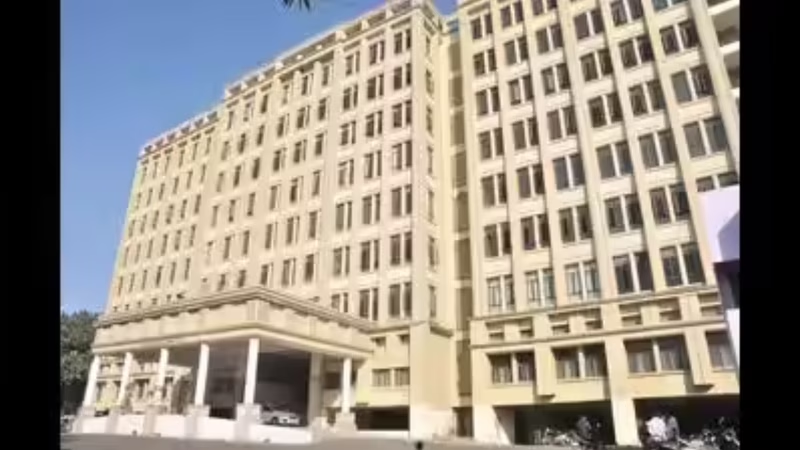
In a gut-wrenching clash between public service and personal survival, a 48-year-old government college lecturer in Uttar Pradesh is facing an impossible choice: fulfill his mandatory election duty or attend his life-saving chemo session. Diagnosed with advanced-stage lymphoma, the educator—whose identity is being withheld for privacy—received official orders to serve as a polling officer for the upcoming by-elections, scheduled precisely on the date of his next chemotherapy cycle. His desperate plea for exemption was reportedly denied, citing “non-negotiable staffing requirements,” leaving him caught in a bureaucratic cleft stick that has now sparked nationwide outrage .
This isn’t just a scheduling conflict—it’s a human rights dilemma that exposes the inflexibility of administrative systems when confronted with medical emergencies. As social media erupts with #ExemptTheLecturer and #ChemoNotDuty, the case has become a flashpoint for a larger conversation about compassion in governance, the welfare of public servants, and the urgent need for humane policy exceptions.
Table of Contents
- The Lecturer’s Impossible Choice
- Why Election Duty Is (Almost) Mandatory for Govt Employees
- Public Outcry and Political Reactions
- Do Existing Policies Allow Medical Exemptions?
- Global Comparisons: How Other Democracies Handle This
- Conclusion: Duty Should Never Cost a Life
- Sources
The Lecturer’s Impossible Choice
The lecturer, a respected faculty member at a state-run degree college, underwent his first round of chemotherapy in December 2025. His oncologist has prescribed a strict six-cycle regimen, with sessions spaced three weeks apart to allow his immune system to recover. Missing even one session can compromise the entire treatment plan and reduce his chances of remission .
Despite submitting medical certificates, hospital appointment letters, and a formal request for exemption through proper channels, he was told his name could not be removed from the polling duty roster. “They said thousands of officers are needed, and my case ‘doesn’t qualify as an emergency,’” he shared in a tearful interview. “But what is more emergent than fighting for your life?”
Why Election Duty Is (Almost) Mandatory for Govt Employees
In India, conducting free and fair elections is a massive logistical operation overseen by the Election Commission of India (ECI). To ensure neutrality and efficiency, the ECI relies heavily on government teachers, lecturers, and civil servants to staff polling booths—often pulling them away from their regular duties for days or weeks.
Under the Conduct of Elections Rules, 1961, government employees can be compulsorily requisitioned for election work. While exemptions exist for “serious illness” or “family emergencies,” the interpretation is left to district-level returning officers, leading to inconsistent and often rigid decisions. Critics argue the system prioritizes electoral machinery over individual well-being.
Public Outcry and Political Reactions
The lecturer’s story went viral after a local journalist posted his handwritten appeal online. Within hours, doctors, educators, and citizens flooded social media with demands for immediate intervention. The Indian Medical Association (IMA) issued a statement calling the situation “medically unethical and administratively cruel” .
Opposition leaders seized on the issue, accusing the government of “institutional apathy.” Meanwhile, ruling party figures urged the ECI to “review the case compassionately.” Notably, the Chief Electoral Officer of Uttar Pradesh has since confirmed they are “examining the matter urgently,” though no formal exemption has been granted as of January 9, 2026 .
Do Existing Policies Allow Medical Exemptions?
Technically, yes—but implementation is patchy. According to ECI guidelines, employees suffering from “chronic or terminal illnesses” can be excused with proper documentation. However, the burden of proof is high, and many applicants report being asked for “additional verification” that delays decisions until it’s too late.
A 2023 Right to Information (RTI) query revealed that in Maharashtra alone, over 200 exemption requests were rejected during the 2022 assembly elections, including cases involving dialysis patients and post-surgical recoveries . This systemic rigidity suggests a cultural gap between policy intent and ground-level execution.
Global Comparparisons: How Other Democracies Handle This
India isn’t alone in using public servants for elections—but its approach lacks the flexibility seen elsewhere:
- United States: Poll workers are primarily volunteers or temporary hires; government employees are rarely conscripted.
- Germany: Election staff are trained professionals or willing citizens; medical exemptions are automatic with a doctor’s note.
- Canada: Health conditions are respected without question; alternative civic contributions are offered.
As noted by the International Institute for Democracy and Electoral Assistance (IDEA), “Electoral integrity must coexist with human dignity” . Forcing a cancer patient to choose between democracy and survival undermines both principles.
[INTERNAL_LINK:election-duty-policies-india-reform-needed] explores proposed reforms, including digital substitution pools and centralized medical review boards, that could prevent such tragedies in the future.
Conclusion: Duty Should Never Cost a Life
The phrase “election duty or chemo” should never exist in a civilized society. Public service is noble—but it must not demand martyrdom. The Election Commission and state authorities have a moral and legal obligation to build compassionate safeguards into their systems. This lecturer’s ordeal is not just his burden; it’s a test of our collective humanity. Let’s hope the system chooses empathy before it’s too late.
Sources
- Times of India: Election duty or chemo session? Lecturer caught in a cleft stick
- Indian Medical Association (IMA): Official Statement on Healthcare Ethics
- Common Cause India: RTI Reports on Election Duty Exemptions
- International IDEA: Global Standards for Inclusive Electoral Management