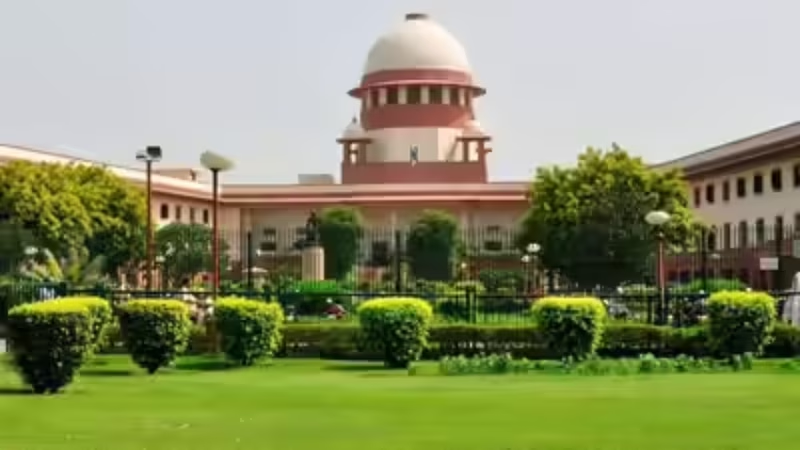
The political temperature in West Bengal has just hit boiling point. In an unprecedented escalation, the Enforcement Directorate (ED) has filed a petition in the Supreme Court of India against Chief Minister Mamata Banerjee, accusing her of directly interfering with and obstructing a critical investigation into alleged money laundering linked to a coal scam. This move follows a dramatic confrontation at the offices of the Indian National Developmental Inclusive Alliance’s (INDIA bloc) think-tank, I-PAC, in Kolkata, setting the stage for a landmark legal battle that could redefine the boundaries between state power and central investigative agencies.
Table of Contents
- The Dramatic Raid and Mamata’s Response
- ED vs Mamata Banerjee: The Core Allegations
- Legal Journey: From Calcutta HC to Supreme Court
- Understanding the ED: Its Powers and Mandate
- Political Fallout and National Implications
- Conclusion: A Defining Moment for Indian Democracy
- Sources
The Dramatic Raid and Mamata’s Response
The saga began when the ED launched a search operation at I-PAC’s Kolkata office as part of its probe into a 2020 coal pilferage scam. The agency claims the raid was a legitimate PMLA (Prevention of Money Laundering Act) operation aimed at recovering key evidence . However, the situation took a sharp turn when Chief Minister Mamata Banerjee arrived at the scene with a large contingent of Kolkata Police officers.
Mamata Banerjee has fiercely denied any wrongdoing, framing the ED’s actions as a politically motivated witch-hunt orchestrated by the BJP to target her party, the Trinamool Congress (TMC). She alleges that the central agency was specifically trying to seize sensitive internal party data from I-PAC, which serves as a strategic hub for the opposition INDIA bloc [[26], [28]]. In a bold counter-move, her administration has even initiated steps to identify and potentially file charges against the ED officials involved, citing alleged theft during the raid .
ED vs Mamata Banerjee: The Core Allegations
The heart of the ED vs Mamata Banerjee conflict lies in the agency’s explosive claim that the Chief Minister, with the active support of state police, forcibly entered the premises under search and removed what it describes as “key” evidence, including a hard disk [[6], [34]]. The ED has characterized this act as a serious obstruction of justice and an unconstitutional interference in a federal investigation.
In its legal filings, the ED has painted a picture of a chaotic scene where its officers were vastly outnumbered—reports suggest a ratio of just three ED officials to dozens of state police personnel—rendering them unable to perform their duties . The agency contends that this was not a spontaneous protest but a premeditated effort to derail a crucial financial crime investigation.
Legal Journey: From Calcutta HC to Supreme Court
Faced with this alleged obstruction, the ED first approached the Calcutta High Court on January 9th, 2026. In its urgent plea, the agency sought two primary reliefs: a directive for the CBI to register an FIR against Mamata Banerjee for obstruction, and a declaration that her actions were illegal and unconstitutional [[20], [30]].
However, the Calcutta High Court adjourned the hearing, reportedly due to administrative chaos within the court itself . Frustrated by the delay and the gravity of the situation, the ED swiftly decided to bypass the High Court and move directly to the Supreme Court of India to seek immediate intervention and a clear legal precedent [[2], [4]]. In response, the West Bengal government has also filed a caveat in the Supreme Court, signaling its intent to vigorously defend the Chief Minister’s actions .
Understanding the ED: Its Powers and Mandate
To fully grasp the significance of this standoff, it’s essential to understand the Enforcement Directorate’s role. The ED is India’s premier financial crime investigation agency, primarily tasked with enforcing the Prevention of Money Laundering Act, 2002 (PMLA) and the Foreign Exchange Management Act, 1999 (FEMA) [[13], [16]].
Its powers are extensive. Under the PMLA, the ED is authorized to conduct searches, seize documents and property, and even provisionally attach assets believed to be proceeds of crime [[11], [15]]. The agency operates under the Department of Revenue in the Ministry of Finance and is a key player in the nation’s fight against economic offences. Any perceived obstruction of its work is treated with the utmost seriousness by the central government.
Political Fallout and National Implications
This clash transcends West Bengal and has become a flashpoint in the national political arena. For the ruling BJP, it’s an opportunity to highlight alleged corruption within the TMC. For Mamata Banerjee and the wider INDIA opposition bloc, it’s a rallying cry against what they see as the misuse of central agencies for political vendetta—a narrative they have been pushing for years .
The outcome of this Supreme Court ED petition will have far-reaching consequences. It will test the limits of a state government’s authority to challenge a central agency’s operations on its soil. Furthermore, it will set a crucial precedent for how future conflicts between state executives and federal investigators are resolved, making it a pivotal moment for India’s federal structure and the independence of its investigative bodies.
Conclusion: A Defining Moment for Indian Democracy
The ED vs Mamata Banerjee case is more than just a legal tussle; it’s a high-stakes political and constitutional drama. With the matter now before the highest court in the land, all eyes are on the judiciary to provide clarity and uphold the rule of law. The Supreme Court’s decision will not only determine the immediate fate of those involved but will also shape the delicate balance of power between the Centre and the states for years to come. As this story develops, it remains one of the most critical political-legal battles in contemporary Indian history.
Sources
- Times of India: ED to move Supreme Court against Mamata over Kolkata raid
- Mint: ED moves SC over I-PAC raid row; West Bengal govt files caveat
- Business Standard: ED Says Mamata Banerjee Seized Docs During I-PAC Raids
- Ministry of Home Affairs: Enforcement Directorate
- The Hindu: Calcutta HC adjourns ED raids hearing due to court chaos