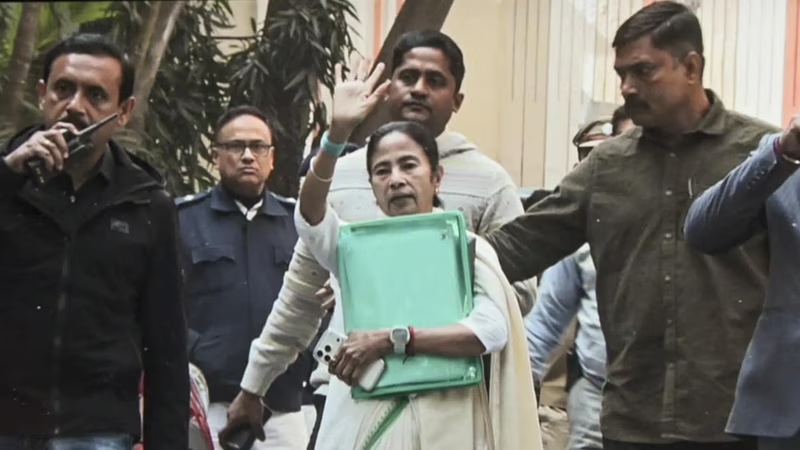
The simmering tension between West Bengal’s ruling Trinamool Congress (TMC) and the central government has exploded into a full-blown legal and political firestorm. At the heart of it? The ED vs I-PAC face-off now playing out in the Calcutta High Court—a high-stakes drama that could reshape the state’s political landscape ahead of crucial elections.
On January 8, 2026, the Enforcement Directorate (ED) formally accused Chief Minister Mamata Banerjee and her Inner-Parliamentary Action Committee (I-PAC) of actively obstructing a money laundering probe linked to alleged irregularities in civic projects . In response, the TMC has not only challenged the legitimacy of the ED’s raids but also announced a massive protest across West Bengal, framing the investigation as a politically motivated witch hunt by the BJP-led Centre .
Table of Contents
- Background of the ED Investigation
- ED vs I-PAC: Agency Flags ‘Deliberate Obstruction’
- TMC’s Fiery Response and Statewide Protest Call
- The Legal Battle Unfolds in Calcutta High Court
- Political Implications for West Bengal in 2026
Background of the ED Investigation
The current conflict stems from an ongoing ED probe into alleged financial irregularities involving several municipal corporations under TMC control. The agency claims to have uncovered a web of shell companies, inflated contracts, and kickbacks funneled through intermediaries—all allegedly orchestrated to fund party activities .
I-PAC, chaired by Mamata Banerjee herself, was formed to coordinate parliamentary strategy and civic governance. However, the ED now alleges this committee was used as a conduit to approve and conceal dubious financial transactions, effectively blurring the lines between party machinery and state administration .
ED vs I-PAC: Agency Flags ‘Deliberate Obstruction’
In its affidavit before the Calcutta High Court, the ED made explosive claims. It stated that during recent raids on I-PAC offices and key TMC functionaries, officials—including those acting on instructions from “higher authorities”—physically blocked entry, deleted digital records, and refused to hand over critical documents .
“This wasn’t mere non-cooperation; it was a coordinated effort to scuttle the investigation,” argued the ED counsel. The agency has urged the court to issue contempt notices and compel full compliance, warning that such obstruction undermines the rule of law itself .
TMC’s Fiery Response and Statewide Protest Call
The TMC has dismissed the ED’s allegations as “baseless” and “fabricated.” Senior leader Abhishek Banerjee called the raids “a brazen assault on federalism” and accused the BJP of using central agencies to destabilize opposition-ruled states .
In a dramatic escalation, the party announced a day-long statewide protest on January 12, 2026, under the banner “Save Democracy, Stop Misuse of ED.” The protest aims to mobilize public opinion and pressure the judiciary to scrutinize the ED’s methods:
- Rallies planned in all 23 districts of West Bengal
- Black flag demonstrations outside ED offices
- Social media campaign with #HandsOffBengal trending
The Legal Battle Unfolds in Calcutta High Court
The Calcutta High Court is now at the epicenter of this constitutional tug-of-war. The TMC has filed a petition challenging the very legality of the ED’s actions, arguing that the raids violated procedural safeguards and exceeded the agency’s jurisdiction .
Legal experts are divided. Some, like former Solicitor General Harish Salve, emphasize that while agencies must follow due process, obstruction of a lawful investigation is indefensible . Others point to a pattern of central agencies targeting opposition leaders, citing data from the PRS Legislative Research showing a sharp rise in ED cases against non-BJP parties since 2014 .
Political Implications for West Bengal in 2026
With assembly elections looming in early 2027, this confrontation is more than legal—it’s deeply political. For Mamata Banerjee, positioning herself as a victim of central overreach galvanizes her core voter base. For the BJP, a successful prosecution could dent her image as an incorruptible leader.
However, the risk is mutual. If the courts side with the TMC and brand the ED’s actions as partisan, it could backfire spectacularly on the Centre, reinforcing narratives of authoritarianism. The Calcutta High Court’s eventual ruling will thus be watched not just in Bengal, but across India’s democratic ecosystem.
Final Summary
The ED vs I-PAC clash in the Calcutta High Court is far more than a procedural dispute—it’s a litmus test for India’s federal balance and judicial independence. With the ED alleging obstruction by Mamata Banerjee’s office and the TMC planning mass protests, the stage is set for a prolonged legal and political showdown that could define West Bengal’s trajectory for years to come.
Sources
- Times of India. (2026, January 9). ED vs I-PAC battle reaches HC: Agency flags ‘obstruction’ by Mamata; TMC to hold protest. Retrieved from https://timesofindia.indiatimes.com/india/ed-i-pac-face-off-at-cal-hc-central-agency-flags-obstruction-by-mamata-committee-questions-raid-legitimacy/articleshow/126416484.cms
- The Hindu. (2026, January 8). ED tells Calcutta HC of obstruction by TMC leaders in I-PAC raid.
- Indian Express. (2026, January 9). TMC announces statewide protest against ED raids.
- PRS Legislative Research. (2025). Use of Central Agencies in Indian Politics: A Data Analysis. Retrieved from https://prsindia.org
- Live Law. (2026, January 8). Calcutta HC to hear TMC’s plea against ED raids on I-PAC offices.