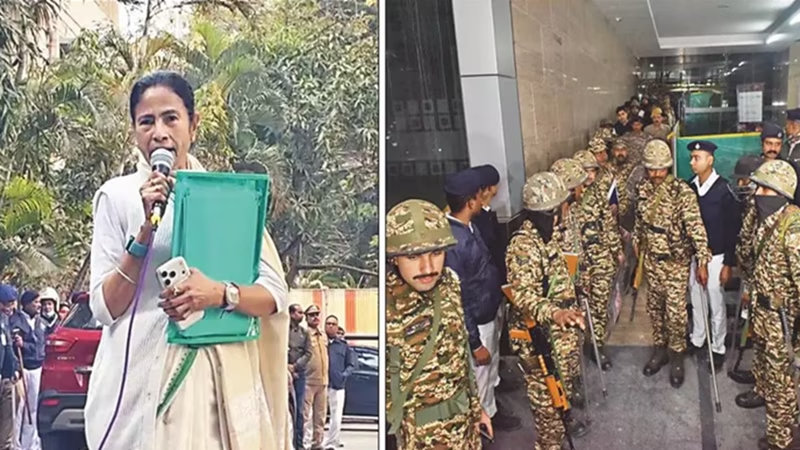
In a dramatic escalation of tensions between the Centre and West Bengal, the Enforcement Directorate (ED) launched high-profile ED raids I-PAC premises in Kolkata on Thursday, January 8, 2026—searching both the office of the influential political consultancy firm I-PAC and the residence of its director. The move, tied to a five-year-old money laundering probe, has been swiftly branded by Chief Minister Mamata Banerjee as a “politically motivated assault” aimed at sabotaging her party’s electoral machinery ahead of crucial state elections .
Within hours of the raids, Mamata Banerjee arrived at the scene flanked by the state’s top law enforcement officials—the Director General of Police (DGP) and the Commissioner of Police (CP)—in an unprecedented show of defiance. Her presence wasn’t just symbolic; it was a direct challenge to the federal agency’s authority and a clear signal that she would not allow what she called “institutional bullying” to go unchallenged.
Table of Contents
- What Happened During the ED Raids?
- Who Is I-PAC and Why Are They Under Scrutiny?
- Mamata Banerjee’s Fiery Response
- Political Context: Timing and Implications
- Legal and Institutional Questions
- Conclusion: A Flashpoint in Centre-State Relations
- Sources
What Happened During the ED Raids?
Early on Thursday morning, ED teams descended on I-PAC’s office in central Kolkata and the residential apartment of its director, initiating a day-long search operation. Officials reportedly seized digital devices, financial documents, and other materials linked to an ongoing investigation into alleged irregularities in campaign funding dating back to 2021 .
The raid marks a revival of a dormant probe that had previously drawn little public attention. What makes this development explosive is not just the target—but the timing. With West Bengal gearing up for local body elections and national political realignments underway, the raid is being interpreted by many as more than a routine enforcement action.
Who Is I-PAC and Why Are They Under Scrutiny?
I-PAC (Indian Political Action Committee) is one of India’s most prominent political strategy firms. Founded by Prashant Kishor, it has played a pivotal role in shaping election victories for major parties across the spectrum—including the BJP in 2014, TMC in 2021, and several regional outfits. While officially non-partisan, I-PAC’s deep involvement in candidate selection, voter outreach, and data-driven campaigning has made it a powerful behind-the-scenes player—and a frequent subject of political controversy .
The current ED probe reportedly stems from allegations of undisclosed foreign funding and potential violations of the Foreign Contribution (Regulation) Act (FCRA). However, no formal charges have been filed, and I-PAC has consistently denied any wrongdoing. Critics argue that such investigations are often used selectively to pressure political opponents or their allies.
Mamata Banerjee’s Fiery Response
Chief Minister Mamata Banerjee wasted no time in condemning the raids. Arriving at the I-PAC office with DGP Manoj Verma and Kolkata Police Commissioner Rajesh Kumar in tow, she accused Union Home Minister Amit Shah of orchestrating a “conspiracy” to destabilize her government.
“This is not an investigation—it’s intimidation,” Mamata declared to reporters. “They are targeting those who helped us win the people’s mandate. This is an attack on democracy itself.” Her decision to bring senior police officials underscored her assertion that the state’s law and order apparatus remains under her control—not the Centre’s .
She further alleged that similar tactics were being deployed across opposition-ruled states, calling it a “blueprint of authoritarianism.” Her remarks echo growing concerns among regional parties about the perceived misuse of central agencies like the ED and CBI.
Political Context: Timing and Implications
The timing of the ED raids I-PAC could hardly be more significant:
- Post-2024 Mandate: The TMC is still consolidating its position after a hard-fought victory in the 2024 Lok Sabha polls.
- Upcoming Elections: Panchayat and municipal elections in West Bengal are expected later this year, making political strategy firms like I-PAC critical assets.
- National Opposition Unity: Mamata is a key figure in the INDIA bloc; weakening her could fracture opposition cohesion.
[INTERNAL_LINK:west-bengal-political-landscape-2026] explores how such raids impact electoral preparedness and public trust. For Mamata, framing this as political persecution serves to rally her base and position herself as a defender of federalism.
Legal and Institutional Questions
Beyond the political drama, the raid raises serious questions about institutional independence. The ED operates under the Ministry of Finance but is often accused of acting on political directives. A 2023 report by the PRS Legislative Research noted a sharp increase in ED actions against opposition leaders compared to ruling party figures—a trend that fuels perceptions of bias .
Legal experts point out that while agencies have the right to investigate, the manner and visibility of such operations—especially when involving political consultants—can cross the line from due process into psychological warfare. The presence of the CM and top cops at the raid site, while unusual, highlights the deep erosion of trust between state and central institutions.
Conclusion: A Flashpoint in Centre-State Relations
The ED raids I-PAC office in Kolkata are far more than a procedural law enforcement action. They represent a flashpoint in the ongoing power struggle between New Delhi and state governments, particularly those led by opposition parties. Mamata Banerjee’s defiant response signals that she will leverage every available platform—legal, political, and symbolic—to resist what she sees as an existential threat. As India navigates a complex electoral calendar, the line between investigation and intimidation has never been blurrier—or more consequential.
Sources
- Times of India: Searches at I-PAC office & director’s home
- The Indian Express: Who is I-PAC and what does it do?
- PRS Legislative Research: Analysis of Enforcement Directorate Actions (2023)