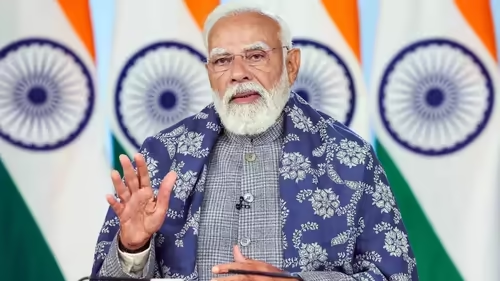
On January 29, 2026—the day before India’s Union Budget presentation—Prime Minister Narendra Modi dropped a major economic bombshell: the Economic Survey 2025–26 isn’t just another government report. It’s, in his words, a “comprehensive snapshot of India’s Reform Express.”
That phrase—Reform Express—isn’t just political flair. The survey paints a picture of an economy undergoing structural metamorphosis, shifting from reactive policy-making to proactive, long-term nation-building. From boosting manufacturing to embedding strategic resilience against global shocks, India appears to be playing a different game altogether.
But is this optimism backed by hard data—or just hopeful rhetoric? Let’s unpack the real story behind the Economic Survey 2025–26, its key pillars, and what it signals for businesses, investors, and everyday citizens.
Table of Contents
- What Is the Economic Survey 2025–26?
- Modi’s ‘Reform Express’ Vision Explained
- Key Themes: Strategic Resilience & Global Integration
- Manufacturing Competitiveness: The New Engine of Growth
- Critiques and Challenges Ahead
- Conclusion: What’s Next for India’s Economy?
- Sources
What Is the Economic Survey 2025–26?
Published annually by the Ministry of Finance ahead of the Union Budget, the Economic Survey serves as the government’s official review of the past year’s economic performance and its outlook for the coming fiscal period. The 2025–26 edition, tabled in Parliament on January 29, 2026, carries special weight—it marks the midpoint of PM Modi’s third term and sets the tone for India’s ambition to become a $5 trillion (and eventually $10 trillion) economy.
Unlike previous editions that focused heavily on post-pandemic recovery, this year’s survey emphasizes forward-looking structural reforms. It doesn’t just track GDP—it analyzes supply chains, industrial policy, innovation ecosystems, and geopolitical risk buffers.
Modi’s ‘Reform Express’ Vision Explained
When PM Modi called the report a snapshot of India’s “Reform Express,” he was signaling speed, direction, and inevitability. The metaphor suggests that India’s reform momentum is no longer stop-and-go—it’s a high-speed train with clear tracks and growing passenger confidence.
The survey highlights several landmark reforms already in motion:
- Production Linked Incentive (PLI) schemes now cover 14 key sectors—from semiconductors to specialty steel—with over ₹2 lakh crore committed.
- Banking sector consolidation has reduced NPAs and strengthened public sector banks’ balance sheets.
- Digital Public Infrastructure (DPI)—including UPI, Aadhaar, and ONDC—is being exported as a global public good.
These aren’t isolated policies. They’re interconnected rails on which the Reform Express runs.
Key Themes: Strategic Resilience & Global Integration
One of the most striking shifts in the Economic Survey 2025–26 is its focus on strategic resilience. This goes beyond self-reliance (Aatmanirbhar Bharat) to include:
- Supply chain diversification: Reducing overdependence on single countries for critical imports like electronics and pharmaceuticals.
- Energy security: Massive investments in green hydrogen, solar manufacturing, and strategic oil reserves.
- Food and water buffers: Using AI-driven forecasting to manage agricultural output and prevent price volatility.
Simultaneously, India is deepening its global integration through new trade pacts (like the ongoing negotiations with the UK and EU), participation in the Indo-Pacific Economic Framework (IPEF), and positioning itself as a trusted alternative manufacturing hub.
As the survey notes: “India is not decoupling—it’s recoupling with partners who share democratic values and open markets.”
Manufacturing Competitiveness: The New Engine of Growth
Gone are the days when services alone drove India’s economy. The Economic Survey 2025–26 makes a compelling case that manufacturing is now the central pillar of India’s growth strategy.
Key indicators support this shift:
- Manufacturing’s share in GDP has risen to 18.2% in FY2025, up from 16.9% in 2019.
- Electronics exports have surged by 140% since 2021, with mobile phones leading the charge.
- Over 300 global firms have set up or expanded operations in India under the PLI scheme.
The survey also introduces the concept of “competitive federalism”—where states compete to offer better logistics, power, and ease of doing business. Gujarat, Tamil Nadu, and Karnataka are highlighted as top performers, but even landlocked states like Madhya Pradesh are making strides in defense and auto component manufacturing.
This isn’t just about jobs—it’s about building a durable export engine that can withstand global downturns.
Critiques and Challenges Ahead
Despite the optimistic tone, experts caution that the Reform Express faces headwinds:
- Job creation still lags behind GDP growth, especially in formal-sector manufacturing.
- Rural distress persists, with agrarian incomes vulnerable to climate shocks.
- Fiscal space is tightening, limiting room for aggressive capital expenditure without higher tax revenues.
Moreover, while FDI inflows remain strong, some analysts argue that India must move beyond assembly-led manufacturing to R&D-intensive production to truly climb the value chain.
Conclusion: What’s Next for India’s Economy?
The Economic Survey 2025–26 is more than a report—it’s a manifesto for India’s next phase of development. By framing progress as a “Reform Express,” the government is signaling continuity, confidence, and clarity of purpose.
For investors, this means predictable policy frameworks and expanding opportunities in green tech, defense, and digital infrastructure. For citizens, it promises better jobs, stronger buffers against global crises, and a more globally respected economy.
Whether the train stays on track will depend on execution, inclusion, and adaptability. But one thing is clear: India is no longer waiting at the station. It’s full steam ahead.
Sources
[INTERNAL_LINK:union-budget-2026-preview]
[INTERNAL_LINK:pli-scheme-impact-analysis]
Official Economic Survey 2025–26 – Ministry of Finance, Government of India
World Bank – India Overview
PM Modi on Economic Survey 2025–26 – The Times of India