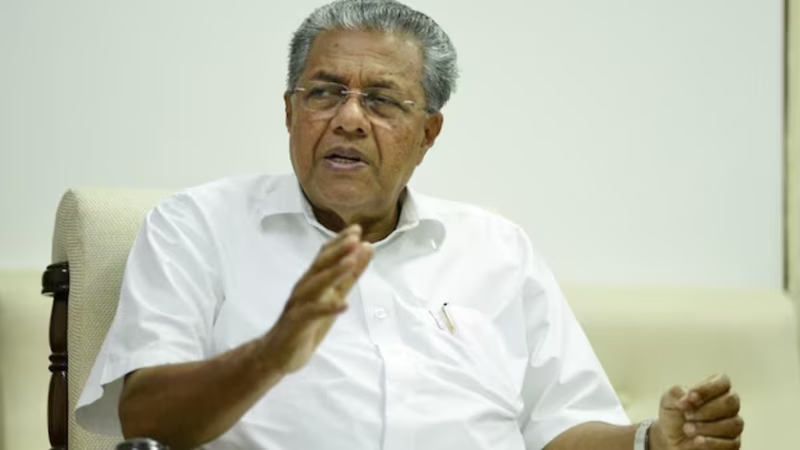
The fault lines between India’s federal structure have deepened dramatically. On January 9, 2026, Kerala Chief Minister Pinarayi Vijayan launched a blistering attack on the Union government, accusing it of deliberately strangling his state’s finances through what he termed an “economic blockade.” In a fiery address to party workers in Thiruvananthapuram, Vijayan announced a day-long satyagraha across Kerala on January 12—a move that threatens to ignite a nationwide debate on fiscal federalism .
Vijayan’s core allegation is stark: that the Centre is systematically withholding constitutionally mandated funds, delaying critical project approvals, and using financial levers as a political weapon against opposition-ruled states. “They are financially strangling Kerala,” he declared, claiming this policy extends beyond his own Communist-led government to other non-BJP states .
Table of Contents
- What Is the ‘Economic Blockade’ Allegation?
- Key Funding Disputes Fueling Tensions
- Economic Blockade: The January 12 Satyagraha Plan
- Congress in the Crosshairs: Vijayan’s Broader Critique
- Constitutional and Political Implications
What Is the ‘Economic Blockade’ Allegation?
Vijayan’s “economic blockade” charge isn’t just rhetorical—it’s rooted in specific grievances over delayed or denied financial transfers:
- Goods and Services Tax (GST) Compensation: Kerala claims it is owed over ₹8,000 crore in pending GST compensation cess arrears.
- Central Assistance for Projects: Key infrastructure and welfare schemes, including those under the Bharatmala and Sagarmala programs, have seen approvals stalled or funds released in dribs and drabs.
- Disaster Relief Funds: Reimbursements for floods and landslides have been significantly delayed, straining the state’s disaster response budget.
The CM argues that while BJP-ruled states receive timely and generous disbursements, opposition states like Kerala, West Bengal, and Punjab face bureaucratic hurdles and political obstruction .
Key Funding Disputes Fueling Tensions
One flashpoint is the long-standing demand for the implementation of the 15th Finance Commission’s recommendations on revenue deficit grants. Kerala, with its high social development indicators but limited revenue-generating capacity, is heavily dependent on these central transfers.
According to data from the Department of Expenditure, Ministry of Finance, Kerala’s share of central taxes has stagnated despite rising costs of governance. The state’s fiscal deficit has widened, forcing it to borrow more at higher interest rates—something Vijayan blames directly on the Centre’s “discriminatory” policy .
Economic Blockade: The January 12 Satyagraha Plan
The January 12 protest is designed to be both symbolic and disruptive. Organized by the ruling CPI(M), the satyagraha will feature:
- Mass rallies in all 14 district headquarters.
- Peaceful sit-ins outside central government offices, including Income Tax and Customs buildings.
- A statewide shutdown of party-affiliated institutions (schools, hospitals) for half a day.
- A social media campaign under #StopEconomicBlockadeOnKerala.
Vijayan framed the protest as a defense of constitutional rights, not just a political stunt. “This is about the right of a democratically elected state government to function without being held hostage by the Centre,” he stated .
Congress in the Crosshairs: Vijayan’s Broader Critique
In a surprising twist, Vijayan didn’t limit his criticism to the BJP. He took direct aim at the Congress, India’s principal opposition party, accusing it of complicity. “The party, which claims to be the principal opposition party of the country, is also moving along the same path,” he said, likely referencing Congress-ruled states’ silence on the issue or their own alignment with central policies .
This barb underscores a deeper strategic rift within the opposition camp. By calling out Congress, Vijayan is positioning the Left as the only true defender of federalism—a narrative aimed at consolidating his base ahead of the 2026 local body elections.
Constitutional and Political Implications
This standoff transcends Kerala. It touches on a fundamental question: can the Union government use fiscal tools to punish or pressure dissenting states? Legal scholars point to Article 282 of the Constitution, which allows discretionary grants, but argue that systematic denial based on political affiliation violates the spirit of cooperative federalism.
As noted by the PRS Legislative Research, there has been a measurable decline in the share of unconditional transfers to states since 2014, with more funds tied to centrally sponsored schemes—a trend that gives the Centre greater control .
The January 12 satyagraha could become a rallying cry for other opposition-ruled states, potentially forging a united front against perceived fiscal centralization.
Final Summary
Pinarayi Vijayan’s accusation of an “economic blockade” is more than political rhetoric—it’s a serious indictment of India’s current fiscal federalism model. By calling for a mass satyagraha on January 12, he has forced a national conversation about the balance of power between the Centre and the states. Whether this leads to policy concessions or further polarization remains to be seen, but one thing is clear: the battle over Kerala’s finances is now a frontline in India’s broader democratic struggle.
Sources
- Times of India. (2026, January 9). ‘Economic blockade’: Kerala CM targets Centre; calls for satyagraha on Jan 12. Retrieved from https://timesofindia.indiatimes.com/india/financially-strangling-kerala-cm-pinarayi-vijayan-targets-centre-calls-for-satyagraha-on-january-12/articleshow/126416791.cms
- The Hindu. (2026, January 9). Vijayan alleges Centre is financially strangling Kerala.
- Ministry of Finance, Government of India. (2025). Report of the 15th Finance Commission. Retrieved from https://dea.gov.in
- PRS Legislative Research. (2025). Trends in Centre-State Financial Relations. Retrieved from https://prsindia.org
- Indian Express. (2026, January 9). Kerala to hold satyagraha against ‘economic blockade’ by Centre.