Introduction
In a bold bid to position itself as a global leader in democratic governance, India’s Election Commission (EC) is set to take center stage at the **International Conference on Democracy and Election Management** in New Delhi this January 2026. With nearly 100 delegates from 70 countries expected to attend, the EC plans to showcase its flagship **Special Intensive Revision (SIR)** drive—an aggressive voter list cleanup effort that has drawn both praise for its ambition and sharp criticism over fears of mass disenfranchisement. This high-profile event isn’t just about sharing best practices; it’s a strategic assertion of India’s model of electoral management on the world stage, even as debates rage at home about the fairness and transparency of the electoral process.
Table of Contents
- What Is the SIR Initiative?
- Why the Global Conference Matters
- Controversy at Home: Opposition Raises Alarm
- ECINET: The Digital Backbone of Modern Elections
- India’s Growing Influence in Global Election Management
- Conclusion: Democracy on Display Amid Domestic Debate
- Sources
What Is the SIR Initiative?
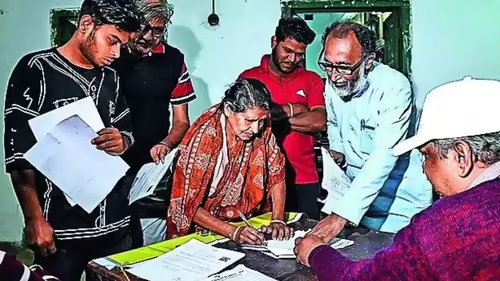
The **Special Intensive Revision (SIR)** is the Election Commission’s latest push to ensure the accuracy and integrity of India’s electoral rolls—currently the world’s largest, with over 968 million registered voters . Unlike routine annual updates, the SIR is a targeted, tech-driven campaign that uses data analytics, door-to-door verification, and AI-powered discrepancy detection to identify and resolve anomalies such as:
- Duplicate or fake voter registrations
- “Logical discrepancies” (e.g., impossible age-family relationships)
- Deceased individuals still listed as active voters
- Migrants who have moved but remain on old rolls
The EC argues that cleaning these errors strengthens the electoral process by preventing fraud and ensuring “one person, one vote.” However, critics warn that automated exclusions—without adequate notice or appeal mechanisms—could inadvertently remove millions of legitimate voters, particularly from marginalized communities.
Why the Global Conference Matters
Hosted in partnership with international bodies like International IDEA and UNDP, the January 2026 conference will bring together election officials, policymakers, and technologists from across Africa, Asia, Latin America, and Europe. Sessions will cover critical topics including:
- Securing elections against cyber threats
- Ensuring inclusivity for women, youth, and persons with disabilities
- Leveraging technology for transparent vote counting
- Managing disinformation during campaigns
By showcasing the SIR and its new **ECINET** platform (see below), India aims to export its “frugal innovation” model—proving that large-scale, credible elections are possible even in complex, resource-constrained democracies.
Controversy at Home: Opposition Raises Alarm
While the EC touts the SIR as a success, opposition parties have sounded the alarm. In West Bengal alone, over 4.3 million voters were flagged for exclusion before the Supreme Court intervened, ordering public display of lists and extra time for appeals . Similar concerns have emerged in Tamil Nadu, Assam, and Punjab.
Critics argue that the timing—just months before key state elections—suggests political motives. “You can’t claim to strengthen democracy while potentially stripping citizens of their most fundamental right,” said one opposition leader. The EC denies bias, insisting the process is technical, not political—but the skepticism remains.
ECINET: The Digital Backbone of Modern Elections
A centerpiece of the conference will be the official launch of **ECINET**—the Election Commission’s new integrated digital ecosystem. This secure, cloud-based platform connects all levels of election administration, enabling real-time monitoring of voter registration, polling booth allocation, EVM logistics, and result transmission.
Key features include:
- Blockchain-verified audit trails for voter additions/deletions
- AI-driven anomaly detection in nomination papers
- Mobile apps for Booth Level Officers (BLOs) to update records offline
- Public dashboards showing live revision statistics
ECINET represents India’s answer to the global demand for transparent, tamper-proof election infrastructure—a model many developing nations are eager to study.
India’s Growing Influence in Global Election Management
India has long assisted other democracies—from training poll workers in Nepal to providing EVMs to Namibia. But this conference marks a shift from aid recipient to knowledge exporter. With its experience managing elections larger than most countries’ entire populations, India’s insights on voter authentication, logistics, and security are increasingly sought after.
For more on India’s soft power in governance, see our analysis on [INTERNAL_LINK:india-democracy-export-model].
Conclusion: Democracy on Display Amid Domestic Debate
The Election Commission’s decision to showcase the SIR initiative at a global forum underscores its confidence in India’s electoral process. Yet, the move also highlights a paradox: while India preaches electoral integrity abroad, it faces urgent questions about inclusion and due process at home. The true test of its model won’t be applause from foreign delegates—it will be whether every eligible Indian voter, especially the poor, the migrant, and the voiceless, can cast their ballot without fear or barrier. As the world watches, India’s democracy must prove it’s as robust in practice as it is in presentation.
Sources
- Times of India: EC to showcase SIR as step to strengthen electoral process
- Election Commission of India – SIR Guidelines & ECINET Brochure: Official Documentation
- International Institute for Democracy and Electoral Assistance (International IDEA): Global Election Standards
- Supreme Court of India Order on West Bengal Voter List (January 2026)