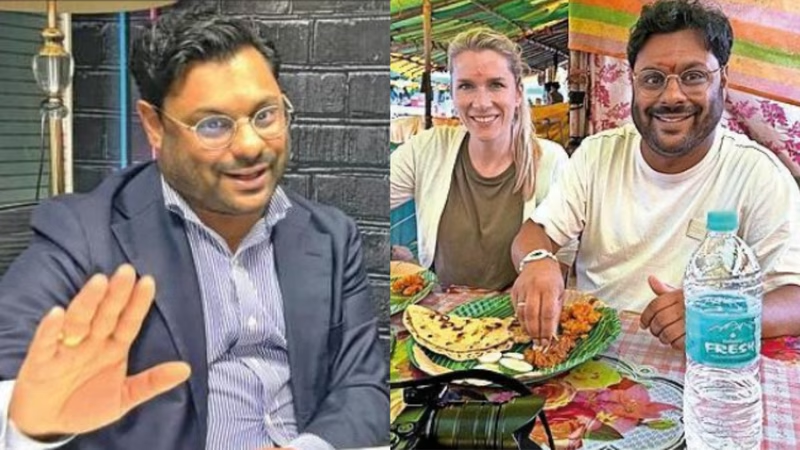
In a story that reads like a modern-day epic, a man who was left as a newborn on the streets of Nagpur in 1985 has returned to the city—not as a tourist, but as a dignitary on a mission of the heart. Today, he is Arjen van der Sluis, the Mayor of Heemstede in the Netherlands. But 41 years ago, he was just a nameless infant wrapped in cloth, left outside a hospital with nothing but hope for a better life.
Now, driven by a profound need to understand his origins, the Dutch mayor Nagpur connection has become a global symbol of identity, resilience, and the unbreakable human desire to know where we come from. His journey isn’t just about finding a person—it’s about closing a circle that began in abandonment and could end in reconciliation.
Table of Contents
- From Abandoned Baby to Dutch Mayor
- The Emotional Return to Nagpur
- The Challenges of Finding a Birth Parent in India
- International Adoption and the Right to Roots
- Why This Search Matters for All Adoptees
- Conclusion: A Quest for Peace, Not Just Answers
- Sources
From Abandoned Baby to Dutch Mayor
On a quiet day in October 1985, a 3-day-old boy was found abandoned near a hospital in Nagpur, Maharashtra. He was taken in by local authorities and eventually placed with an international adoption agency. From there, his life took a dramatic turn when a Dutch couple, seeking to build a family, welcomed him into their home with open arms.
Raised in the Netherlands with love, education, and opportunity, Arjen thrived. He pursued public service with passion, eventually becoming the mayor of Heemstede—a town known for its historic charm and civic pride. Yet, despite his success and stable upbringing, a quiet question lingered: Who was his birth mother? Why did she leave him?
“I’ve always felt a sense of gratitude toward my Dutch parents,” he shared in a recent interview. “But I also carry a deep curiosity about the woman who gave me life. She deserves to know I’m okay.”
The Emotional Return to Nagpur
Arjen’s return to Nagpur is more than a physical journey—it’s an emotional pilgrimage. He visited the very spot where he was found, now part of a bustling urban landscape, and met with local officials and social workers who helped reconstruct the timeline of his early days.
He has been working closely with Indian authorities and NGOs specializing in adoption records. While official documentation from 1985 is sparse—common in many international adoptions of that era—he remains hopeful. Local media reports note that he’s even referencing the Mahabharata, calling himself “Karna” and his unknown mother “Kunti,” drawing a poignant parallel between myth and reality .
The Challenges of Finding a Birth Parent in India
Finding a birth parent in India, especially after four decades, is an uphill battle. Here’s why:
- Limited Records: In the 1980s, many adoptions—especially of abandoned children—were processed with minimal paperwork. Birth certificates or hospital logs may not exist.
- Stigma Around Abandonment: Social stigma often prevented birth mothers from coming forward, even anonymously. Many feared judgment or family rejection.
- Data Privacy Laws: While well-intentioned, current Indian laws can restrict access to old adoption files, making it hard for adult adoptees to trace their origins.
- Geographic Scale: Nagpur is a large city. Without a name, address, or identifying mark, the search is like finding a needle in a haystack.
Despite these hurdles, advances in DNA testing and growing support networks for adoptees are offering new hope. Organizations like [INTERNAL_LINK:indian-adoptee-network] are now bridging gaps between diaspora adoptees and their roots.
International Adoption and the Right to Roots
Arjen’s story is not unique—but it is increasingly visible. Thousands of Indian children were adopted internationally between the 1970s and 1990s, often due to poverty, social pressure, or lack of support systems. Today, many of these adoptees are adults asking the same questions: Where do I come from? Who am I?
The Hague Convention on Intercountry Adoption, which India ratified in 2003, emphasizes the child’s right to identity and cultural heritage . While retroactive application is limited, it has sparked a global conversation about ethical adoption practices and post-adoption support.
For Arjen, this isn’t about blame. It’s about closure. “I don’t need her to be in my life,” he said. “I just want her to know her son is alive, happy, and grateful.”
Why This Search Matters for All Adoptees
Beyond the headlines, Arjen’s quest resonates with millions of adoptees worldwide. It validates a universal human need: to understand one’s origin story. Identity isn’t just shaped by upbringing—it’s also woven from biological and cultural threads.
His position as a public figure adds weight to this narrative. By speaking openly, he’s helping normalize the adoptee experience and encouraging governments to improve access to historical records. As noted by UNICEF, “Every child has the right to know and be cared for by their parents, as far as possible” .
Conclusion: A Quest for Peace, Not Just Answers
The Dutch mayor Nagpur story is a powerful reminder that our past never truly leaves us. Whether Arjen finds his birth mother or not, his journey has already inspired countless others to seek their own truths. In returning to the place of his beginning, he honors both the woman who let him go and the parents who gave him a future. Sometimes, the search itself is the answer.
Sources
- Times of India: Karna deserves right to meet his Kunti: Abandoned 41 years ago as 3-day-old in Nagpur, Dutch mayor back to find mom
- UNICEF: Convention on the Rights of the Child – Article 7
- Hague Conference on Private International Law: Hague Convention on Protection of Children and Co-operation in Respect of Intercountry Adoption