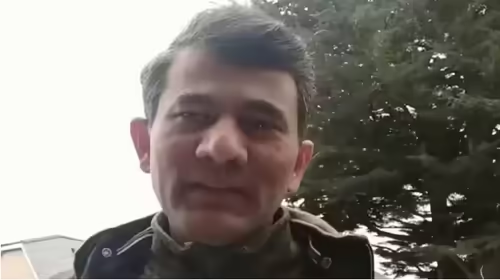
Introduction: When a Return Home Turns Into a Legal Battle
Imagine flying back to your home country for a visit—only to be stopped at immigration, questioned for hours, and barred from leaving the airport. That’s exactly what happened to Dr. Sangram Patil, a UK-based medical professional and popular YouTuber with over 100,000 followers. His alleged “crime”? Posting critical opinions about BJP leaders on Facebook .
Now, Dr. Patil is fighting back. He’s filed a petition in the Bombay High Court seeking to quash both the FIR registered against him and the lookout circular (LOC) that led to his detention at Mumbai’s Chhatrapati Shivaji Maharaj International Airport. This case has reignited a national debate about free speech, digital rights, and the growing legal scrutiny of online commentary in India.
Table of Contents
- Who Is Dr. Sangram Patil?
- The Incident at Mumbai Airport
- Dr. Sangram Patil and the Controversial FIR
- What Is a Lookout Circular—and Why Is It Controversial?
- Free Speech vs. Hate Speech: The Legal Gray Zone
- Public Reaction and Digital Rights Concerns
- Conclusion: A Test Case for Online Expression in India
- Sources
Who Is Dr. Sangram Patil?
Dr. Sangram Patil isn’t just a social media personality—he’s a qualified medical doctor currently practicing in the United Kingdom. On his YouTube channel and Facebook page, he discusses a mix of health topics, political commentary, and current affairs, often from a critical perspective on Indian governance. His content, primarily in Marathi and Hindi, resonates with a large diaspora audience and domestic viewers alike .
Despite living abroad, Patil remains deeply engaged with Indian socio-political issues. His recent posts—allegedly targeting senior BJP leaders—appear to have crossed a line in the eyes of Mumbai police, triggering a formal investigation.
The Incident at Mumbai Airport
According to court filings, Dr. Patil arrived in Mumbai on a personal visit when immigration officials flagged his name due to an active lookout circular. He was held for several hours before being released, but the experience left him shaken. In his petition, he claims the detention was not only distressing but also legally unjustified, as no formal charges or arrest warrant had been issued .
He argues that the LOC was issued without proper judicial oversight—a common criticism of how such tools are used in politically sensitive cases.
Dr. Sangram Patil and the Controversial FIR
The FIR against Dr. Sangram Patil was filed by the Mumbai Police’s Cyber Cell under sections of the Indian Penal Code (IPC) and the Information Technology Act. While the exact wording of his posts hasn’t been publicly disclosed in full, authorities allege they contained “defamatory” and “inflammatory” content directed at BJP leadership .
Critics argue that the charges blur the line between legitimate political dissent and criminal offense. In a democracy, robust criticism of public figures is not just allowed—it’s essential. Yet, recent years have seen a surge in FIRs against journalists, activists, and even ordinary citizens for their social media activity .
What Is a Lookout Circular—and Why Is It Controversial?
A lookout circular is an alert issued by law enforcement to prevent a person from leaving or entering the country. Traditionally used in serious criminal cases like fraud or terrorism, LOCs have increasingly been deployed in cases involving speech-related offenses.
According to the Ministry of Home Affairs guidelines, an LOC should only be issued when there’s a “reasonable suspicion” of involvement in a cognizable offense and when other legal remedies (like a non-bailable warrant) aren’t feasible .
However, human rights organizations like Amnesty International have repeatedly warned that LOCs are being misused to harass critics and silence dissent—especially those based overseas who may not have immediate access to legal recourse .
Free Speech vs. Hate Speech: The Legal Gray Zone
Article 19(1)(a) of the Indian Constitution guarantees freedom of speech and expression. But this right isn’t absolute. Reasonable restrictions can be imposed under Article 19(2) for reasons including public order, defamation, and incitement to offense.
The challenge lies in interpretation. What one person sees as satire, another may label as hate speech. Courts have consistently ruled that mere criticism of the government or its leaders does not constitute sedition or defamation—unless it incites violence or public disorder .
In the landmark Shreya Singhal v. Union of India case (2015), the Supreme Court struck down Section 66A of the IT Act for being “vague and overbroad,” emphasizing that online speech deserves the same constitutional protection as offline speech .
Public Reaction and Digital Rights Concerns
Dr. Patil’s case has sparked outrage among digital rights advocates and free speech organizations. Many see it as part of a broader pattern where social media users face disproportionate legal action for expressing political views.
Key concerns include:
- Lack of transparency in how FIRs are filed for online posts
- Misuse of cyber laws to target dissenters
- Extrajudicial tools like LOCs being used without adequate safeguards
- Chilling effect on public discourse, especially among the diaspora
This case could set a precedent for how India balances national security, public order, and fundamental rights in the digital age.
Conclusion: A Test Case for Online Expression in India
The legal battle of Dr. Sangram Patil is more than just a personal fight—it’s a litmus test for India’s commitment to democratic values in the internet era. As the Bombay High Court weighs whether to quash the FIR and LOC, the outcome will send a powerful message about the boundaries of acceptable speech.
For now, Patil’s story serves as a cautionary tale for millions of Indians who use social media to voice their opinions. It also underscores the urgent need for clearer legal standards and stronger protections against the weaponization of law enforcement tools. To explore more on digital rights in India, see our coverage on [INTERNAL_LINK:digital-free-speech-india].