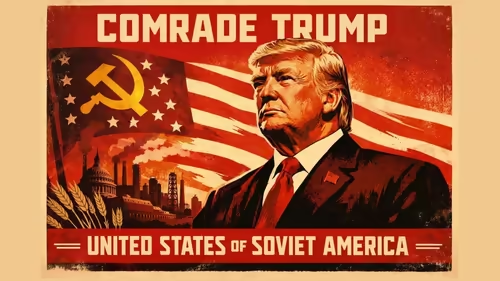
Is Donald Trump the Most Left-Leaning President in US History?
For nearly a decade, the political landscape has been dominated by one figure: Donald J. Trump. He’s been labeled a right-wing nationalist, a white supremacist, and the standard-bearer of American conservatism. But what if this entire narrative is a colossal misunderstanding? What if, beneath the bombastic rhetoric and culture-war theatrics, Trump’s actual governing philosophy was far more left-leaning than anyone admits?
This isn’t just a contrarian hot take. A growing body of analysis suggests that Trump’s core economic instincts and policy actions often defied traditional right-wing orthodoxy, placing him firmly on the populist left of the political spectrum .
Table of Contents
- The Misleading Label of “Right-Wing”
- Trump’s Left-Leaning Economic Agenda
- Populism Over Ideology
- The Foreign Policy Wild Card
- Conclusion: Redefining the Political Spectrum
- Sources
The Misleading Label of “Right-Wing”
The term “right-wing” traditionally implies a belief in limited government, free markets, fiscal conservatism, and a strong national defense rooted in international alliances. By these metrics, Trump’s presidency was a series of heresies.
He showed little interest in shrinking the size of government, instead using its power aggressively to achieve his goals. He abandoned the Republican Party’s long-standing commitment to free trade, a cornerstone of classical conservatism, in favor of protectionist tariffs that are more commonly associated with left-wing economic planning . His foreign policy was defined by a disdain for America’s traditional allies and institutions, a stance that is neither traditionally conservative nor liberal, but something entirely new: celebrity populism .
As one analysis notes, “Like the populists of the late nineteenth century, however, his economic policies clearly placed him on the left-wing of the political spectrum” . This perspective forces us to question whether our current political labels are even capable of describing a figure like Trump.
Trump’s Left-Leaning Economic Agenda
While Trump signed the massive 2017 tax cuts, which are a hallmark of Republican policy, his broader economic vision was anything but orthodox. His administration was characterized by a willingness to use state power to directly intervene in the economy, a tactic anathema to free-market conservatives.
Consider these key aspects of his agenda:
- Protectionism & Tariffs: Trump’s aggressive use of tariffs on China, Europe, and others was a direct assault on global free trade, a policy more aligned with left-wing economic nationalism than with Reagan-era conservatism.
- Skepticism of Global Capitalism: He consistently railed against multinational corporations moving jobs overseas, framing it as a betrayal of the American worker—a classic populist, and often left-leaning, grievance.
- Government Intervention: From bailing out farmers hurt by his own trade wars to threatening to use the Defense Production Act to control drug prices, Trump demonstrated a comfort with government intervention that would make many Democrats blush.
His economic policy wasn’t about a coherent ideology; it was about using the levers of state power to deliver tangible results for his base, a strategy that often borrowed from the left’s playbook on economic justice for the working class .
Populism Over Ideology
The most accurate label for Trump may not be “left” or “right,” but simply populist. His politics were driven by a direct, unmediated connection with his supporters, bypassing traditional party structures and elite institutions.
This populism is inherently fluid. It can adopt left-wing economic policies to protect workers while simultaneously embracing right-wing cultural stances on immigration and national identity. This blend has created a new faction within the GOP—voters who are “more supportive of left-leaning economic policies, more favorable toward China, more critical of Israel, and more liberal on issues” than their predecessors .
For Trump, ideology was a tool, not a guiding principle. His primary loyalty was to his own brand and his perception of his supporters’ immediate needs. This is why he could propose a repeal of the Affordable Care Act one day and then float the idea of a government-backed health plan the next. Consistency was sacrificed at the altar of political expediency and personal loyalty.
The Foreign Policy Wild Card
Trump’s foreign policy further muddies the waters. His “America First” doctrine led him to question the value of NATO, cozy up to authoritarian leaders like Vladimir Putin, and withdraw from international agreements on climate and trade.
This isolationist and transactional approach doesn’t fit neatly into the traditional left-right foreign policy divide. The left has historically been more dovish and internationalist, while the right has been hawkish and supportive of a strong global military presence. Trump rejected both, creating a chaotic and unpredictable foreign policy that was uniquely his own .
His recent comments suggesting he would encourage Russia to attack NATO members who don’t meet defense spending targets is a stark example of this break from decades of bipartisan consensus, showing a complete disregard for the alliance-based order that both Republican and Democratic presidents have upheld.
Conclusion: Redefining the Political Spectrum
So, was Donald Trump America’s most left-leaning president? In terms of a pure, ideological commitment to socialism or progressivism, absolutely not. However, when we look past the culture-war noise and examine his core economic instincts and his use of state power, a different picture emerges.
Trump’s presidency was a powerful demonstration that the old left-right spectrum is increasingly obsolete. He forged a new political path built on populism, where economic policies designed to protect the working class (often left-leaning) are fused with a hardline stance on national sovereignty and culture (often right-leaning). This new paradigm has permanently reshaped the Republican Party and American politics as a whole. To understand Trump, we must stop trying to fit him into a box that was built for a different era.
For more on the evolution of modern political movements, see our deep dive on [INTERNAL_LINK:rise-of-populism-in-the-west].
Sources
- Times of India: Random musing: Is Donald Trump America’s most left-leaning US president?
- Brookings Institution: The Trump Phenomenon and Right-wing Extremism
- Pew Research Center: Survey Analysis of Americans Overall
- Council on Foreign Relations: Does Donald Trump have a Foreign Policy Ideology?