Introduction: A Nation Mourns Its Bravehearts
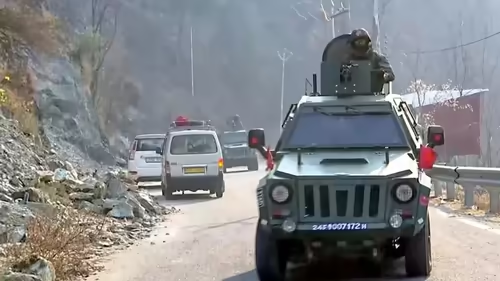
The serene yet treacherous mountains of Jammu and Kashmir were witness to a devastating tragedy on the evening of January 22, 2026. An Indian Army armoured troop carrier, en route to a critical counterterrorism operation, veered off a narrow mountain road in Doda district and plunged into a deep gorge. The result was catastrophic: ten soldiers killed and eleven others injured . This incident, now known as the Doda armoured carrier accident, has sent shockwaves across the nation and reignited a crucial conversation about the extreme risks faced by our military personnel—not just from enemy fire, but from the very terrain they are sworn to protect.
Table of Contents
- The Doda Incident: A Minute-by-Minute Breakdown
- Why Is the Doda Terrain So Dangerous?
- The Human Cost: Beyond the Headlines
- A Pattern of Peril: Road Safety in J&K
- Conclusion: Honoring the Fallen and Demanding Change
- Sources
The Doda Incident: A Minute-by-Minute Breakdown
The ill-fated journey began on the Bhaderwah-Chamba road, a route notorious for its sharp bends and steep drops. The armoured vehicle was carrying a contingent of soldiers who were being deployed for an active anti-terror operation—a mission that underscores the constant state of vigilance in the region .
Preliminary reports suggest the vehicle skidded near the Khanni Top area, a location known for its challenging topography . In a matter of seconds, the heavy carrier lost control and tumbled down a deep gorge. The impact was severe, leading to immediate fatalities and leaving many others with critical injuries.
Rescue operations were launched immediately. Given the remote and difficult location, the efforts were heroic in themselves. Many of the injured soldiers had to be airlifted to advanced medical facilities in Udhampur for urgent care . This rapid response likely saved several lives, highlighting the efficiency of the military’s emergency protocols even in the face of such a disaster.
Why Is the Doda Terrain So Dangerous?
To understand the gravity of this accident, one must look at the geography of Doda itself. The district is nestled in the middle and outer Himalayan ranges, characterized by rugged mountainous terrain, deep gorges, and dense forests . It’s a landscape of breathtaking beauty but also immense danger.
The roads in Doda are often narrow, winding, and carved directly into the mountainside. They are susceptible to landslides, especially during inclement weather, and offer little room for error. The district’s own industrial profile acknowledges that it has “mostly a hilly terrain,” which is a primary factor in its vulnerability to road accidents .
In fact, local authorities have long recognized this threat. The District Road Safety Committee has been actively working to identify accident-prone zones and improve coordination among emergency services . Despite these efforts, the inherent risks of navigating such a landscape, particularly for large, heavy military vehicles, remain exceptionally high.
The Human Cost: Beyond the Headlines
Behind the stark numbers—10 dead, 11 injured—are stories of families shattered and futures erased. These were not just soldiers; they were sons, brothers, and fathers. Their mission was to protect the nation, yet they fell victim to the unforgiving environment of the very land they were defending.
This tragedy is a poignant reminder of the multifaceted dangers our armed forces confront. While much of the public discourse around military sacrifice focuses on combat, incidents like the Doda armoured carrier accident reveal another, often overlooked, battlefield: the treacherous infrastructure of conflict zones. Every deployment on these mountain roads is a gamble with fate.
A Pattern of Peril: Road Safety in J&K
Unfortunately, this is not an isolated event. The rugged topography of Jammu and Kashmir makes it a hotspot for road accidents, both civilian and military. A report on road safety in Doda explicitly states, “The district due to its terrain is prone to road accidents” .
Rash driving and reckless behavior are cited as common causes, but in the context of military operations, the pressure of time, the weight of the vehicle, and the condition of the roads themselves are significant contributing factors . The army is constantly moving personnel and equipment through these hazardous corridors, a logistical necessity that comes with a heavy price.
This incident should serve as a catalyst for a comprehensive review of military logistics and transportation safety protocols in mountainous regions. Are there better vehicle designs for such terrain? Can routes be better maintained or alternative, safer paths be developed? These are questions that demand urgent answers from both military and civilian authorities.
Conclusion: Honoring the Fallen and Demanding Change
The loss of ten brave soldiers in the Doda armoured carrier accident is a national tragedy that extends far beyond a simple traffic incident. It is a stark symbol of the relentless challenges faced by our armed forces in one of the world’s most difficult operational environments.
While we mourn their sacrifice, we must also honor them by demanding action. Investing in safer infrastructure, developing specialized military transport for mountain warfare, and enhancing real-time terrain monitoring could prevent future heartbreak. Their ultimate sacrifice should not be in vain. We owe it to them, and to the soldiers who continue to serve on those perilous roads, to make their journey a little less dangerous.
Sources
- Times of India: 10 soldiers killed, 11 injured as armoured carrier skids off mountain road in Jammu & Kashmir’s Doda
- Daijiworld: Ten Army personnel killed as vehicle plunges into gorge in Doda
- Jammu and Kashmir Government Portal: Doda District Profile
- [INTERNAL_LINK:jammu-and-kashmir-security-operations-2026]
- [INTERNAL_LINK:indian-army-challenges-in-high-altitude-warfare]