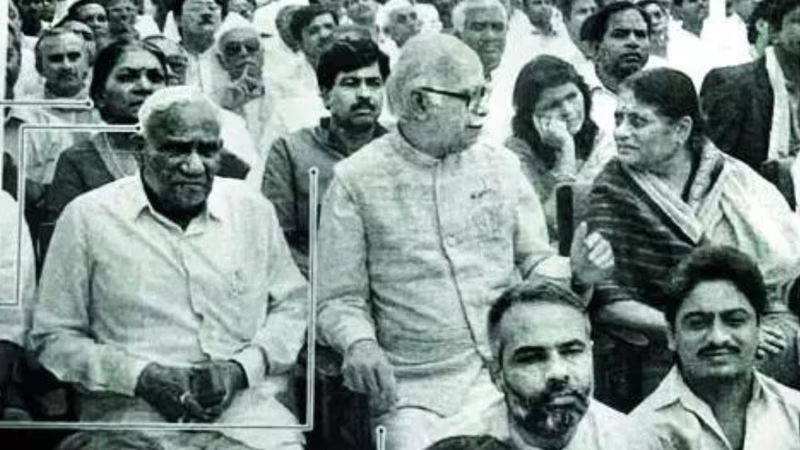
In what can only be described as political dynamite dropped inside the Congress party’s inner sanctum, veteran leader Digvijaya Singh has ignited a firestorm by publicly praising the RSS-BJP’s organizational machinery—and holding up Prime Minister Narendra Modi’s rise from grassroots worker to national leader as the gold standard .
The comments, made during a closed-door Congress Working Committee (CWC) meeting, were not just a passing observation. They were a direct critique of the party’s current top-down leadership model, widely seen as revolving around the Gandhi family. Singh didn’t just admire the opposition—he held it up as a mirror to Congress’s own structural decay.
Unsurprisingly, his remarks have split the party down the middle, exposed deep generational and ideological rifts, and handed the BJP a ready-made weapon to intensify its attacks on Rahul Gandhi’s leadership. This isn’t just internal party chatter—it’s a defining moment in the Congress’s existential struggle to reinvent itself.
Table of Contents
- Digvijaya Singh Praises RSS BJP: The Controversial Remarks
- What He Said About Modi’s Rise and Congress Failures
- Internal Congress Reaction: Split and Silence
- BJP Seizes Moment: Attacks Rahul Gandhi
- The Bigger Picture: Centralization vs. Decentralization
- Historical Context: Congress’s Organizational Decline
- What Comes Next for Congress?
- Sources
Digvijaya Singh Praises RSS BJP: The Controversial Remarks
During the recent CWC conclave, Digvijaya Singh—known for his blunt, often contrarian takes—shared a photo of Prime Minister Narendra Modi and made a stunning declaration: the RSS-BJP ecosystem’s disciplined, bottom-up structure is something the Indian National Congress desperately needs to study and replicate .
“Modi became Prime Minister not because he was born into a political family,” Singh reportedly said, “but because he rose through the ranks—from RSS pracharak to BJP worker to Chief Minister to PM. That’s organizational strength.”
He contrasted this with the Congress’s current reality: a party where key decisions are made by a small circle in Delhi, state units feel ignored, and grassroots workers see little path to leadership unless they carry the right surname.
What He Said About Modi’s Rise and Congress Failures
Singh’s core argument wasn’t just about admiration—it was a call for radical reform. He argued that the Congress’s over-centralized model has crippled its ability to respond to local issues, nurture new leaders, and build a sustainable political future.
He pointed to several systemic failures:
- Lack of internal democracy: Candidates are often parachuted in, bypassing local voices.
- Leadership stagnation: Few non-Gandhi leaders have risen to national prominence organically in decades.
- Weak organizational connect: The party’s booth-level machinery has atrophied in many states, unlike the BJP’s hyper-local ‘karyakarta’ network .
By praising Modi’s journey from a grassroots RSS functionary, Singh was implicitly criticizing the Congress’s dynastic culture and its retreat from organizational work—a retreat that began in earnest after the 1980s.
Internal Congress Reaction: Split and Silence
The reaction within the Congress has been a mix of quiet agreement, furious denial, and strategic silence.
Younger and regional leaders—particularly those from states like Rajasthan, Madhya Pradesh, and Chhattisgarh—reportedly nodded in private agreement, seeing Singh’s words as a long-overdue truth bomb .
But the official party line? Radio silence. No statement from the AICC, no clarification from Sonia or Rahul Gandhi. That silence speaks volumes. It suggests the leadership is either unwilling to engage in this debate or fears that validating Singh’s critique would legitimize the BJP’s narrative.
BJP Seizes Moment: Attacks Rahul Gandhi
The BJP wasted no time. Within hours of the news breaking, BJP spokespersons were all over television studios and social media.
“Even Congress veterans admit their party is leaderless and directionless,” said one BJP leader. “While PM Modi built a party from the ground up, Rahul Gandhi can’t even hold a press conference without a script.”
The BJP’s messaging machine has now weaponized Singh’s comments to reinforce its favorite narrative: that the Congress is a hollowed-out, dynastic club, while the BJP is a meritocratic, mass-based movement. It’s a contrast they’ve been pushing for years—but now, they have a Congress insider’s words to back it up.
The Bigger Picture: Centralization vs. Decentralization
This episode is about more than one politician’s outburst. It’s about two competing models of political organization in India.
The RSS-BJP model is hierarchical but decentralized—local units have autonomy, workers are trained for decades, and leadership emerges through service and loyalty to the ideology.
The modern Congress model, by contrast, is centralized and personality-driven. Power flows from the top, and loyalty to the leadership often trumps policy or grassroots connection. As political scientist Brookings Institution has noted, this centralization has made the Congress fragile in the face of regional and ideological challenges .
Singh’s intervention forces the party to confront a painful truth: you can’t win a 21st-century election with a 20th-century structure.
Historical Context: Congress’s Organizational Decline
It wasn’t always this way. Under leaders like Sardar Patel, the Congress had one of the most robust grassroots networks in the world. But after Indira Gandhi’s centralization drive in the 1970s—epitomized by the “India is Indira, Indira is India” slogan—the party’s organizational backbone began to weaken .
By the 2000s, the party relied more on coalition math and minority vote banks than on booth-level activism. The rise of regional parties and the BJP’s organizational blitzkrieg only accelerated this decline. Today, in many states, the Congress has no meaningful presence below the district level.
What Comes Next for Congress?
The Digvijaya Singh episode is a symptom, not the disease. The real question is whether the Congress leadership will use this moment of internal dissent as a catalyst for reform—or bury it in silence and continue down its current path.
If they embrace Singh’s critique, they could initiate a genuine democratization process: empowering state units, holding internal elections, and creating pathways for new leaders. But if they dismiss it as the rant of a “frustrated old guard,” they risk further alienating their base and ceding more ground to a BJP that thrives on organizational discipline.
One thing is clear: in the battle for India’s political future, structure matters as much as message. And right now, the Congress is losing on both fronts.
Sources
- Times of India. “Sharing PM Modi photo, Digvijaya Singh lauds Sangh, BJP says attack on Rahul.” https://timesofindia.indiatimes.com/…
- Indian Express. “How BJP’s grassroots network outpaces Congress.”
- The Hindu. “Congress CWC meeting highlights internal rifts.”
- Brookings Institution. “The Organizational Challenge for India’s Opposition Parties.” https://www.brookings.edu/
- Academic sources on Congress party history and centralization (e.g., works by Paul Brass, Atul Kohli)