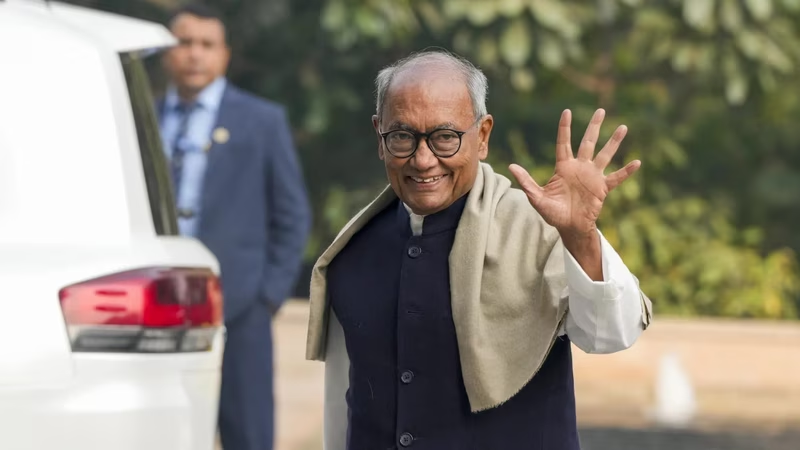
Digvijaya Singh’s ‘Power of Organisation’ Post: A Leadership Nudge or a Coterie Jab?
In the ever-dramatic world of Indian politics, a single social media post can ignite a thousand speculations. And that’s exactly what happened when veteran Congress leader Digvijaya Singh recently shared a cryptic message on X (formerly Twitter), quoting the late Madhavrao Scindia: “The power of organisation is greater than the power of individuals.”
On the surface, it reads like a nostalgic throwback to an era of structured party machinery. But in the current climate of the Indian National Congress—grappling with electoral setbacks, leadership transitions, and internal factionalism—this Digvijaya Singh Congress post has been widely interpreted as anything but innocent. Was it a gentle nudge to the party leadership? Or a sharp jab at Rahul Gandhi’s so-called ‘parivar’ (family-style coterie)?
Coming from a G-23 leader—a group of senior Congress figures who have previously called for internal reforms and collective leadership—the timing and phrasing feel deliberate. And in Indian political parlance, subtlety often speaks louder than slogans.
Table of Contents
- What Did Digvijaya Singh Post—and Why It Matters
- Digvijaya Singh Congress Post: A Message to Leadership?
- The Coterie Question: Is He Attacking Rahul Gandhi’s Inner Circle?
- Historical Context: The Decline of Congress Organisational Structure
- Reactions and Repercussions Within the Party
- Summary and Conclusion
- Sources
What Did Digvijaya Singh Post—and Why It Matters
On December 29, 2025, Digvijaya Singh shared a quote from former Congress stalwart Madhavrao Scindia, emphasizing that “the power of organisation is greater than the power of individuals.” The accompanying caption was minimal, but the implication was seismic.
In today’s Congress, where decisions are often perceived to flow from a small, close-knit circle around the Gandhi family rather than through formal party forums like the Congress Working Committee (CWC), the post reads like a coded critique. It’s a reminder that the Congress was once built on a robust, grassroots organisational model—not personality cults.
Digvijaya Singh Congress Post: A Message to Leadership?
Many political analysts believe Singh’s message is directed squarely at the party’s top leadership. The Congress has suffered a string of electoral defeats in recent years, from state elections to the 2024 Lok Sabha polls, where it underperformed despite high expectations .
Critics within the party, including the G-23 group, argue that this is due to a hollowed-out organisational structure. Without strong state units, district committees, and block-level workers, the party relies too heavily on national-level rallies and social media campaigns—tactics that lack staying power.
By invoking Scindia—a leader known for his organisational acumen—Singh is implicitly urging the Congress to return to its roots. As he told The Indian Express in a past interview, “Organisation is the backbone of any political party. Without it, you’re just a movement, not a ruling alternative” .
The Coterie Question: Is He Attacking Rahul Gandhi’s Inner Circle?
Equally potent is the interpretation that Singh is targeting Rahul Gandhi’s advisory circle—often derided by critics as a non-elected, unelected “kitchen cabinet” that bypasses formal party democracy.
This group, consisting of a handful of loyalists and consultants, is accused of monopolizing access to the Gandhi family and dictating strategy without accountability to the wider party. For old guards like Singh, this model is anathema to the Congress’s democratic traditions.
Key signs that this is a coterie jab include:
- The emphasis on organisation vs. individuals—a direct contrast to personality-driven politics.
- Singh’s history of advocating for collective decision-making, not top-down diktats.
- The post’s timing, just weeks after Congress’s poor showing in key state by-elections.
Historical Context: The Decline of Congress Organisational Structure
To understand the weight of Singh’s statement, one must look back. In its heyday under leaders like K. Kamaraj and S. Nijalingappa, the Congress ran on a powerful organisational engine. State presidents had real authority, and party discipline was enforced through internal mechanisms.
But over the decades—particularly post-Indira Gandhi—the party became increasingly centralized around the Nehru-Gandhi family. Regional satraps were sidelined, and organisational posts became rewards for loyalty rather than merit .
[INTERNAL_LINK:congress-party-organisational-revival] Today, many state units exist only on paper. This structural decay is what Digvijaya Singh and the G-23 have been warning about for years.
Reactions and Repercussions Within the Party
Unsurprisingly, the post has divided Congress ranks. Younger leaders and Gandhi loyalists have dismissed it as “nostalgic noise,” arguing that modern politics demands agile, responsive leadership—not bureaucratic machinery .
But a significant section of the old guard—especially in states like Madhya Pradesh, Rajasthan, and Chhattisgarh—has quietly applauded Singh’s stance. They see the party’s future hinging on rebuilding its base, not just crafting viral hashtags.
So far, the official leadership has remained silent—a strategy typical of the Congress when navigating internal dissent.
Summary and Conclusion
Digvijaya Singh’s post on the “power of organisation” is far more than a historical quote. In the context of the Congress’s current identity crisis, it’s a strategic intervention—one that questions the very foundation of how the party is run today. Whether it’s a respectful nudge to the leadership or a pointed critique of Rahul Gandhi’s inner circle, the message is clear: the Congress cannot win elections without first rebuilding its organisational soul. In a party where silence often speaks volumes, Singh has chosen to speak—and the entire political ecosystem is listening.
Sources
- Times of India: Message to Congress leadership or attacking coterie? Why Digvijaya Singh’s ‘power’ post is intriguing
- The Hindu: G-23 leaders renew call for organisational reforms in Congress
- Mint: Congress’s 2024 Election Performance: A Deep Dive
- JSTOR: The Evolution of the Indian National Congress – Organisational Structure (Academic Source)
- Indian Express: Digvijaya Singh on Why Congress Needs Strong Organisation