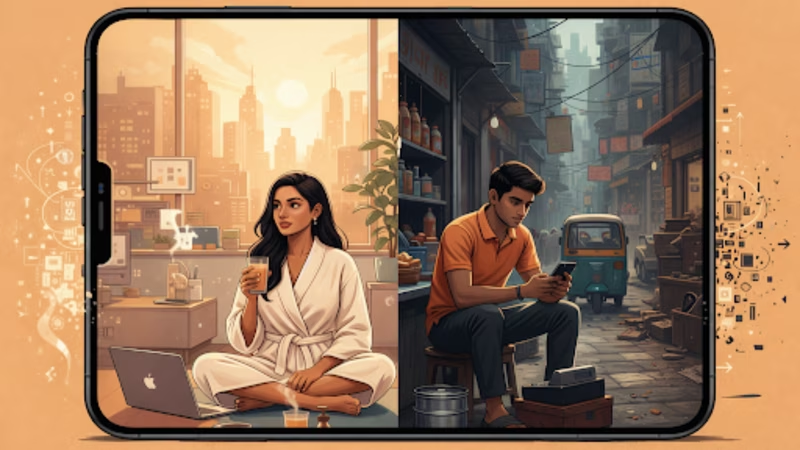
Your thumb scrolls. A reel of a luxury resort in Goa flashes by. The next post is a farmer’s plea for help after his crops failed. Then, a meticulously staged coffee table, followed by a street vendor’s time-lapse of a 14-hour workday. This isn’t just your feed—it’s the digital divide India on full, surreal display in 2025.
In a nation where over 491 million people are on social media , the virtual world has become the ultimate public square. But it’s a square with two distinct sides, separated not by geography, but by a curated illusion. As affordable data and smartphones push internet penetration to new heights—especially in Tier-2 and Tier-3 cities—these two worlds are now sharing the same screen, creating a complex, often jarring, national narrative.
Table of Contents
- Two Indias on One Screen
- The Rise of ‘Bharat’ Online
- The Algorithmic Abyss
- Beyond the Feed: What Does It Mean?
- Conclusion: Navigating the Duality
- Sources
Two Indias on One Screen
The most striking feature of the 2025 Indian social media experience is its inherent duality. On one side, you have what we can call the “Filtered India”: a world of aspirational content, aesthetic flat-lays, international travel vlogs, and a lifestyle that seems to exist in a perpetual state of leisure. This is the India often associated with major metros and a certain affluent class.
Right next to it, often in the very same feed, is the “Raw India”: the unfiltered chronicle of daily life for the majority. This is the India of small business owners documenting their hustle, students studying in power cuts, artisans showcasing their craft, and communities rallying around local causes. It’s authentic, immediate, and often, profoundly moving.
This isn’t a new phenomenon, but in 2025, the scale is unprecedented. The physical distance between these two worlds has always existed, but the digital divide India is now a matter of a single swipe.
The Rise of ‘Bharat’ Online
The driving force behind this new duality is a demographic earthquake in India’s digital landscape. Forget the old narrative of the internet being a metro-centric luxury. The real story is in the heartland.
As of early 2025, a staggering over 70% of India’s nearly 500 million social media users hail from Tier-2 and smaller cities . This “Bharat” is not just consuming content; they are creating it, shaping trends, and driving the next wave of digital commerce. With India’s total internet user base projected to reach over 900 million, the vast majority of this growth is fueled by these non-metro regions .
This massive influx has fundamentally altered the content ecosystem. While the “Filtered India” still exists, the feed is now overwhelmingly populated by the diverse, chaotic, and incredibly vibrant voices of the rest of the country. Their stories are no longer on the periphery; they are the main event.
Why This Shift Matters
This isn’t just about who’s posting; it’s about who the internet is for:
- Economic Power: New digital consumers are creating a massive market for affordable, locally relevant products and services .
- Cultural Influence: Regional languages, music, and humor are dominating social platforms, challenging the historical dominance of English and metro-centric culture.
- Political Voice: These newly connected citizens are using social media to organize, demand accountability, and participate in civic discourse like never before .
The Algorithmic Abyss
But here’s the paradox: even as these two worlds share the same platform, they often remain in their own bubbles. This is the work of the algorithm—the invisible hand that curates our reality.
Algorithms are designed to maximize engagement. They learn our preferences and show us more of what we like. If you engage with luxury travel, you’ll see more of it. If you follow local artisans, your feed will reflect that. This creates a digital echo chamber that can make the other India feel like a distant, almost alien, concept.
This algorithmic curation is the modern, subtle form of the digital divide India. It’s not just about access to the internet anymore—it’s about access to each other’s realities. We are all on the same highway, but we’re driving in separate, soundproof lanes.
Beyond the Feed: What Does It Mean?
This digital duality has profound real-world implications that extend far beyond our phone screens.
For businesses, it means a complete overhaul of strategy. A one-size-fits-all marketing campaign is dead. Success in 2025 requires a deep, nuanced understanding of both the premium and the mass-market consumer, who now coexist in the digital space .
For policymakers, it presents a unique challenge and opportunity. The digital space is now the primary forum for public sentiment. Ignoring the voices from Tier-2 and Tier-3 cities is no longer an option. At the same time, the digital welfare state must ensure that online access translates to real-world opportunity, not just social media presence .
For ordinary citizens, it’s a call for mindful consumption. Our feed is not reality; it’s a curated, algorithmically-chosen slice of it. The healthiest digital citizens in 2025 are those who actively seek out perspectives that challenge their own, who step out of their algorithmic lane to witness the full, complex tapestry of their nation.
Conclusion: Navigating the Duality
The 2025 Indian social media feed is a powerful, if unsettling, reflection of a nation in transition. The collapse of distance between the “Filtered India” and the “Raw India” is forcing a national conversation that was long overdue. It exposes our inequalities, celebrates our diversity, and connects us in ways that are both beautiful and bewildering.
The digital divide India is no longer just a gap in infrastructure; it’s a complex web of perception, representation, and access. The challenge for all of us—users, creators, businesses, and leaders—is not to erase this duality, but to navigate it with empathy, awareness, and a commitment to building a digital future that serves the whole of India, not just its curated parts. The story of India in 2025 is being written one scroll at a time, and every one of us is both an author and a reader.
Sources
- DataReportal – Digital 2025: India
- The Times of India – Between two Indias: Life on the 2025 feed
- 360info – India’s digital divide and the consequent welfare bias
- The Digital Divide: A Barrier to Social, Economic and Political Life
- YourStory – The Battle for Bharat: How Super Apps are Targeting Tier 2 and 3 Cities
- Financial Express – Only 20-25% of India’s 850 mn internet users shop online
- Social Samosa – Inside 2025’s Social Media Game: How Top Indian Marketers Are Winning