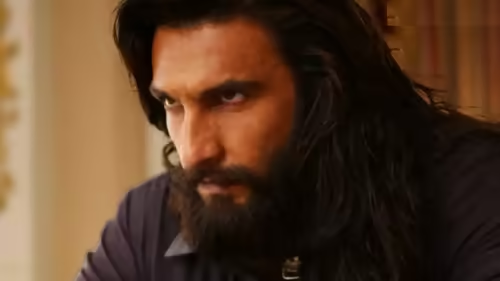
It was hailed as one of the boldest, most unfiltered Hindi films of the year—a gritty, dialogue-driven thriller that didn’t pull punches. But when fans tuned in to watch Dhurandhar on Netflix after its successful theatrical run, they were met with something jarringly different: a sanitized, partially muted, and noticeably shorter version of the film they remembered.
The backlash was immediate. Social media exploded with complaints about **muted abusive language**, **altered background scores**, and an estimated **10 minutes of missing footage**—all in a film that already carried an ‘A’ (Adults Only) certificate from the Central Board of Film Certification (CBFC). For many viewers, this raised a critical question: Why censor an ‘A’-rated movie on an OTT platform?
Table of Contents
- What Changed in the Dhurandhar OTT Release?
- Fan Reactions: Comparing OTT to Theatrical Version
- Why Are A-Rated Movies Being Censored on OTT?
- Double Standards? Animal and Kabir Singh Remain Uncut
- What This Means for Indian OTT Regulation
What Changed in the Dhurandhar OTT Release?
According to multiple viewer comparisons and side-by-side analyses, the Netflix version of Dhurandhar includes several significant alterations:
- Muted or replaced expletives: Strong language in key confrontational scenes has been either silenced or dubbed over with muffled sounds.
- Trimmed violent sequences: Approximately 8–10 minutes of runtime appear to be missing, particularly in the second half involving intense action and emotional outbursts.
- Altered background audio: In some scenes, the original score has been lowered or replaced to mask uncensored dialogue remnants.
- Visual blurring: Brief moments showing alcohol branding or suggestive gestures have been digitally obscured.
These changes are especially puzzling given that the film was cleared by the CBFC with an ‘A’ certificate—meaning it was legally intended for adult audiences only, both in theaters and at home.
Fan Reactions: Comparing OTT to Theatrical Version
Within hours of the Netflix premiere, fans began posting detailed comparisons online. One viral Twitter thread highlighted a pivotal courtroom scene where the protagonist’s explosive monologue—once raw and emotionally charged—was now reduced to awkward silence during key swear words.
“I paid for the same experience I got in theaters,” tweeted user @BollyCritic99. “Instead, I got a watered-down version that ruins the character’s intensity. If it’s ‘A’ certified, why treat it like a prime-time TV show?”
Others pointed out that the cuts disrupt narrative flow. “The 10-minute trim isn’t just filler—it includes crucial character development,” noted a Reddit user in r/Bollywood. “It feels like watching a summary, not the full story.”
Why Are A-Rated Movies Being Censored on OTT?
This isn’t the first time an ‘A’-rated film has been edited for streaming—but the inconsistency is what’s fueling frustration.
While India currently lacks a formal regulatory body for OTT platforms (the much-debated IT Rules 2021 are still evolving), streaming services often self-censor to avoid potential legal scrutiny or public backlash. Netflix, in particular, has faced pressure from advocacy groups over “excessive” violence and language in Indian originals.
Industry insiders suggest that Dhurandhar’s edits may stem from internal compliance protocols rather than government mandate. “Platforms like Netflix apply global content standards,” explains media analyst Priya Mehta. “Even if a film is ‘A’ rated in India, their internal AI or review team might flag it for ‘brand safety’—especially if ads or family profiles are linked to the account.”
[INTERNAL_LINK:indian-ott-content-regulations-explained] However, this ad-hoc approach creates confusion and erodes trust among paying subscribers who expect authenticity.
Double Standards? Animal and Kabir Singh Remain Uncut
Fans aren’t just upset—they’re calling out perceived hypocrisy. As one popular Instagram post asked: “How come Animal and Kabir Singh are available on OTT in their full, uncut glory—with all the profanity, violence, and toxic dialogue intact—while Dhurandhar gets butchered?”
Indeed, both Animal (2023) and Kabir Singh (2019) carry ‘A’ certificates and feature far more graphic content than Dhurandhar, yet remain untouched on platforms like Netflix and JioCinema. This inconsistency has led to accusations of selective censorship—possibly based on star power, production house influence, or algorithmic bias.
“It’s not about the content—it’s about who made it,” commented film critic Anupama Chopra in a recent podcast. “Smaller films without big studio backing often get the short end of the stick when platforms decide what’s ‘too risky.’”
What This Means for Indian OTT Regulation
The Dhurandhar OTT release controversy highlights a growing crisis in India’s digital entertainment landscape: the absence of transparent, uniform content guidelines for streaming platforms.
Without clear rules, platforms operate in a gray zone—sometimes over-censoring to avoid trouble, other times pushing boundaries for clicks. The result? A fragmented, unpredictable viewing experience that disadvantages both creators and audiences.
Consumer rights groups are now demanding that OTT platforms disclose editing policies upfront and offer “director’s cut” or “theatrical version” labels—much like physical media does. Until then, fans of bold cinema may keep finding their favorite films… quietly muted.
Final Summary
The censored Dhurandhar OTT release on Netflix has ignited a firestorm among fans who expected the same unfiltered experience they saw in theaters. With muted dialogues, missing scenes, and no clear explanation, the incident exposes deeper issues around inconsistent self-regulation in India’s streaming industry. As viewers rightly ask—why edit an ‘A’-rated film at all?—the demand for transparency and creative integrity grows louder.
Sources
- Times of India: Dhurandhar OTT release censored: Fans fume over muted dialogues, 10-min cuts
- Indian Express: The OTT Censorship Debate in India
- Netflix Help Center: Content Ratings and Editing Policies
- Film Companion: Why Are Indian OTT Platforms Self-Censoring?