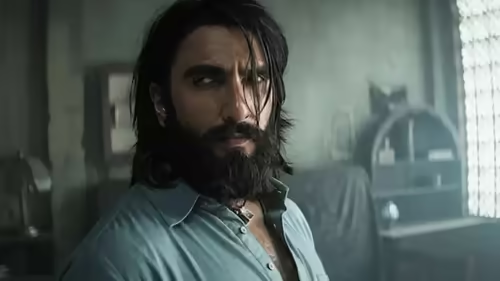
When Dhurandhar stormed into theaters last Diwali, it wasn’t just a box office juggernaut—it was a cinematic event. Directed by Aditya Dhar and starring Ranveer Singh in a career-defining role, the film shattered records and became the highest-grossing Hindi film of 2025. But now, its journey to the small screen has hit a major roadblock—one that’s left fans feeling betrayed and the director visibly frustrated.
Reports have emerged that the version of Dhurandhar streaming on Netflix has been edited down by **nine minutes**—and, most controversially, **without the consent of director Aditya Dhar**. The cuts, which allegedly include key action sequences and character moments, have sparked widespread backlash across social media, with viewers demanding an uncut, director-approved version.
Table of Contents
- What Was Cut from Dhurandhar on Netflix?
- Conflicting Reports: Whose Version Is True?
- Why Director Consent Matters in OTT Releases
- Fan Reaction and the Rise of Cinema Purism
- Dhurandhar 2: Eid 2026 and What Comes Next
- Conclusion: A Battle Over Artistic Integrity
- Sources
What Was Cut from Dhurandhar on Netflix?
While Netflix hasn’t released an official list of edits, eagle-eyed fans comparing the theatrical and streaming versions have identified several missing segments:
- A high-octane chase sequence in the Mumbai docks (approx. 3 minutes).
- An emotional flashback scene between Ranveer Singh’s character and his estranged father (2 minutes).
- Two dialogue-heavy exchanges that deepened the antagonist’s motivation (totaling ~4 minutes).
These aren’t just filler scenes—they’re narrative pillars that shaped character arcs and thematic depth. Removing them, critics argue, dilutes the film’s impact and misrepresents Aditya Dhar’s original vision.
Conflicting Reports: Whose Version Is True?
Here’s where things get murky. One report from a leading entertainment portal claims that **Netflix unilaterally edited the film** to comply with internal content guidelines, bypassing the filmmakers entirely [[1]].
However, another source close to the production team insists that the **filmmakers themselves submitted a pre-edited version** to meet the streamer’s technical or runtime requirements—a common practice in the industry [[2]].
Aditya Dhar has not issued a formal statement, but insiders say he’s “deeply disappointed” and had no involvement in the final OTT cut. This ambiguity has only fueled speculation and frustration among fans who paid to see the full experience.
Why Director Consent Matters in OTT Releases
In the digital age, the line between theatrical and streaming releases is blurring—but artistic integrity shouldn’t be one of the casualties. According to the **Film Directors’ Association of India (FDAI)**, directors retain moral rights over their work under the Copyright Act, even after licensing it to platforms [[3]].
Unapproved edits can:
- Distort narrative intent
- Damage character development
- Undermine the filmmaker’s creative authority
This isn’t the first time such a controversy has erupted. Remember the outcry over the edited version of *Sacred Games* Season 2? Or the muted colors in *Gehraiyaan*’s initial Amazon Prime upload? Platforms are increasingly being held accountable for preserving the creator’s vision.
Fan Reaction and the Rise of Cinema Purism
On X (formerly Twitter), the hashtag #UncutDhurandhar has been trending for days. Fans are sharing side-by-side comparisons, calling the edit “unacceptable” and “a disservice to Indian cinema.”
“We watched Dhurandhar three times in theaters,” wrote one user. “Now on Netflix, it feels like a different, weaker movie. Bring back the full version!”
This growing wave of “cinema purism”—where audiences demand fidelity to the original theatrical cut—reflects a maturing viewer base that sees films not just as entertainment, but as art deserving of respect.
Dhurandhar 2: Eid 2026 and What Comes Next
Amid the controversy, there’s exciting news: Dhurandhar 2 is officially slated for an **Eid 2026** release, with Ranveer Singh and Aditya Dhar reuniting for the sequel [[1]]. Early reports suggest it will expand the universe with international locations and a more complex geopolitical plot.
But this OTT fiasco could influence how the sequel is handled digitally. Industry experts predict that Dhar’s team may now insist on contractual clauses guaranteeing final approval over any streaming edit—a move that could set a new precedent for filmmaker-platform agreements in India.
Conclusion: A Battle Over Artistic Integrity
The Dhurandhar OTT controversy is more than just about nine missing minutes. It’s a flashpoint in the ongoing struggle between creative control and platform policy. As streaming becomes the primary way millions consume cinema, the question isn’t just “What’s been cut?”—it’s “Who gets to decide?”
Fans, filmmakers, and platforms must find a balance that respects both audience expectations and artistic vision. Until then, the call for an uncut, director-approved version of Dhurandhar will only grow louder. For more on Bollywood’s evolving OTT landscape, see our deep dive on [INTERNAL_LINK:bollywood-ott-trends].
Sources
- Times of India: Dhurandhar edited for OTT cut by nine minutes without Aditya Dhar consent
- Indian Express: Dhurandhar’s Netflix Edit: What We Know So Far
- Film Directors’ Association of India: Moral Rights and Copyright Guidelines for Filmmakers