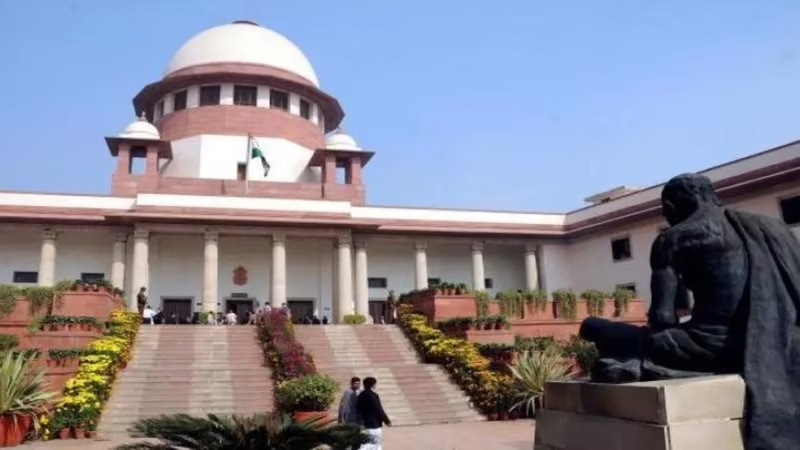
In a case that cuts to the heart of India’s ongoing citizenship crisis, a woman who says she was born in Assam—and whose 16 family members are officially recognized as Indian citizens—has been deported to Bangladesh. Now, she’s fighting back from across the border, urging the Supreme Court to intervene and restore what she insists is her rightful identity: that of an Indian citizen.
Her story isn’t just tragic—it’s emblematic of a systemic flaw in how citizenship is verified, contested, and sometimes revoked in one of the world’s most complex bureaucratic exercises: the National Register of Citizens (NRC). With documents allegedly “junked” by authorities and no recourse at the state level, her plea to the apex court raises urgent questions about due process, documentation bias, and the human cost of exclusion.
Table of Contents
- The Widow’s Claim: Born in India, But Deported to Bangladesh
- What Is the NRC and Why Does It Matter?
- How Can Someone Be Deported If Their Family Is in the NRC?
- The Role of Foreigners’ Tribunals and Document Rejection
- Legal Precedents and Supreme Court Intervention
- Broader Implications for Thousands in Assam
- Conclusion: A Test for India’s Commitment to Justice
- Sources
The Widow’s Claim: Born in India, But Deported to Bangladesh
According to court filings, the petitioner—a widow from Assam—asserts she was born in Dhubri district, a region historically part of undivided India and now in western Assam. She submitted multiple legacy documents, including electoral rolls, land records, and school certificates, to prove her lineage.
Critically, 16 of her close relatives—including parents, siblings, and children—were included in the final NRC list published in 2019, a document meant to identify “genuine Indian citizens” in Assam . Yet, her own application was rejected. Authorities reportedly dismissed her supporting papers as “inadmissible” or “junked,” a phrase that appears in official notes cited in media reports .
Following her exclusion, she was declared a “foreigner” by a Foreigners’ Tribunal and subsequently deported to Bangladesh—a country she claims she has never lived in and where she has no ties.
What Is the NRC and Why Does It Matter?
The National Register of Citizens was first prepared in 1951 but was updated in Assam following a 2014 Supreme Court directive. The goal? To identify undocumented immigrants, primarily from Bangladesh, who entered after March 24, 1971—the day before Bangladesh’s independence.
Over 33 million people applied for inclusion. In 2019, nearly 1.9 million were left out—rendering them legally vulnerable to detention or deportation . While the process was hailed as a tool for national security, critics warned it would disproportionately impact the poor, women, and marginalized communities who often lack formal documentation.
This widow’s case appears to validate those fears: even with familial proof and legacy data, bureaucratic hurdles can override lived reality.
How Can Someone Be Deported If Their Family Is in the NRC?
Technically, NRC inclusion is individual—not familial. Each person must independently prove their lineage through a chain of admissible documents. However, having close relatives in the NRC is often treated as strong corroborative evidence.
In this case, the discrepancy is stark. How can 16 direct family members be deemed “Indian” while one is not—especially when they share the same ancestral roots? Legal experts suggest possible reasons:
- Inconsistent document standards: One tribunal may accept a birth certificate another rejects.
- Gender bias: Women, especially widows, often lack property or voter records in their own names.
- Administrative error: Misplaced files or clerical mistakes during mass processing.
Whatever the cause, the outcome is devastating: statelessness.
The Role of Foreigners’ Tribunals and Document Rejection
Foreigners’ Tribunals (FTs)—quasi-judicial bodies in Assam—are empowered to determine citizenship. But they’ve faced criticism for opaque procedures, lack of legal aid, and high rejection rates.
A 2022 report by the Commonwealth Human Rights Initiative found that FTs often dismiss legacy documents like pre-1971 electoral rolls if minor discrepancies exist—such as spelling variations in names or missing middle initials . For illiterate or rural populations, such errors are common, not fraudulent.
In this widow’s case, the phrase “9 docus junked” (as reported) suggests her entire evidentiary base was discarded without adequate justification—a practice that undermines the very principle of fair hearing.
Legal Precedents and Supreme Court Intervention
The Supreme Court has previously ruled that citizenship cannot be determined solely on documentary technicalities. In State of Assam v. Moslem Mondal (2014), the Court emphasized that “the benefit of doubt should go to the individual.”
Moreover, in 2020, the Court stayed all deportations arising from NRC exclusions, noting the humanitarian risks involved . This widow’s appeal could test whether that protection extends to those already removed.
Her lawyers are likely to argue that her deportation violates Article 21 of the Constitution—the right to life and personal liberty—which includes the right to identity and dignity.
Broader Implications for Thousands in Assam
This isn’t an isolated case. Thousands remain in limbo—detained in camps, separated from families, or living in fear of deportation. Many, like this widow, have deep roots in India but lack the paperwork to prove it.
If the Supreme Court rules in her favor, it could set a precedent for re-evaluating other exclusions based on familial NRC inclusion and legacy data. If not, it may signal that bureaucratic rigidity trumps human reality.
Conclusion: A Test for India’s Commitment to Justice
The case of a woman deported to Bangladesh despite her family’s NRC status is more than a legal anomaly—it’s a moral reckoning. At stake is not just one woman’s citizenship, but the integrity of a system meant to protect national identity without erasing human dignity.
As the Supreme Court weighs her plea, the nation watches. Will justice recognize that belonging isn’t just about documents—but about generations of lived experience on Indian soil?
Sources
- Times of India: Deported to Bangladesh, widow moves SC, says born in India, 16 of family in NRC
- The Hindu: Assam NRC Final List – 1.9 Million Left Out
- Commonwealth Human Rights Initiative: Foreigners’ Tribunals in Assam – A Critical Review
- Supreme Court Order on NRC Deportations (2020)
- Internal: Understanding the Assam NRC Process and Its Controversies