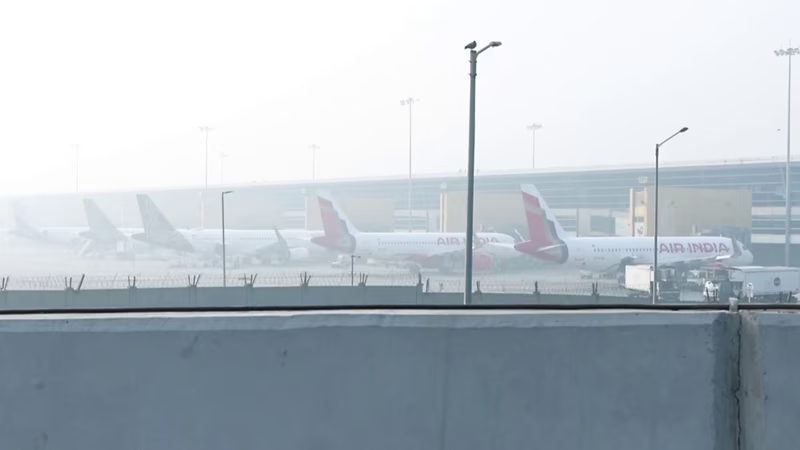
Delhi Crippled by Dense Fog: Is This the New Normal for Winter Travel?
It’s that time of year again. The air in Delhi turns thick, grey, and almost solid. Visibility drops to near zero, and the city’s complex web of transport—its lifeline—grinds to a halt. In a stark reminder of winter’s grip, a severe bout of dense fog in Delhi has plunged the capital into chaos, cancelling over 120 flights, delaying nearly 200 others, and causing significant disruptions on the national rail network . For thousands of stranded travelers during the busy holiday season, this isn’t just an inconvenience; it’s a logistical and personal nightmare.
Table of Contents
- The Scale of the Chaos: Flights and Railways in Disarray
- Dense Fog in Delhi: Why Does This Keep Happening?
- The Hidden Danger: Beyond Travel Delays
- What Is Being Done? The Response from Authorities
- A Traveler’s Guide to Navigating Delhi’s Foggy Winters
- Conclusion: Is Delhi Prepared for Its Annual Fog Crisis?
- Sources
The Scale of the Chaos: Flights and Railways in Disarray
The primary victim of the dense fog in Delhi was Indira Gandhi International Airport (IGI), one of the busiest aviation hubs in South Asia. With visibility plummeting below 50 meters—far below the 125-meter minimum required for most commercial landings—air traffic controllers had no choice but to impose severe restrictions .
The results were staggering:
- Over 120 flights were outright cancelled. Passengers were left stranded in terminals, scrambling for rebookings or refunds.
- Nearly 200 flights were delayed, some for several hours, creating a massive ripple effect across domestic and international routes.
- Several incoming flights were diverted to alternative airports like Jaipur and Amritsar, adding to the logistical headache for airlines and passengers alike .
On the ground, the national rail network wasn’t spared. Indian Railways reported significant delays and cancellations on key routes originating from or passing through New Delhi Railway Station and Hazrat Nizamuddin. For safety reasons, drivers were forced to reduce speeds drastically, leading to widespread disruptions and anxious travelers unsure of their arrival times .
Dense Fog in Delhi: Why Does This Keep Happening?
This annual crisis is not just ‘bad weather.’ It’s a predictable, recurring event driven by a combination of meteorological and man-made factors. During the winter months, cold, dry air from the Himalayas meets the moisture-laden air over the Indo-Gangetic plain. Without strong winds to disperse it, this moisture condenses into fog.
However, the problem is massively exacerbated by air pollution. The toxic cocktail of vehicle emissions, industrial pollutants, and stubble burning residue from neighboring states provides millions of ‘condensation nuclei’—tiny particles that water vapor clings to, making the fog denser, more persistent, and far more hazardous . Meteorologists from the India Meteorological Department (IMD) have confirmed that this particular spell of fog was intensified by these high levels of particulate matter .
The Hidden Danger: Beyond Travel Delays
While the travel disruptions are front-page news, the more insidious threat lies in the health impacts. This isn’t just fog; it’s often a form of smog—a toxic mix of water droplets and harmful pollutants like PM2.5 and PM10.
Exposure to such conditions can lead to:
- Severe respiratory problems, especially for children, the elderly, and those with asthma or bronchitis.
- Increased risk of heart attacks and strokes.
- Eye and skin irritation.
The World Health Organization (WHO) has long warned about the dangers of air pollution in cities like Delhi, which consistently ranks among the world’s most polluted . This dense fog is a visible manifestation of that invisible health crisis.
What Is Being Done? The Response from Authorities
In response to the crisis, authorities have activated emergency protocols. At IGI Airport, Air Traffic Control is providing minute-by-minute updates and has deployed advanced Instrument Landing Systems (ILS) to assist any aircraft capable of using them in low-visibility conditions .
Indian Railways has issued a public advisory, urging passengers to check the status of their trains on the NTES (National Train Enquiry System) app before heading to the station. Local traffic police are also on high alert, managing the increased risk of road accidents due to poor visibility .
For health concerns, the Delhi government has advised residents to stay indoors, use air purifiers, and wear N95 masks if they must go outside. You can find more detailed health advisories and air quality data on the official Central Pollution Control Board (CPCB) website .
A Traveler’s Guide to Navigating Delhi’s Foggy Winters
If you’re planning to travel to or through Delhi between December and January, it’s wise to be prepared:
- Build in Buffer Time: Always assume your flight or train could be delayed by several hours.
- Check Real-Time Status: Use official airline apps, the AAI (Airports Authority of India) website, or the NTES app for the latest updates before you leave for the airport or station.
- Pack a Health Kit: Carry an N95 mask, eye drops, and any necessary medication for respiratory issues.
- Have a Backup Plan: Know the alternative airports or train routes in case of a diversion or cancellation.
For more essential tips, check out our [INTERNAL_LINK:winter-travel-tips-delhi] guide.
Conclusion: Is Delhi Prepared for Its Annual Fog Crisis?
The recurring chaos caused by dense fog in Delhi highlights a critical gap between our technological capabilities and our long-term environmental planning. While advanced landing systems and real-time apps can mitigate the immediate travel fallout, they are mere band-aids on a much deeper wound: the city’s chronic air pollution. Until systemic changes are made to address the root causes of this toxic winter phenomenon, the capital will remain vulnerable to this predictable, paralyzing annual event. For now, the best we can do is stay informed, stay safe, and plan our journeys with extreme caution.
Sources
- Times of India: “Dense fog paralyses Delhi…” (Article ID: 126227456) .
- Airports Authority of India (AAI) Official Advisory on IGI Airport Operations .
- India Meteorological Department (IMD) Weather Bulletin for Delhi .
- The Hindu: “Over 120 flights cancelled at Delhi airport due to fog” .
- Indira Gandhi International Airport (IGI) Operational Update .
- Hindustan Times: “Rail services hit as dense fog blankets North India” .
- India Today: “Delhi’s dense fog: A blend of weather and pollution” .
- World Health Organization (WHO) – Ambient Air Pollution Data .
- Central Pollution Control Board (CPCB) – Air Quality Index Portal .