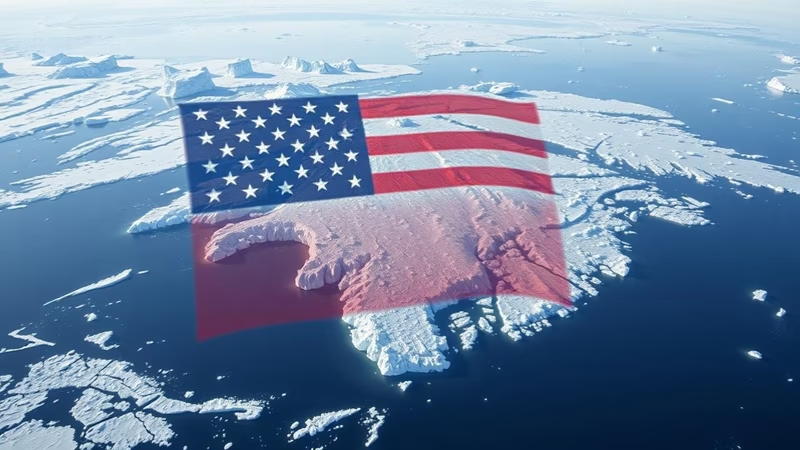
The icy expanse of Greenland is no longer just a remote outpost—it’s becoming a frontline in a new era of great-power competition. In a decisive response to growing U.S. concerns over Arctic security, Denmark has announced it will significantly strengthen its military presence in Greenland. This move isn’t just about sovereignty; it’s a clear signal to allies and adversaries alike that Copenhagen is serious about defending NATO’s northernmost frontier.
Table of Contents
- Why Denmark Is Acting Now
- Denmark Military Presence Greenland: What’s Changing?
- The ‘US Greenland Threat’ Context
- Greenland’s Strategic Value in the Arctic Race
- NATO’s Role and Alliance Reassurance
- Conclusion
- Sources
Why Denmark Is Acting Now
For decades, Greenland—though an autonomous territory within the Kingdom of Denmark—has been a quiet backwater in global defence planning. But climate change and geopolitical rivalry have changed everything. As Arctic ice melts, new shipping lanes open, and vast mineral and energy reserves become accessible, the region has drawn intense interest from Russia, China, and the United States.
Recent statements from U.S. officials expressing concern over potential gaps in Arctic surveillance and defence appear to have spurred Copenhagen into action. Rather than waiting for external pressure to mount, Denmark is proactively reinforcing its commitment to collective security—on its own terms.
Denmark Military Presence Greenland: What’s Changing?
The Danish government’s plan involves a multi-pronged enhancement of its capabilities in the world’s largest island:
- Permanent Military Deployment: Establishing a year-round naval and air presence, including patrol vessels and surveillance aircraft stationed at Thule Air Base and other key locations.
- Infrastructure Investment: Upgrading ports, airstrips, and communication networks to support sustained operations in extreme conditions.
- NATO Integration: Hosting more joint exercises with allied forces and enhancing data-sharing on maritime domain awareness in the North Atlantic and Arctic Ocean.
- Personnel Increase: Expanding the contingent of Danish Armed Forces personnel dedicated to Greenlandic operations, including specialized Arctic warfare units .
This marks a dramatic shift from Denmark’s historically light-footprint approach. The goal? To ensure that any activity near Greenland—whether scientific, commercial, or military—is monitored and, if necessary, challenged under international law.
The ‘US Greenland Threat’ Context
The phrase “US Greenland threat” might sound alarming, but it stems from a series of candid assessments by American defence leaders. In recent years, U.S. officials have repeatedly warned that the Arctic is the “least defended” part of NATO territory, with Russia rapidly modernizing its Northern Fleet and China declaring itself a “near-Arctic state” .
While the U.S. operates the strategically vital Thule Air Base in northern Greenland under a 1951 defence agreement, it relies heavily on Denmark for overall sovereignty and coordination. Washington’s implicit message has been clear: if Denmark doesn’t step up, others might fill the void—or worse, exploit it. Denmark’s response is both a reassurance to Washington and a reassertion of its own authority.
Greenland’s Strategic Value in the Arctic Race
Why all the fuss over a sparsely populated island? Three reasons:
- Geographic Position: Greenland sits between North America and Europe, controlling access to the Northwest Passage and the GIUK Gap (Greenland-Iceland-UK)—a critical chokepoint for naval movements.
- Resource Wealth: Estimates suggest vast deposits of rare earth minerals, oil, and natural gas lie beneath its ice—resources essential for green tech and national security.
- Early Warning Capability: Thule Air Base hosts U.S. missile warning and space surveillance systems, making it indispensable to North American defence .
As one NATO strategist noted, “Who controls Greenland doesn’t just influence the Arctic—they shape transatlantic security for decades” .
NATO’s Role and Alliance Reassurance
Denmark’s move is deeply embedded in its NATO obligations. By boosting its military presence in Greenland, Copenhagen is fulfilling its role as a responsible ally while also pushing the alliance to take the High North more seriously.
In 2023, NATO established its first formal Arctic policy framework, recognizing the region as a zone of emerging risk. Denmark’s actions provide tangible support to this strategy, offering concrete assets rather than just rhetoric. For smaller NATO members, this is a way to punch above their weight—and secure greater U.S. and European backing in return.
For deeper insights into how climate change is reshaping global security, see our feature on [INTERNAL_LINK:climate-security-arctic-militarization].
Conclusion
Denmark’s decision to enhance its military presence in Greenland is far more than a national defence update—it’s a geopolitical statement. In an age where ice is receding but tensions are rising, Copenhagen is positioning itself as a guardian of the Arctic order. By acting decisively, Denmark not only addresses U.S. concerns but also strengthens NATO’s cohesion and deters opportunistic moves by rival powers. The message from the North is clear: the Arctic may be frozen, but the race for its future is heating up fast.
Sources
- Times of India. (2026). ‘Will boost military presence’: Denmark hits back at US’ Greenland threat. Retrieved from https://timesofindia.indiatimes.com/world/europe/will-boost-military-presence-denmark-hits-back-at-us-greenland-threat-to-beef-up-arctic-defences/articleshow/126523643.cms
- Ministry of Defence, Denmark. (2026). Arctic Strategy and Greenland Defence Plan.
- NATO. (2023). NATO’s Approach to the High North. Retrieved from https://www.nato.int/
- U.S. Department of Defense. (2025). Report on Arctic Capabilities and Security.
- Council on Foreign Relations. (2025). The Geopolitics of the Melting Arctic. Retrieved from https://www.cfr.org/