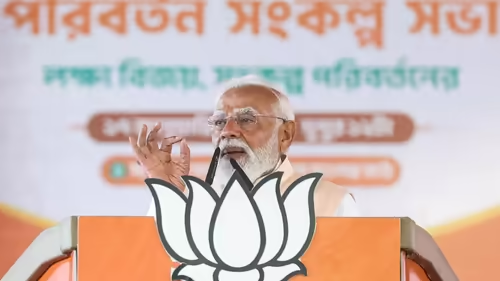
The political temperature in West Bengal has just shot through the roof. At a massive rally in the heart of the state, Prime Minister Narendra Modi didn’t just attack his political rivals—he pointed to a far more explosive and deeply sensitive issue: demographic imbalance. In a statement that has sent shockwaves across the political spectrum, PM Modi asserted that this “imbalance” is the primary driver behind the persistent violence plaguing parts of Bengal.
This isn’t just another campaign soundbite. It’s a deliberate invocation of a long-standing, highly polarizing narrative that has shaped national discourse for years. With assembly elections looming, the Prime Minister’s words are being seen as both a strategic political gambit and a dangerous escalation of communal rhetoric. But what exactly did he say, and why does it matter so much right now?
Table of Contents
- What PM Modi Said at the Bengal Rally
- Understanding ‘Demographic Imbalance’ in Bengal
- The Political Context: West Bengal’s Electoral Battle
- Reactions from Opposition and Civil Society
- Historical Precedents and the National Debate
- Expert Analysis: Is There a Statistical Basis?
- Conclusion: A Defining Moment for Bengal Politics
- Sources
What PM Modi Said at the Bengal Rally
Speaking to a sea of supporters, PM Modi drew a direct line between law and order issues and population dynamics. “Wherever there is a demographic imbalance, you will find an increase in violence and a breakdown of social harmony,” he declared . He went on to criticize the state government, led by Chief Minister Mamata Banerjee, for allegedly failing to protect the interests of all communities and allowing certain areas to become “no-go zones” for specific groups.
While he didn’t explicitly name any community, the implication was clear to many observers. The phrase “demographic imbalance” has, in recent political discourse, often been used as a coded reference to changes in religious or ethnic population ratios, particularly concerning migration.
Understanding ‘Demographic Imbalance’ in Bengal
The concept of demographic imbalance Bengal is complex and historically layered. West Bengal shares a long, porous border with Bangladesh, leading to decades of migration—both documented and undocumented. Successive governments have grappled with the socio-economic and political implications of this movement.
Census data shows shifts in population composition over time, but attributing violence solely to these shifts is a massive oversimplification. Experts argue that land disputes, political patronage, economic marginalization, and local power struggles are far more immediate causes of conflict than broad demographic trends .
The Political Context: West Bengal’s Electoral Battle
This statement comes at a critical juncture. The ruling Trinamool Congress (TMC), led by Mamata Banerjee, is locked in a fierce battle for survival against a resurgent BJP, which is aiming to replicate its 2019 Lok Sabha success at the state level. The BJP’s strategy has increasingly focused on identity-based politics, seeking to consolidate its base by highlighting issues of security, culture, and demography.
By framing the election as a choice between “chaos” and “order,” and linking the former to demographic change, the PM is attempting to tap into deep-seated anxieties among certain voter blocs. It’s a high-stakes play that could energize his core supporters but also risks deepening social fissures.
Reactions from Opposition and Civil Society
Unsurprisingly, the opposition has hit back hard. TMC leaders called the remarks “divisive,” “irresponsible,” and an attempt to “import foreign agendas into Bengal’s soil.” They accused the BJP of trying to stoke fear for electoral gain rather than addressing real governance issues like unemployment and healthcare.
Civil society groups and legal experts have also expressed concern. “Using vague and inflammatory terms like ‘demographic imbalance’ without evidence can fuel prejudice and lead to real-world harm,” warned a spokesperson for a leading human rights organization .
Historical Precedents and the National Debate
PM Modi’s comments echo a broader national narrative that has gained traction over the past decade. The idea of “ghar wapsi” (returning home) and concerns about “illegal immigration” have been central planks of the BJP’s platform. The controversial Citizenship Amendment Act (CAA) of 2019 was itself rooted in this worldview, offering a path to citizenship for non-Muslim migrants from neighboring countries.
This framing positions certain communities as “outsiders” or “infiltrators,” a narrative that critics argue undermines India’s secular and pluralistic foundations. For more on this, see our explainer on [INTERNAL_LINK:india-citizenship-laws-and-politics].
Expert Analysis: Is There a Statistical Basis?
Let’s look at the data. According to the 2011 Census—the latest available—West Bengal’s religious demographics showed a Muslim population of approximately 27%, up from 25% in 2001. While this is a notable increase, it is not dramatically out of step with national trends or natural growth rates.
More importantly, studies by institutions like the Centre for Policy Research have found that most violence in Bengal’s border districts is driven by localized factors like smuggling, land grabbing, and political rivalry—not by abstract demographic shifts . Attributing complex social problems to a single cause is not just inaccurate; it’s dangerous.
Conclusion: A Defining Moment for Bengal Politics
PM Modi’s remarks on demographic imbalance Bengal have set the stage for one of the most volatile and closely watched elections in recent history. Whether this strategy will pay off electorally remains to be seen, but its impact on social cohesion is already evident. As Bengal stands at a crossroads, the choices made in the coming weeks will not only shape its political future but also test the resilience of its famously syncretic culture. One thing is certain: the stakes have never been higher.
Sources
[1] Times of India: In poll-bound Bengal, PM Modi blames demographic imbalance for violence
[4] Economic & Political Weekly: Migration and Identity in West Bengal
[5] Amnesty International India: Statement on inflammatory political rhetoric
[6] Centre for Policy Research: Borderland Realities – Conflict and Cooperation in Bengal
[7] Census of India 2011: West Bengal District Religion Data