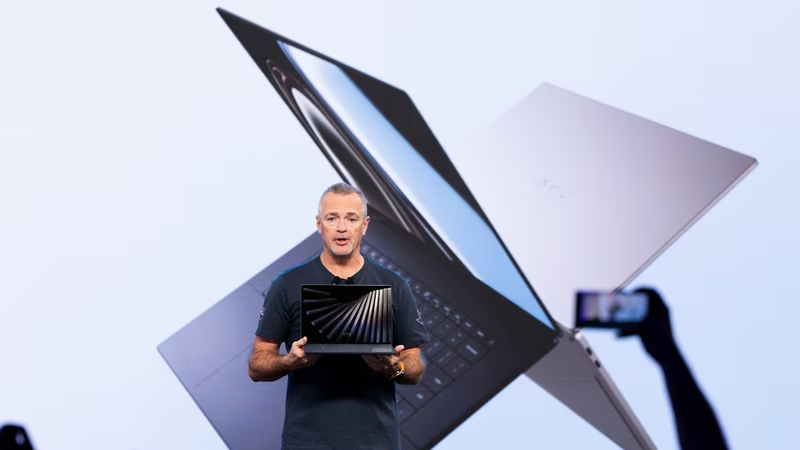
In the glittering halls of CES 2026, where the future is sold with a smile and a spec sheet, one company chose brutal honesty over buzzwords. Dell, a titan of the PC industry, dropped a truth bomb that sent ripples through the tech world: consumers aren’t just unimpressed by AI PCs—they’re actively confused by them.
This stark admission cuts through the relentless marketing fog that has enveloped the industry for the past year, challenging the very foundation of Microsoft’s grand Copilot+ PC strategy. So, what does this mean for the future of your next laptop? Let’s break it down.
Table of Contents
- Dell’s AI PC Reality Check
- Why Are Consumers Confused by AI PCs?
- The Awkward Position for Microsoft
- Dell’s New Strategy: Back to Basics
- What This Means for You, The Buyer
- Conclusion: The Future of AI PCs Isn’t Dead—It’s Just Complicated
- Sources
Dell’s AI PC Reality Check
At its CES 2026 showcase, Dell didn’t mince words. A senior executive, widely reported as Kevin Terwilliger, stated plainly that their market research revealed a harsh truth: people simply aren’t choosing their next computer based on its AI capabilities .
The official line was even more direct: “AI probably confuses them more than it helps them” . This is a remarkable pivot from the industry-wide narrative that has been pushing AI as the must-have feature of 2025 and 2026. Instead of doubling down on neural processing units (NPUs) and teraflops of AI performance, Dell is admitting that for the average buyer walking into a Best Buy, these specs are meaningless noise.
Why Are Consumers Confused by AI PCs?
The confusion isn’t coming from nowhere. The AI PC market has been a classic case of a solution in search of a problem. Here’s why buyers are scratching their heads:
- Lack of Killer Apps: What can you actually do on an AI PC that you can’t do on your old laptop? Features like Cocreator in Paint or Recall are often seen as gimmicks or raise privacy concerns, not as essential productivity tools.
- Marketing Overload: Terms like “40+ TOPS” and “Copilot+” have been thrown around without clear explanations of what they mean for the end-user’s daily life .
- Perceived Value Gap: Many new AI PCs come with a premium price tag. When the core benefits aren’t immediately obvious, consumers question whether the extra cost is justified .
In short, the AI PC promise hasn’t translated into tangible, everyday value for most people. They’re still prioritizing the classic pillars of a great laptop: a long-lasting battery, a blazing-fast processor, a stunning display, and a sleek, portable design .
The Awkward Position for Microsoft
Dell’s confession puts its biggest partner, Microsoft, in a very tight spot. Microsoft has staked its entire Windows 11 future on the AI PC, launching the Copilot+ PC category with massive fanfare in 2024. They positioned these devices as the “fastest, most intelligent Windows PCs ever built,” designed to replace aging Windows 10 machines before its 2025 end-of-support date .
However, the market reality appears to be far more lukewarm than Microsoft’s projections. Reports indicate that Copilot+ PCs are “facing a lukewarm reception in the market,” struggling to gain the mass-market traction that was anticipated . Dell, as one of the world’s largest PC manufacturers, is essentially saying that Microsoft’s big bet isn’t resonating with its core customers. This is a significant crack in the AI PC facade that other OEMs might now feel emboldened to acknowledge.
Dell’s New Strategy: Back to Basics
So, what’s Dell’s plan now? Simple: retreat from the AI hype and return to what it does best. At CES 2026, the company’s big move wasn’t about its latest AI chip—it was the triumphant return of its beloved XPS brand .
The new XPS 14 and XPS 16 are being marketed on their premium build quality, stunning displays, powerful Intel Core Ultra processors, and overall user experience—not their AI prowess . Dell is betting that by focusing on the fundamentals that consumers actually care about, they can win back market share in a crowded and confusing landscape .
This strategic shift signals a broader industry correction. It’s a move from speculative future-tech to delivering proven, reliable value. As one analyst noted, the focus at Dell is now firmly on screen quality, portability, and value for money—elements that have always defined a great PC .
What This Means for You, The Buyer
This reality check is actually great news for consumers. It means you can finally cut through the AI marketing noise and focus on what truly matters when buying a new laptop.
You don’t need to feel pressured into buying an expensive AI PC if you don’t have a specific need for its niche features. For most everyday tasks—browsing, streaming, working on documents, and even most photo editing—a standard high-performance laptop from Dell’s new XPS line or other quality brands will serve you perfectly.
The market is now being forced to cater to your real priorities, not a manufacturer’s desire to sell you the next big thing. This is a win for informed, practical purchasing decisions.
Conclusion: The Future of AI PCs Isn’t Dead—It’s Just Complicated
Dell’s CES 2026 confession isn’t the death knell for AI in computing, but it is a necessary course correction. It highlights a critical gap between the enterprise and commercial potential of AI PCs—which is real and growing—and the current consumer reality, which is one of apathy and confusion.
The technology will likely find its footing as developers create more genuinely useful and integrated AI applications. But for now, the industry must listen to its customers. Dell’s surprising honesty has done everyone a favor by pulling the conversation back down to earth, where battery life and performance still reign supreme.
Sources
- Times of India: One of the world’s biggest PC company Dell admits
- The Verge: Dell Exec Says Consumers Aren’t Buying New PCs “Based on AI”
- Tom’s Hardware: Dell Pivots from AI Hype in XPS Laptops at CES 2026
- Tom’s Guide: Copilot+ PCs struggle to gain traction despite AI hype
- Microsoft News: Microsoft unveils Copilot+ PCs